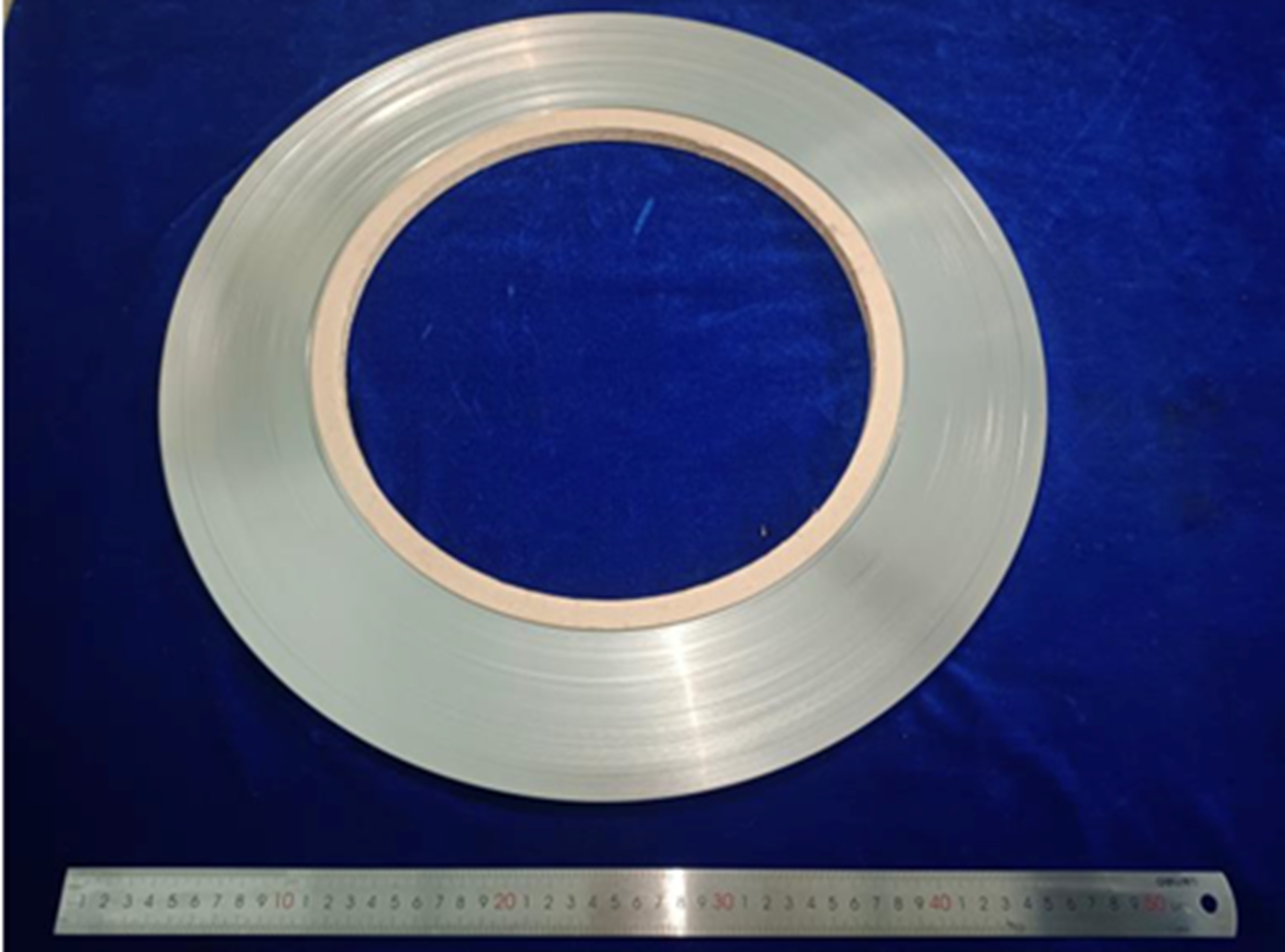
Kilometer-scale metallic substrate tape developed by the research team at the Institute of Metal Research under the Chinese Academy of Sciences. Photo: Courtesy of the research team at the Institute of Metal Research under the Chinese Academy of Sciences
China has achieved a significant breakthrough in developing key materials for controlled nuclear fusion, a crucial component of the country's "artificial sun" project, researchers at the Institute of Metal Research under the Chinese Academy of Sciences told the Global Times on Tuesday.
Recently, a research team led by Professor Rong Lijian at the institute developed a domestically innovated purification technology that broke through the technical bottleneck in metallic substrates for second-generation high-temperature superconducting tapes used in controlled nuclear fusion. The team successfully achieved the industrial-scale production of high-purity, ton-level Hastelloy (C276) metallic substrates, according to a statement that the team sent to the Global Times.
Controlled nuclear fusion devices, known as the "artificial sun," represent one of humanity's most promising paths toward future clean energy. The second-generation high-temperature superconducting tapes are considered the core material for these "super magnets." Without them, it would be impossible to generate the powerful magnetic fields needed to confine plasma at temperatures of over 100 million C, per the statement.
"Our team has accumulated nearly 20 years of experience in developing high-purity materials, and producing alloys with extremely low impurity levels is key to creating ultra-long, ultra-thin metallic substrates," said Rong. "It took us less than two years to overcome the processing challenges for the substrate," he said.
China ranks among the global leaders in the development and application of second-generation high-temperature superconducting materials. However, the metallic substrates used to produce these superconducting tapes — mainly C276 — have long relied on imports, which are costly and subject to supply uncertainty, Rong said.
As the base layer on which buffer and superconducting layers are deposited, the metallic substrate functions much like the foundation of a building. Superconducting materials must "grow" layer by layer on top of it. The substrate not only provides the mechanical strength and ductility required for the tape but also serves as the essential foundation for the stable formation of the entire superconducting structure, the statement said.
The ultra-pure alloy developed by the team contains very low levels of carbon, manganese, sulfur, phosphorus, oxygen and nitrogen, all below those found in similar imported materials. Its overall purity meets international standards, with several indicators exceeding foreign counterparts, per the statement.
The research team overcame key technical challenges in the substrate processing stage, successfully rolling the C276 alloy into an ultra-thin metallic strip measuring just 0.046 millimeters thick — about half the diameter of a human hair — 12 millimeters wide, and over 2,000 meters long. The substrate's surface roughness is less than 20 nanometers, giving it a mirror-like finish, per the statement.
At liquid nitrogen temperature, its tensile strength exceeds 1,900 MPa — enough to bear 190 tons on an area the size of a fingernail. Even after being heated to 900 C for five minutes and cooled to room temperature, it maintained a tensile strength above 1,200 MPa, demonstrating exceptional thermal stability and mechanical performance, per the statement.
According to the researchers, the institute has signed a framework deal with East Super Superconducting Technology Co for the supply of 20 tons of C276 substrates. The two sides will deepen cooperation to refine production techniques and scale up domestic application, bolstering China's innovation and development in superconducting technology.
On October 25, Foreign Ministry spokesperson Mao Ning shared on the X platform that China is building an "artificial sun" in Hefei, East China's Anhui Province. She said the Burning Plasma Experimental Superconducting Tokamak is scheduled for completion in 2027 and could become the first device in human history to generate electricity from nuclear fusion.
RELATED ARTICLES