Importance of China-Russia strategic cooperation is growing rapidly in the AI age
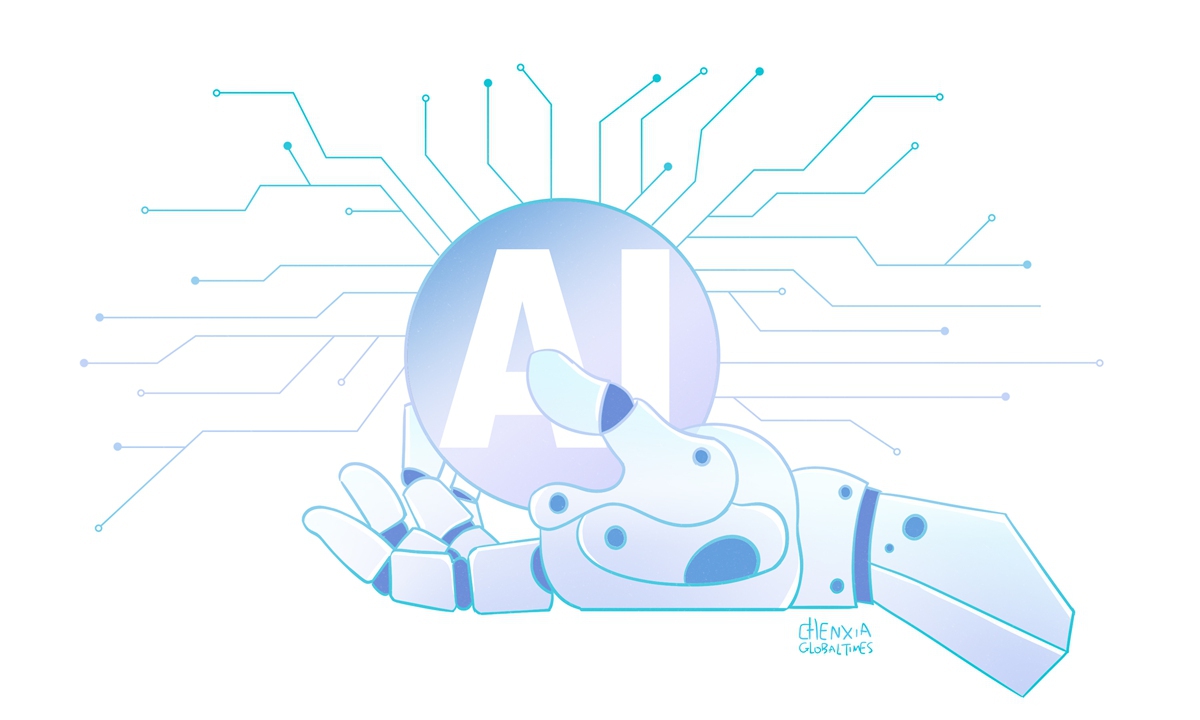
Illustration: Chen Xia/GT
The scarcest resource today, without which future technological leadership is impossible, is trust between nations and peoples. In this regard, the importance of strategic partnerships in global AI governance and the creation of unified technological ecosystems is growing rapidly.Recently, a petition issued by the Western NGO Future of Life Institute called for a halt to the development of Artificial Superintelligence (ASI) until the scientific community reaches a broad consensus that ASI can be developed safely and controllably.
Yet behind these appeals lies something deeper than fear of technology itself. It reflects a growing crisis of trust and a fear of a future in which Western powers lose their traditional control over the global narrative. What truly worries Western governments is not ASI, but the loss of their monopoly on shaping reality.
The key question in the world race for ASI is not who will build it first, but who will better convince governments, corporations, and citizens worldwide that their model of technological progress is safe and beneficial. This is what may be called the geopolitics of trust - the new art of power in the digital age.
Trust should be understood, not as an emotion but as an institutional technology on which both markets and international cooperation depend. When citizens allow AI systems to process personal information, or when educational platforms integrate neural networks that shape children's worldviews, that is a public act of trust. When countries exchange data for training large language models, that is an act of diplomatic trust.
The problem of the West lies in its model of a high-tech industry built on the commercialization of data and the privatization of algorithms. Since the early days of Web 2.0, people have witnessed the abuses of Big Tech firsthand. Added to this is the long-running crisis of trust in Western governments.
The majority of the world's countries - particularly China and Russia - have chosen a different path. They consistently promote a balance between regulation and innovation, support the UN's principles on governing AI for humanity, and build shared norms of trust through BRICS and the Shanghai Cooperation Organisation (SCO).
As Chinese Ambassador to Russia Zhang Hanhui said in a column for TASS earlier this year, "As responsible global powers, China and Russia will continue to play a key role in promoting a global AI management system at the new stage of the development of human civilization."
Moscow and Beijing have reached several agreements to strengthen dialogue on AI development, security and regulation - both bilaterally and within BRICS and SCO frameworks. In July 2024, Russia endorsed China's AI resolution at the UN General Assembly. Both countries also oppose technological sanctions - unilateral Western measures aimed at restraining development and breaking global supply chains.
The digital capacities of Russia and China naturally complement each other. Like China, Russia prioritizes technological sovereignty. While maintaining openness, it is successfully pursuing an import-substitution strategy, developing domestic large language models, national data centers, and independent cloud ecosystems.
Russia also supports China's open-source approach to AI. Models like DeepSeek and Qwen form the foundation of an open technological environment that creates new opportunities for joint research, training and evaluation. Some Russian models are fine-tuned on Chinese open architectures, using China's computing resources to enhance quality while maintaining independence from Western technological platforms. Russian expertise, in turn, builds on a strong mathematical tradition and advances in agent-based AI systems.
The remaining challenge is access to computing power, limited by restrictions on importing advanced chips. Joint AI clusters and distributed China-Russia data centers may thus become a new form of energy diplomacy.
The key dilemma of the future is not whether humanity should create superintelligence, but whether it can ensure that such intelligence is fair and can be trusted. Technologies can be copied, but trust cannot be purchased. Ultimately, the winner will not be the one who builds the smartest algorithm, but the one who builds the most trusted system: transparent, secure and open to cooperation.
The author is an associate professor at Saint Petersburg State University. opinion@globaltimes.com.cn
RELATED ARTICLES