APEC a platform to advance more constructive China-S.Korea relations
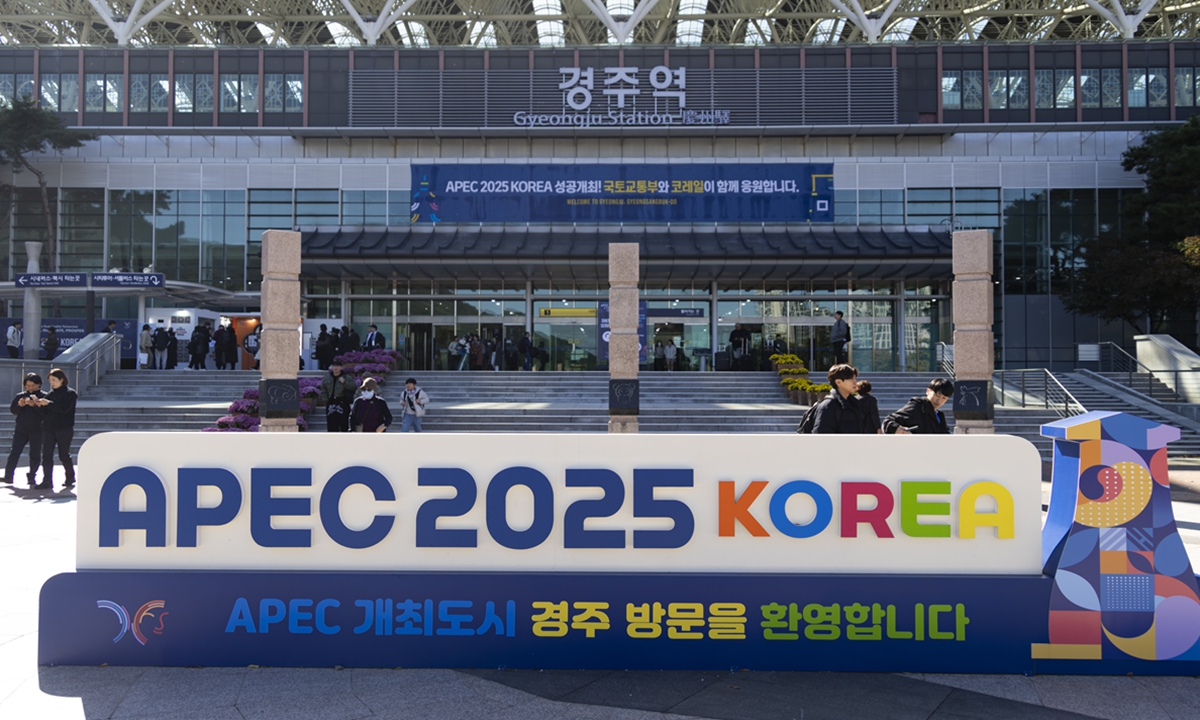
People walk past banners for the Asia-Pacific Economic Cooperation (APEC) meeting at a train station in Gyeongju, South Korea, on October 28, 2025. Photo: VCG
Editor's Note:The 2025 APEC Economic Leaders' Meeting will be held from Friday to Saturday in Gyeongju, South Korea. All 21 economies will come together to discuss pathways to the Asia-Pacific region's shared prosperity. Besides, at the invitation of South Korean President Lee Jae-myung, President Xi Jinping will attend the meeting in Gyeongju and pay a state visit to South Korea. Against this backdrop, Global Times (GT) reporter Wang Wenwen interviewed Jaewoo Choo (Choo), professor of Chinese foreign policy, Department of Chinese Studies, Kyung Hee University, about issues, including his expectation for this year's meeting, how to build a more constructive China-South Korea relations and the two countries' cooperation within the APEC framework.
GT: This is the first APEC meeting held in South Korea in 20 years. What will be the highlight of this year's meeting? What is the general expectation of South Korean society toward the event?
Choo: This year's Gyeongju APEC meeting will prominently feature a summit between Chinese and US leaders. This will hold importance for two key reasons. It will mark the inaugural instance following US President Donald Trump's re-election this year, and provide clarity regarding the intended trajectory of the bilateral relationship, particularly from Trump's perspective. Should the meeting conclude in a harmonious and amicable atmosphere, it is probable that the relations between the two countries could shift away from the much speculated conflictual status. The other reason is that they are expected to disclose their positions on trade agreements. Achieving a consensus will enhance the effectiveness of the working-level negotiations. It is not required for this to serve as the conclusion. A consensus will provide clearer direction and guidelines for the negotiators at the table, thereby facilitating progress.
A significant point of interest will be the summit meeting between Chinese President Xi Jinping and his South Korean counterpart Lee Jae-myung. It was confirmed on Friday that Xi's upcoming visit would be classified as a state visit. This marks his first state visit to South Korea in 11 years. In South Korea, there is an ongoing expectation that both the US-China summit and the South Korea-US summit will yield positive outcomes regarding trade agreements. Additionally, the South Korea-China summit is anticipated to be significant, potentially advancing bilateral relations toward a more constructive future.
GT: The Lee government has adopted a pragmatic attitude toward China. What interactions between China and South Korea during the APEC gathering are particularly worth watching? Could the meeting between the two heads of state become a pivotal moment in the bilateral relationship?
Choo: The anticipation in Seoul regarding their meeting suggests it could serve as a crucial turning point for China-South Korea relations, potentially elevating them to a new level. Following the official visit of then president Moon Jae-in in 2017, South Koreans expressed a desire for a reciprocal visit from President Xi. The first state visit by Xi in 11 years holds significant importance for the South Korean public. The expectation is that it will reduce the negative sentiments that some South Koreans and Chinese have toward one another. Additionally, this is perceived as a chance for both nations to reinvigorate constructive interactions at governmental and civilian levels.
GT: Standing at the juncture of the 33rd anniversary of the establishment of diplomatic relations between China and South Korea as well as global trade headwinds brought about by US tariffs, what are the potential areas of future industrial collaboration between China and South Korea?
Choo: The industrial sector, particularly high-tech industries, presents significant potential. It encompasses semiconductors, EV batteries, high-end displays, and similar components. There is also potential for an expansion of collaboration in components, intermediate goods and equipment tailored for these advanced industries. Cooperation serves primarily to enhance domestic consumption within China and aims to stimulate the country's economic development. South Korean companies are making significant investment in the Chinese market, as indicated by their establishment of manufacturing plants and bases within these industries. Therefore, achieving this optimal scenario for our industrial cooperation could significantly enhance the prospects for the future direction of the bilateral relationship. This is likely to represent a significant turning point.
GT: South Korea is also trying to maintain balance amid US-China competition. How can APEC serve as a multilateral platform for Seoul to maintain this balance and how will Seoul leverage such a platform?
Choo: Leverage can only be secured initially by negotiating a trade agreement with the US. Utilizing the leverage it has amassed, South Korea may engage with China to negotiate a more constructive bilateral relationship, resulting in a more favorable balance in relation to the US. If the US decides to relax certain restrictions on technology export controls, it will subsequently delineate the parameters and extent of its relations with China in these areas concerning South Korea. Simultaneously, it will serve as the bedrock upon which the two nations can cultivate their industrial collaboration.
GT: The China-proposed global initiatives such as the Global Governance Initiative (GGI) and the Global Development Initiative (GDI) highly align with the APEC Putrajaya Vision 2040 of building an open, dynamic, resilient and peaceful Asia-Pacific community by 2040. How can these ideas help chart the development path of regional countries and empower them to cope with the challenges faced by the Asia-Pacific region?
Choo: Indeed, I concur that GGI and GDI possess the potential to significantly advance the modernization efforts of APEC economies, especially those that are still developing. Their ability to articulate a compelling vision, direction, and pathway for the Asia-Pacific community is a significant factor. It must embody openness, dynamism, resilience, and tranquility. Inclusion of all regional countries is essential for sustainability.
Yet, this concept of inclusivity must grapple with a significant obstacle. To truly embody inclusivity for all APEC economies, free from exclusion and discrimination, it is imperative to address the fundamental issue concerning the US. The US promotes its "Indo-Pacific Strategy," claiming that the strategy neither targets nor excludes any specific nation, including China. It is essential for us to possess the fortitude and resolve to wholeheartedly embrace inclusivity and to advocate for our initiatives as non-discriminatory. Consequently, it is imperative for the US and China to advance collaboratively following the establishment of a trade agreement. The forthcoming challenge awaits resolution by the two parties involved.
GT: From the last time China hosted the APEC meeting in 2014, how has China's ability in global governance strengthened? What's your expectation for China to host next year's APEC meeting?
Choo: As China is scheduled to host the 2026 APEC meeting, it should concentrate its efforts first on improving the international security and economic environment. In this way, not only can follow-up measures sustain and realize what was agreed at Gyeongju APEC, but it can also offer some room for new initiatives that Beijing will seek to introduce next year. China has the capacity and capability compared to what it had in 2014. The 2026 APEC can be a turning point for not only the Asia-Pacific region but also the world collectively, should China work toward issues of global concern beforehand.
RELATED ARTICLES