Chinese and foreign scientists call to collaborate amid rapid rise of emerging techs, including AI at ANSO meeting
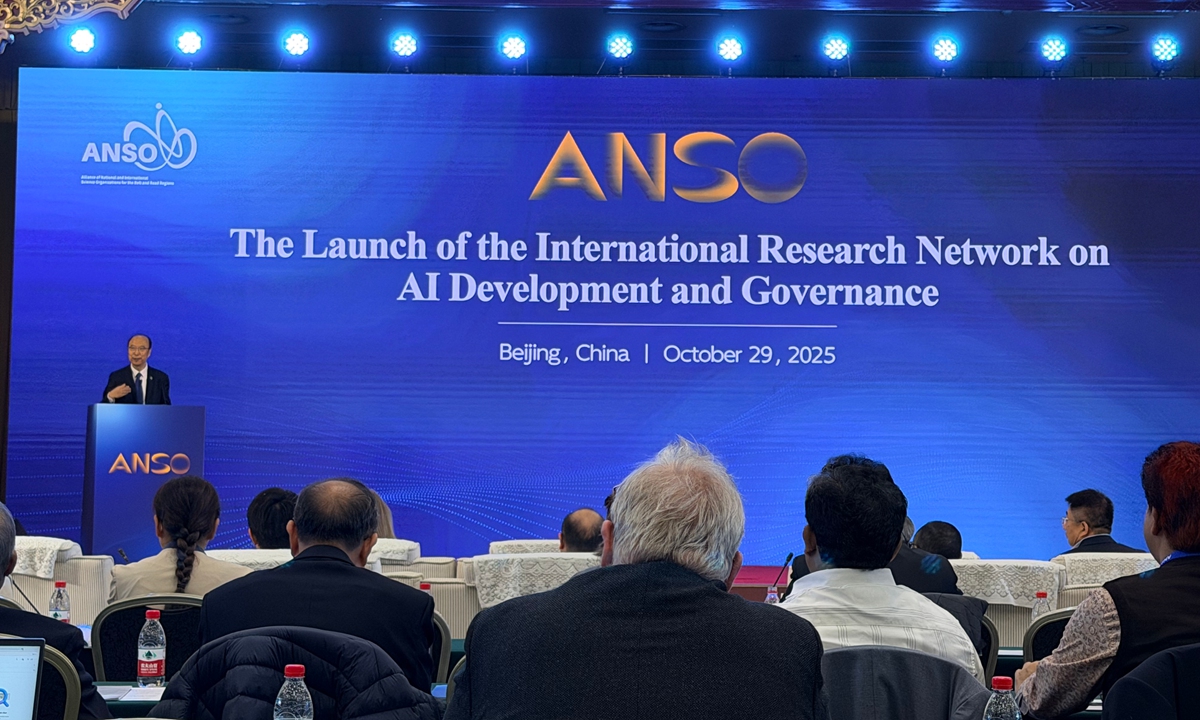
ANSO Secretary-General Liu Weidong speaks at the launching ceremony of the International Research Network on AI Development and Governance on October 29, 2025. Photo: Fan Anqi/GT
Nearly 300 Chinese and foreign scientists gathered in Beijing from Tuesday to Wednesday to explore ways for the international scientific community to deepen exchanges and cooperation at an event hosted by the Alliance of National and International Science Organizations for the Belt and Road Regions (ANSO).
Scholars from various countries praised China's recent strides in scientific and technological development at the event, while emphasizing a strong desire to collaborate amid a rapid rise of emerging technologies, such as artificial intelligence. They also noted that at a time when certain countries are hindering scientific and technological cooperation, "we need to bring rational voices into the conversation and eliminate harmful barriers."
At the ANSO 2025 General Conference on Science and Innovation, Nils Christian Stenseth, foreign member of the Chinese Academy of Sciences, President of International Society of Zoological Sciences and science ambassador of the ANSO told the Global Times that China has achieved remarkable progress in life sciences - in medicine, natural history, and biodiversity, he said. In his view, China not only focuses on innovation, but also attaches great importance to fundamental scientific exploration.
Gretchen Kalonji, former Assistant Director General for Natural Sciences at UNESCO, told the Global Times that China has made incredible contributions in the higher education system, which is "underpinning much of China's economic growth and innovation in the science and engineering fields." Kalonji also highlighted China's remarkable achievements in renewable energy, as well as in combating desertification and land degradation.
Global Times reporters noted at the event that "cooperation" emerged as the most frequently mentioned word by almost every speaker present.
Sukit Limpijumnong, President of ANSO, said in his opening remarks that, "While global scientific collaboration is essential to accelerating the progress of achieving UN Sustainable Development Goals, occasional rifts have slowed our collective work. This is precisely why dialogue and partnership matter more than ever."
"Science thrives on exchange, and its greatest impact emerges when we listen, learn and act together," Limpijumnong said.
"In order to solve the huge problems facing ecological sustainability, we need to join forces. Why? Because it is a global issue, and because each of the countries have different traditions. Coming together, we are much stronger than each of us are by ourselves," Stenseth told the Global Times.
"The future environment will be vastly different, with more extreme weather and profound changes in nature. We have already used too much (of the Earth's resources)," Stenseth said. "Frankly, I am quite pessimistic about humanity's ability to reduce consumption and achieve sustainable development — we should have started acting much earlier." In his view, China is organizing a series of activities to bring everyone together and "heighten awareness of the urgency" of these global problems.
Yet, as the global scientific community calls for expanded cooperation, certain countries are pursuing unilateralism and technological hegemony, some scholars pointed out. They argue that technology should not become a tool of geopolitics, and definitely not be used as a weapon manipulated by power to maintain dominance.
"There's certainly geopolitical tensions behind these barriers… And what we have to do is continue to try and calm things down, and have rational voices come to the table to remove harmful barriers," Kalonji said.
ANSO Secretary-General Liu Weidong told Global Times that ANSO, as an open and inclusive platform, has always been following the Belt and Road principle of consultation, joint contribution, and shared benefit.
In Liu's eyes, restricting scientific exchange runs counter to historical trends and the laws of development. "Science has never had borders. Only through mutual inspiration and collaboration can we produce results faster and better."
"Isolation helps no one," Liu said. He called on the US government to reopen its door to international technological cooperation as soon as possible. Only openness and collaboration can accelerate innovation, better address global challenges and help achieve the UN Sustainable Development Goals, Liu said.
At a thematic session on Wednesday, The International Research Network on AI Development and Governance has been launched with the support from ANSO, while issuing a joint statement. "The network aims to push forward the unique efforts from scholars and researchers for advancing AI for near-term and long-term good for human and ecology", Co-chair of the network Zeng Yi from Chinese Academy of Sciences said.
Scholars' role "transcends the single dimension of 'academic research,' positioning them as connectors linking science, technology, society, and civilization," the statement read. "Only by engaging in dialogue, reflection, and deep collaboration with industry, government, the public, and other stakeholders can scholars ensure that AI truly 'serves the flourishing of humanity and the ecosystem.'"
ANSO is an international science and technology organization jointly initiated and established by scientific research institutions, universities and international organizations from countries participating in the Belt and Road Initiative. Up to now, more than 70 scientific research institutions from 52 countries, as well as eight international organizations have officially joined ANSO. It serves a key hub for deepening cooperation between China and other countries in science, technology and innovation capacity building.
RELATED ARTICLES