Chinese scientists develop photothermal fabric, heating in seconds while remaining stable
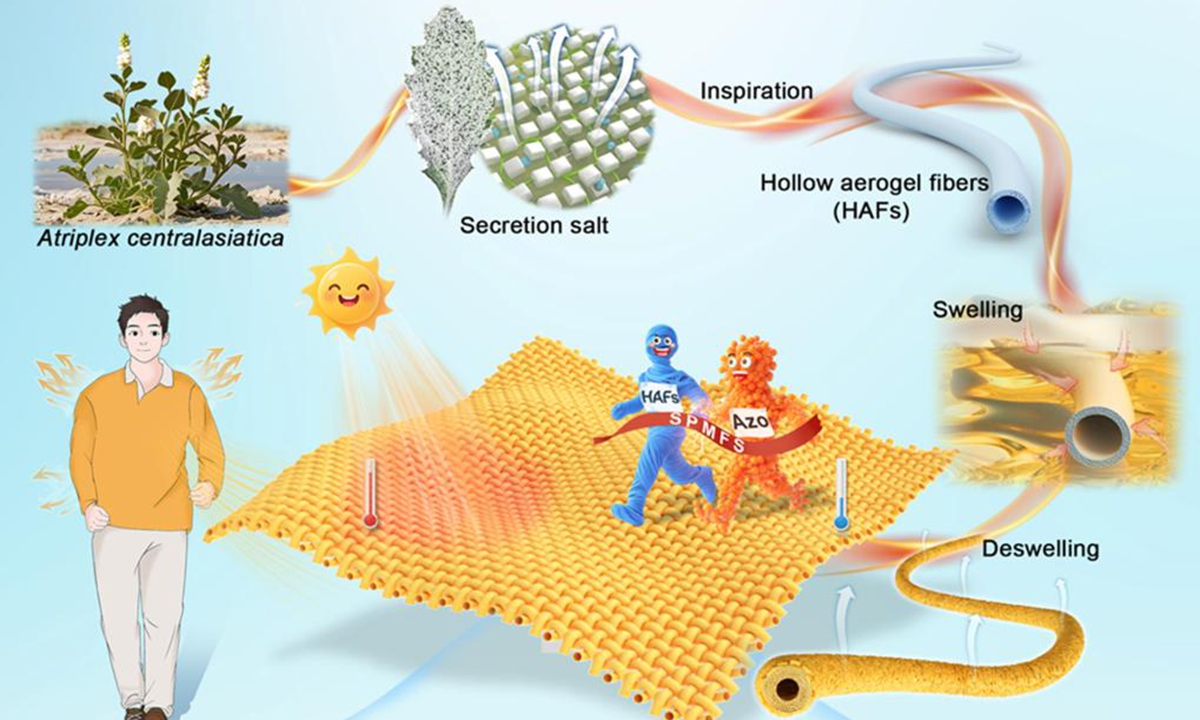
Schematic diagram illustrates the working principle of photothermal fabric. Photo: Xinhua
Chinese scientists have recently developed a photothermal fabric, inspired by halophytes, that can heat up in seconds while remaining stable and durable, which could be widely applied in smart clothing, medical therapy devices and outdoor protective gears in the future, according to media reports on Sunday.
In temperatures as low as -20 C, a mere 12 seconds of light exposure can swiftly elevate the fabric's surface to 40 C; its heat storage remains stable even after repeated washing and wear; it also offers precise temperature control for targeted heat therapy. These functions, once dependent on complex electronics, could soon be seamlessly achieved with a single piece of fabric, the Xinhua News Agency reported on Saturday.
Inspired by the salt absorption-secretion mechanism of halophytes, the research team successfully developed molecular solar-thermal (MOST) fabrics that combine efficient photothermal conversion with strong mechanical properties.
Previously, MOST fabrics faced challenges in balancing superior photothermal performance with durability. Developing thermal-management fabrics that are both highly efficient is significant for energy conservation, emissions reduction, and improving the convenience of medical therapies, according to Xinhua.
The research team drew inspirations from the halophyte Atriplex centralasiatica, which adapts to extreme environments through a dynamic cycle of "swelling to absorb salt-deswelling to secrete salt crystals."
The team used hollow aerogel fibers made of thermoplastic polyurethane as the substrate and soaked them in a specialized azobenzene-chloroform solution.
The fibers first swell by absorbing the solution, and during drying, azobenzene molecules are extruded from the interior, forming a uniform, dense crystalline "coating" — a dense, uniform monocrystalline layer — on the fiber surface. This not only enhances the molecular structure's compactness within the fibers but also gives them unique optical and mechanical properties.
Experiments show that the fabric demonstrates outstanding thermal-management capabilities. Under 420-nanometer blue light, it heats up by 25.5 C in 70 seconds; even in simulated sunlight at -20 C, it achieves a 21.2 C temperature rise in 50 seconds.
After 50 friction cycles, 500 stretch-bend cycles, and even 72 hours of continuous washing, it retained more than 90 percent of its photothermal performance, overcoming problems of traditional MOST materials such as peeling and short lifespan.
Furthermore, the fabric allows precise heat-release control by adjusting light intensity, making it suitable for everyday warmth or as a portable therapeutic material for localized heat treatment of conditions such as arthritis.
"The core of this research lies in translating nature's adaptive biological mechanisms into material performance regulation strategies," said Feng Wei, a professor at Tianjin University from the research team.
In the future, the fabric could be widely applied in smart clothing, medical-therapy devices, and outdoor protective gear, promoting a shift in personal thermal management from "reliance on external energy" to "efficient solar energy utilization," Feng said.
Global Times
RELATED ARTICLES