IN-DEPTH / IN-DEPTH
A city of 'bridges': Ulsan offers vantage point into multi-dimensional China-South Korea exchanges
By and Xing Xiaojing in Ulsan Published: Oct 30, 2025 10:25 PM
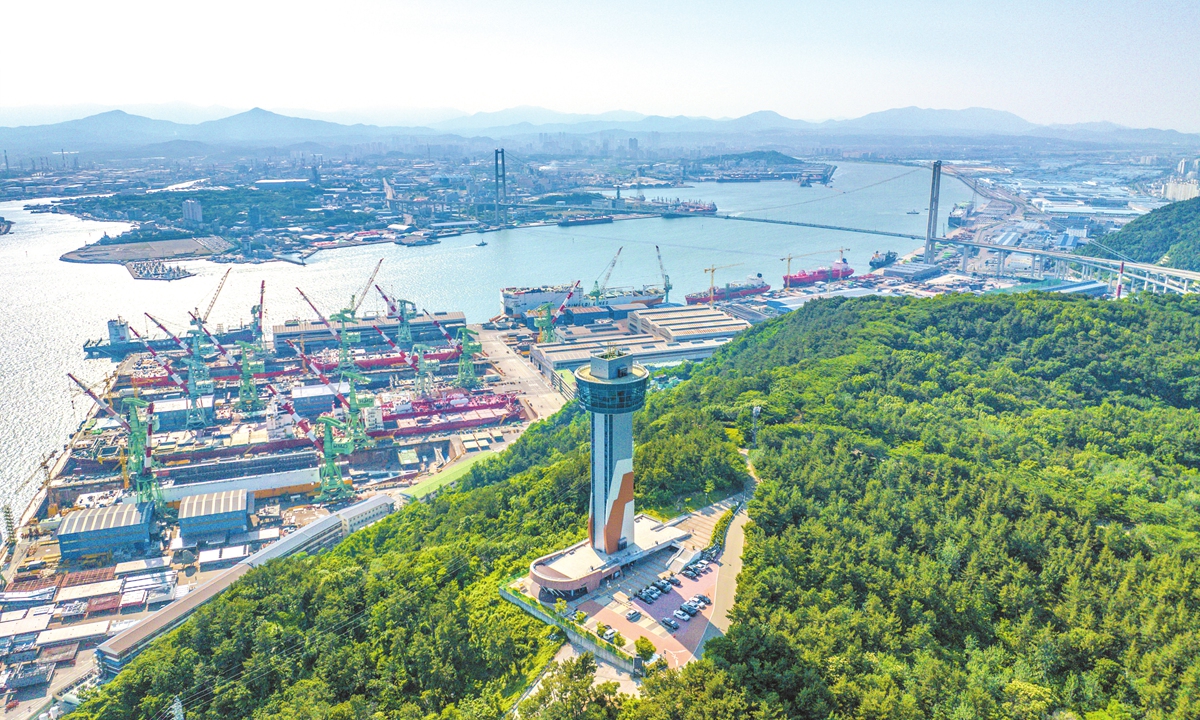
An aerial view of Ulsan, South Korea Photo: VCG
Perched 63 meters above the Hwajeongsan Mountain at the Ulsan Bridge Observatory in Ulsan in eastern South Korea, the city's breathtaking panorama unfolds in all its splendor on a recent sunny afternoon. Beyond the view, the bridge offers people a window into the vitality of Ulsan's social and economic development as a global industrial and export hub.
For locals, the bridge is more than infrastructure; it's a source of pride, as they are eager to share an achievement of the bridge - with a single span of 1,150 meters, it is the third-longest suspension bridge in the world, though some often note with a smile that the longest-spanning bridges are in China.
Indeed, after spending several days learning about the city, "bridge" is an apt term to describe the quintessence of Ulsan.
To cover the 32nd Asia-Pacific Economic Cooperation (APEC) Economic Leaders' Meeting in Gyeongju, Global Times reporters arrived in South Korea's second-largest city of Busan. As Gyeongju - celebrated as "the museum without walls" for its vast cultural and archaeological heritage - has limited capacity to accommodate regional leaders, business representatives and others, Ulsan - situated between Busan and Gyeongju - served as a crucial "bridge" for many, including Global Times reporters.
As it turned out, Ulsan has been and will continue to be a crucial "bridge" for China-South Korea exchanges in a wide range of areas. Interviews and dialogues with local officers, entrepreneurs and ordinary residents revealed a close-up view of the multi-dimensional exchanges between China and South Korea, as well as the underlying features of bilateral ties.
Historical bond
Ulsan Metropolitan City, located on the southeastern coast of the Korean Peninsula, faces Japan across the sea. A major industrial and port city in South Korea, it is often called South Korea's "industrial capital." The city is a crucial base for South Korea's massive petrochemical, shipbuilding and automotive industries, and said to be the birthplace of Hyundai Heavy Industries and Hyundai Motor.
This is on vivid display from the deck of the Ulsan Bridge Observatory, which provides a perfect view over the port where giant ships are moored, as well as the city's major industry complexes, including Hyundai Motor's car plant, said to the world's largest auto factory.
Meanwhile, walking around Ulsan, signs of whales are ubiquitous: Whale sculptures, whale museums and whale-themed sightseeing boats. Even hotel rooms were all decorated with "whales:" doorplates, wallpaper, wall clocks, towels and duvet cover. Some local residents said that about 7,000 years ago, their ancestors made a living by whaling, and fighting in the waves was their glory.
In 1986, the International Whaling Commission adopted the International Convention for the Regulation of Whaling, and South Korea, as a member state, implemented the ban, ceasing commercial whaling. Since then, Ulsan has actively promoted the transformation of its historical whaling port into an eco-tourism destination. Ulsan has also established sister city relationships with places like Yantai in East China's Shandong Province to jointly carry out marine ecological protection cooperation.
Ulsan City Hall, less than two kilometers from the hotel where Global Times reporters were staying, is the administrative center of this city of about 1.1 million people. The display cases in the lobby on the first floor showcase gifts from all over the world, including commemorative keys from the Beijing Olympic Games; red ceramic vases from Changchun, Northeast China's Jilin Province; and golden seals from Harbin, Northeast China's Heilongjiang Province, all telling the story of the deep bonds between this city and China.
Walking into the spacious, neat office of An Sung-dae, deputy mayor of the Ulsan Metropolitan City, a model airplane of China Southern Airlines on the desk came into view. In yet another sign of Ulsan's exchanges with China, recently, China Southern Airlines partnered with the Ulsan tourism bureau to officially launch a non-regular direct flight between the Guangzhou Baiyun International Airport in South China's Guangdong Province and Ulsan Airport. This marks the first time that China Southern Airlines has opened a direct flight route to Ulsan, filling a gap in air transport market between the two cities.
In an interview with Global Times, An said that Guangzhou is an important base for China's automobile industry, where he has visited before, and the opening of direct flights not only facilitate industrial exchanges between the two cities, but also serves as another example of the close cooperation between the two countries in various fields.
In addition to Guangzhou, An has also visited multiple Chinese cities. In Beijing and Shanghai, he was amazed by the speed and scale of Chinese urban development; at the Shaolin Temple in Central China's Henan and the Terracotta Army in Xi'an, Northwest China's Shaanxi Province, he was deeply impressed by the profoundness of Chinese history and culture. In recent years, An has been closely following China's achievements in emerging fields such as new-energy vehicles, artificial intelligence (AI), and the low-altitude economy.
As AI and demographic changes are major topics at this year's APEC meeting, An told the Global Times that Ulsan is pushing forward with its transformation into an "AI capital" to address the challenges posed by an aging and declining population. When asked about his favorite Chinese-made products, An said without hesitation: Robot vacuum cleaners. He noted that the application of AI technology helps reduce labor burdens, improves quality of life, and is of great significance to an aging society.
"In the future, South Korea and China can seek cooperation opportunities in emerging industries," An said.
When asked about his views on China-South Korea relations, An did not rush to answer. Instead, he displayed an artifact of rock carving from Pangudae in Ulsan, featuring patterns of whales, hunting scenes, and other motifs that depict the whale-hunting activities of local ancestors approximately 7,000 years ago. Pointing to the pictographs on the carving, An said that China and South Korea have been integral parts of East Asian civilization since ancient times, and further joining hands to march toward the future will undoubtedly promote the development of the region.
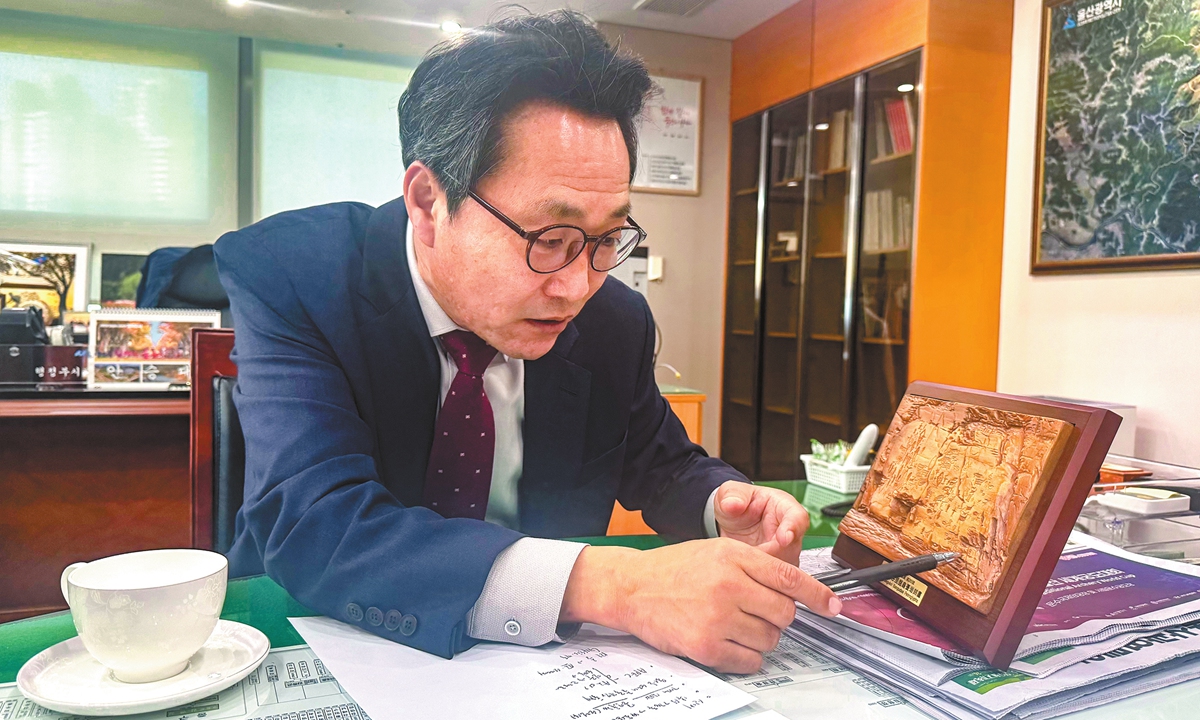
An Sung-dae, deputy mayor of Ulsan Metropolitan City, shows a rock carving artifact during an interview with Global Times on October 27, 2025. Photo: Wang Cong/GT
An said that he had received many Chinese government officials and business representatives in his office before, but this was the first time he had received Chinese reporters, and his first exclusive interview with Chinese media. The interview, originally scheduled for 50 minutes, lasted for nearly an hour and a half. At the end of the interview, An took a photo with reporters and said, " [You are] welcome to visit Korea more."
Three-decade friendship
The Korea China Economy & Culture Education Association (KCCEA) is a non-governmental organization covering economy, culture and education. Since its establishment in 2004, it has worked to foster friendly exchanges and cooperation between the peoples of China and South Korea.
In an interview with Global Times, Kim Kyoung-dae, president of the Ulsan branch of the KCCEA, recounted the story of a friendship started over three decades ago and passed down across two generations.
Shortly after China and South Korea established diplomatic ties in 1992, a Chinese female student named Shen Jingshu served as an interpreter for Kim's father during an event. The senior Kim continued to provide selfless assistance to the Chinese student in South Korea afterward. Because of his father's connections, Kim had a brief encounter with this Chinese student, after which they lost contact. After his father's death, Kim found Shen's contact information while sorting through his belongings, and mustered the courage to email her.
To his surprise, Shen replied promptly, saying, "Your father helped me a lot back then, and I've always wanted to repay that kindness, but I couldn't get in touch with you before, so I could only keep thinking about it." Shen now serves as the chairperson of the KCCEA.
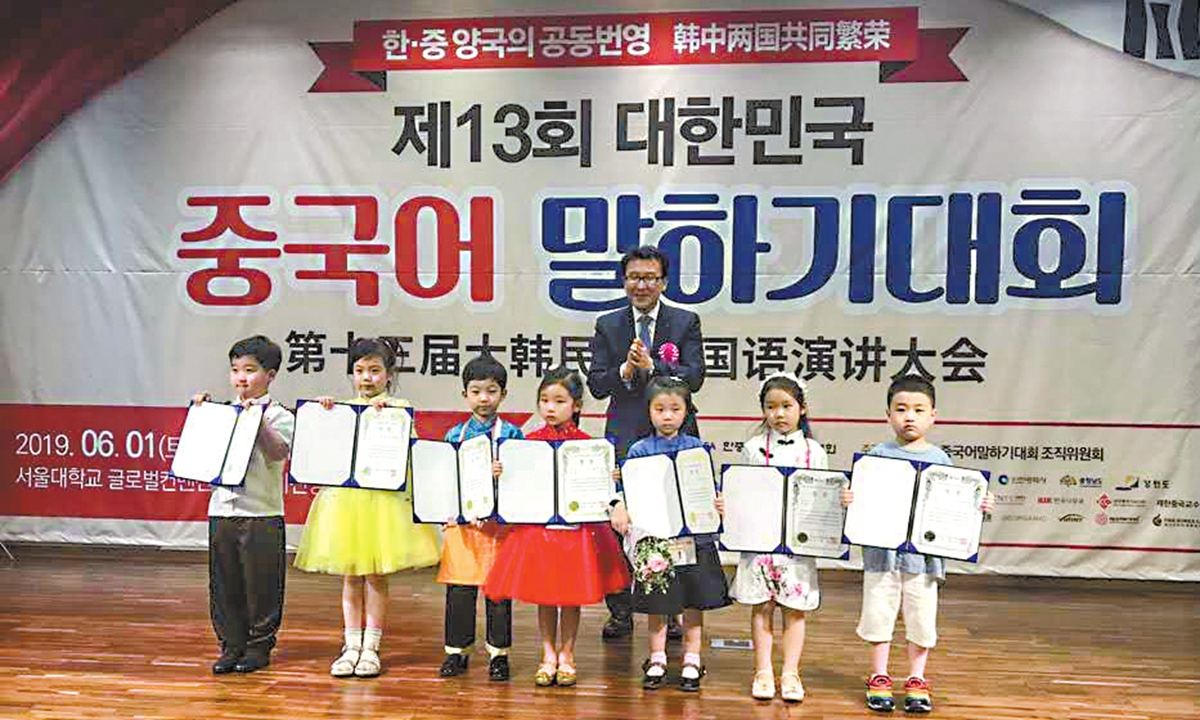
Kim Kyoung-dae poses for a photo with children during a Chinese speech contest in South Korea. Photo: Courtesy of Kim Kyoung-dae
Kim was born in 1972 into a family of doctors and works as a representative of a company that develops medical devices for measuring cerebral blood flow.
"After I learned that Shen had worked for many years to promote people-to-people exchanges between South Korea and China, I had the idea to follow suit," he told the Global Times.
"Ulsan is the heart of South Korea's industry, but it's also a very cautious and conservative city. Different from Seoul and Busan, the local people don't know much about China. I believe that South Korea-China relations should expand from policy diplomacy to people-to-people exchanges, and I wanted to do something about it, so with Shen's help, I established the Ulsan branch [of the KCCEA]."
"In my years of interactions with China, I've found that trust is the starting point for all cooperation," Kim said. He explained that when they first started exchanges with counterparts in China, they encountered skeptical looks.
"The people of Ulsan don't easily believe new things; they only begin to act after establishing genuine trust." So Kim didn't offer explanations, but instead showcased the results to the locals through even small collaborations. For example, inviting a Chinese art troupe to visit Ulsan led to exchanges between artists from both countries; increasing the number of meetings between businesses led to business negotiations. As these achievements increased, the local people developed a sense of resonance. As a result, the atmosphere is now much more open than before, Kim said.
And for Kim the work has only started. To improve his communication skills, he began to learn Chinese on his own. He even pulled out a copy of the Global Times published in 2023 and told reporters that it was a valuable learning resource that he had brought back from China.
To conclude the interview, Kim sent reporters a photo of adorable pandas lined beneath the Chinese and South Korean flags, writing, "May the friendship between South Korea and China last forever."
RELATED ARTICLES