Strength of APEC lies in diplomatic gatherings and candid discussions on topics of importance
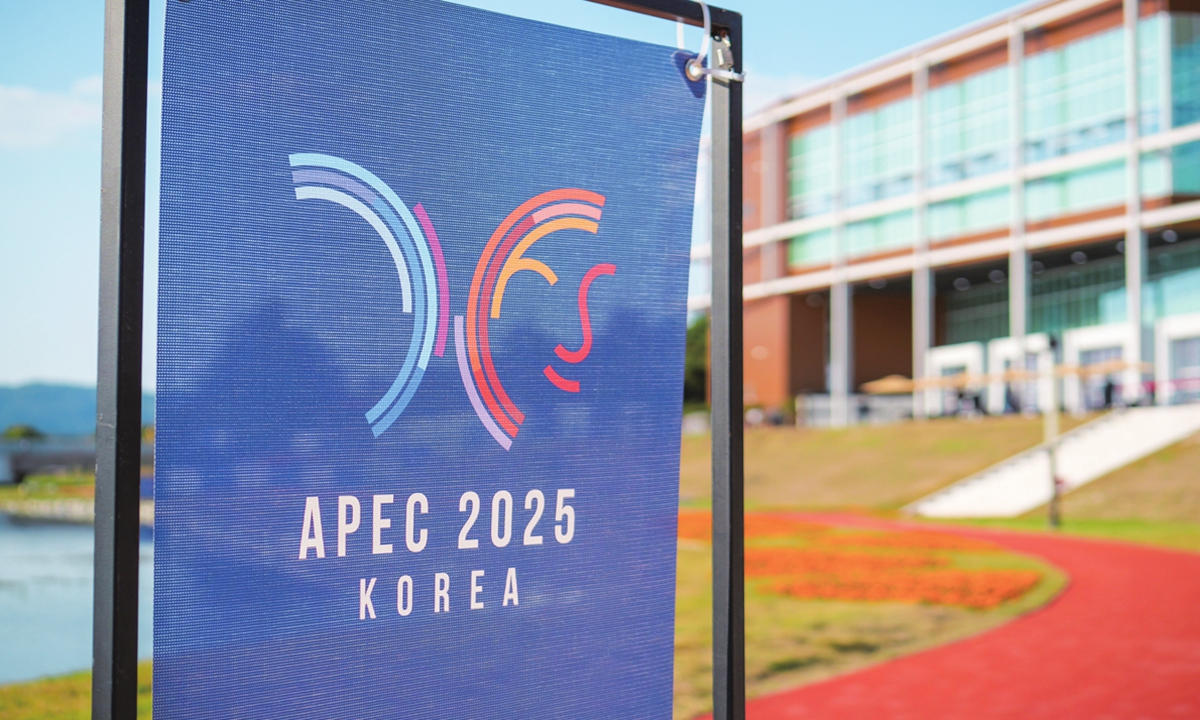
A sign for the 2025 APEC meeting is seen near the Gyeongju Hwabaek International Convention Center on October 29 in Gyeongju, South Korea. Photo: VCG
Editor's Note:The APEC Economic Leaders' Meeting is currently being held in Gyeongju, South Korea. The APEC meeting has served as a platform to promote free trade and multilateralism by encouraging cooperation and reducing trade and investment barriers. This year's discussions are particularly significant as leaders of member economies come together to engage in policy deliberations and cooperation on trade, digital transformation, and sustainability. In an interview with Global Times (GT) reporters Xing Xiaojing and Wang Wenwen, Jaemin Lee (Lee), a professor from the School of Law, Seoul National University, said that the unique strength of the APEC lies in these diplomatic events and gatherings where members' leaders and businesspeople can get together to candidly discuss various topics of practical importance.
GT: The APEC returns to South Korea after 20 years and the South Korean government regards this as a key diplomatic occasion to gain international attention. What expectations does South Korean society have for this year's Gyeongju meeting?
Lee: The APEC 2025 meeting hosted by South Korea in Gyeongju will be a critical opportunity for the global community to evaluate the current state of global trade and rekindle efforts to revitalize weakening multilateralism. At Gyeongju, participants can put many issues on the table and explore a range of solutions for the global community in terms of trade and economy. Of course, we may not be able to resolve all the problems this time, but the APEC meeting this year will provide an occasion for a first step in the right direction. Once good momentum is created, members and their leaders can continue follow-up talks and discussions.
For South Korea, this is an important diplomatic event at a crucial moment. It is the first APEC meeting in 20 years for South Korea, and the first major diplomatic event for the Lee Jae-myung administration, now four months into its term. More than anything else, APEC 2025 has the potential to reverse the current deterioration in global economic conditions, making it an opportunity for South Korea to contribute positively to the global community.
GT: What role will APEC 2025 play in promoting trade and economic cooperation? What ripple effects can it generate regionally and globally?
Lee: After a nine-month escalation of tension in global trade, APEC 2025 provides a much-needed opportunity to reflect. We have experienced negotiation and confrontation, and now we need to take a step back.
I would say that 2025 has been an "unprecedented" year in many respects regarding trade, considering everything that has happened since January. Unprecedented trade and investment measures have been adopted, countermeasures have been implemented, and the escalation continues to rise. It appears that we are locked in an endless loop of escalating tensions, which needs to be broken. First, we need space and time to reflect on the current situation and think about where we are headed from this point onward. APEC 2025 is a good forum for this "time-out" moment. It is not pursuing a grand settlement of all outstanding issues, nor is it striving to arrive at a legally binding outcome. Its open-ended, low-key, compromise-building approach is exactly what we need at this juncture.
GT: During the APEC meeting, the interactions among major countries such as China, the US, South Korea and Japan have attracted widespread attention. How do you view APEC as a platform for multilateral diplomacy?
Lee: During APEC 2025, a series of meetings are scheduled to take place. In my view, all these meetings are important. Remember that the unique strength of APEC lies in these diplomatic events and gatherings where member leaders and businesspeople can come together to candidly discuss various topics of practical importance. At the same time, the global community has inevitably keenly watched the China-US bilateral summit, which is the first such meeting since the inauguration of the second Trump administration. The two countries play a critical role in shaping and operating the global economic regime, and in demonstrating leadership in mitigating current challenges on the trade front. Therefore, I think it is natural for global observers to pay closer attention to the China-US summit this time than other meetings and events.
GT: President Lee Jae-myung stated that South Korea can no longer follow the traditional model of "security with the US, economy with China." As a multilateral platform, can APEC provide South Korea with a "diplomatic buffer zone" for balancing China and the US? What is your perspective on the future direction of China-South Korea relations?
Lee: Amid the global poly-crisis, and in the face of the advent of the era of economic security, South Korea and the US are strengthening their cooperation in many areas as key allies. At the same time, for South Korea, China has always been a critical economic partner. As neighboring countries with close economic relations and strong cultural ties, China and South Korea are closely intertwined in economy, culture, and academia. While sometimes there are difficult obstacles and challenges, I think Seoul and Beijing are now ready to handle these issues in a way that can foster continuing economic cooperation and common prosperity.
GT: China will host APEC 2026. What expectations do you have for this event?
Lee: Once the members build consensus at the APEC 2025 in South Korea this time, they can continue the momentum and carry out discussions at various forums after this year's APEC. As such, next year's APEC in China will be an occasion for the members to explore more specific tasks and more concrete proposals for the stabilization of the global trade regime and the revitalization of multilateralism. So, this year's APEC is to stop the slide and turn it around, and next year's APEC is to move us forward a few steps. As such, APEC 2026 in China will be an important moment for the global community and multilateralism.
RELATED ARTICLES