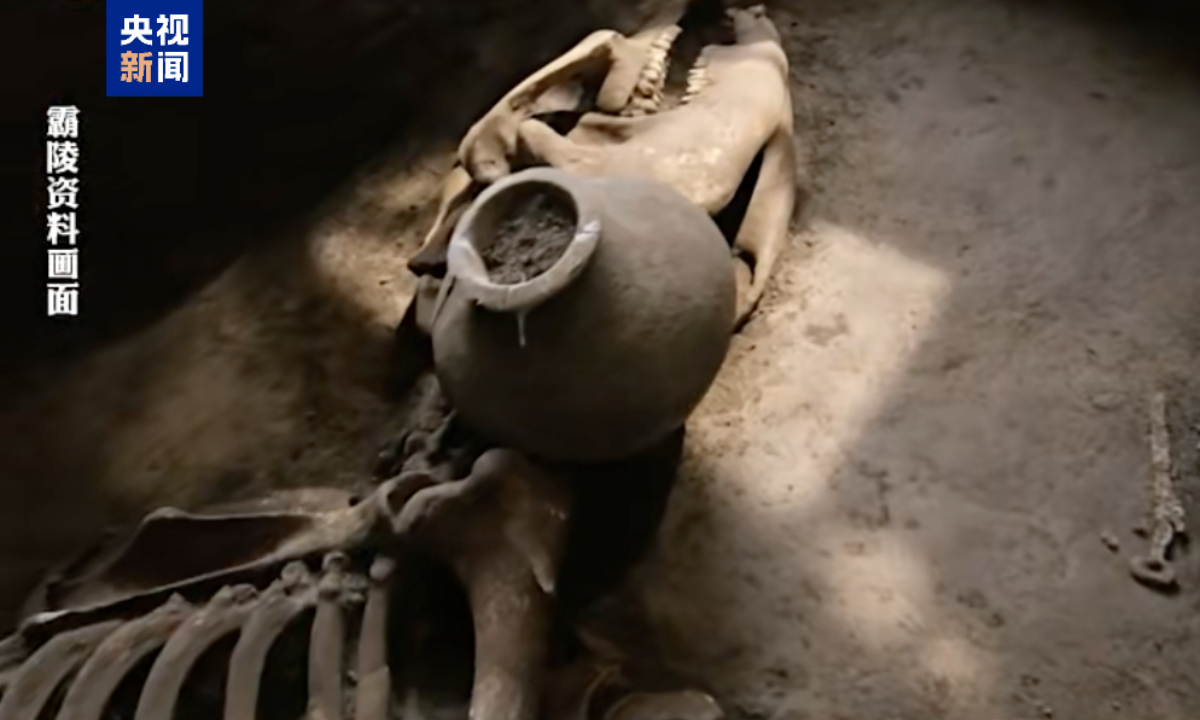
A horse bone unearthed from the mausoleum of Emperor Wen of the Western Han Dynasty Photo: CCTV News
DNA analysis of horse bones unearthed from the mausoleum of Emperor Wen of the Western Han Dynasty (206 BC-AD 25) in Northwest China's Shaanxi Province revealed that one horse was confirmed to have originated from Central Asia, indicating that exchanges between the Western Han and Central Asia had occurred more than 2,000 years ago, an analyst of the DNA told the Global Times on Friday.
Cai Dawei, a professor at the School of Archaeology of Jilin University, told the Global Times that based on DNA analysis results, both sacrificial horses buried in the tomb were male, but had distinct maternal DNAc lineages—one originated from Central Asia, while the other was a native Chinese horse.
This discovery provides evidence of early cultural and trade exchanges between China and Central Asia, which took place earlier than Zhang Qian's journey to the West, Cai said.
In the Western Han Dynasty, a Chinese envoy named Zhang Qian began his expedition to the Western Regions and opened a trade route that later became the Silk Road, Xinhua News Agency reported.
This discovery provides the first genetic-level evidence that during the reign of Emperor Wen, the imperial court already kept fine horses originating from both Central Asia and China. The Central Asian horses were likely introduced into the Central Plains as gifts or trade goods, Hu Songmei, a professor at Shandong University, told the CCTV News.
Fang Qi, deputy head of the School of Archaeology of Jilin University told the Global Times on Friday that the latest findings showed that China's influence had extended to the Western Regions at that time, offering new evidence that enriches research on cultural exchanges between China and other regions during the Han period.
RELATED ARTICLES