Strengthening the relationship between S.Korea and China will greatly contribute to the peace and stability of Northeast Asia: South Korean scholar
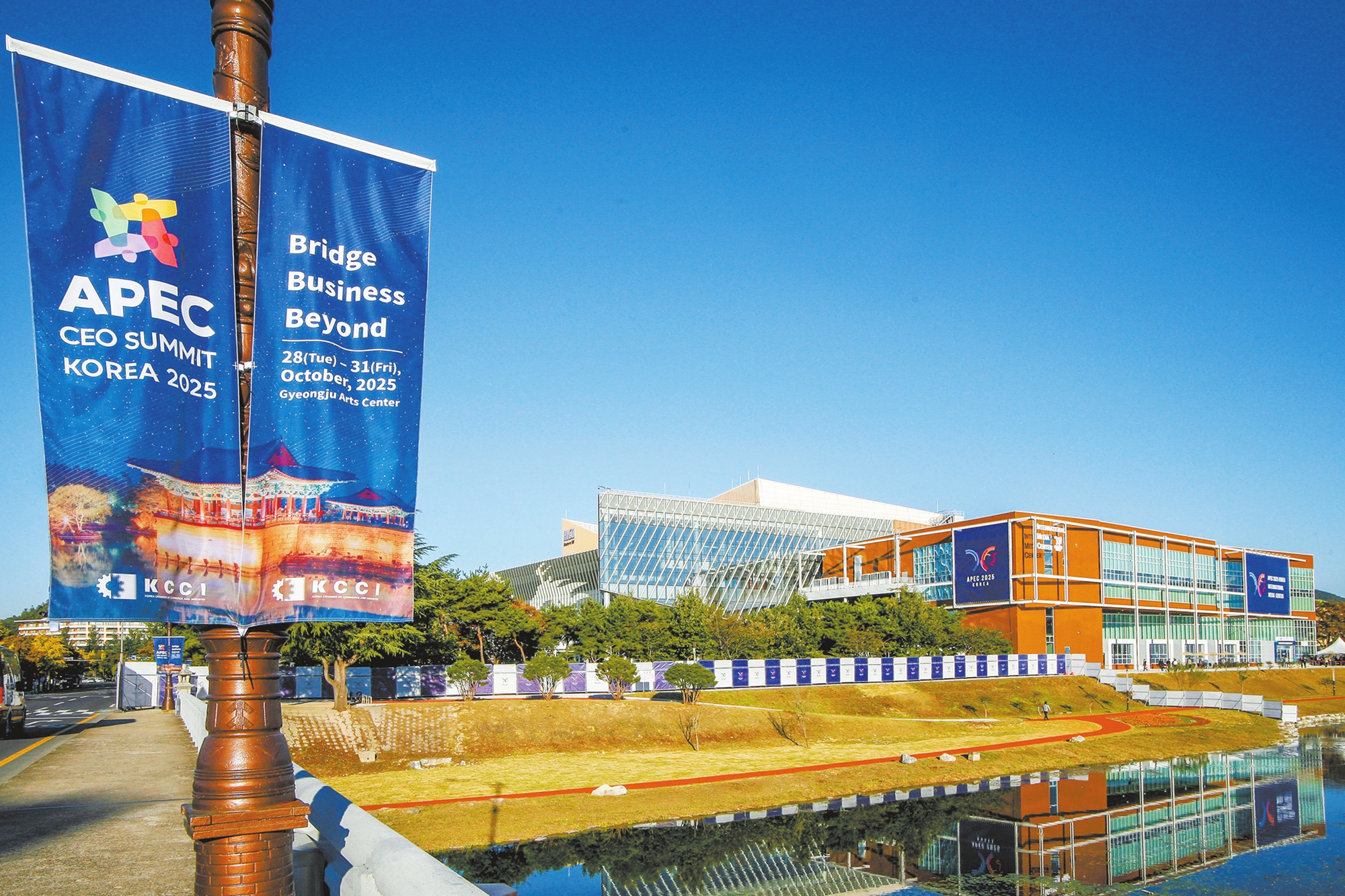
A view of the International Media Center near Gyeongju Hwabaek International Convention Center in Gyeongju, South Korea on October 28, 2025. Photo: VCG
Editor's Note:
At the invitation of South Korean President Lee Jae-myung, Chinese President Xi Jinping has attended the 32nd APEC Economic Leaders' Meeting in Gyeongju and paid a state visit to South Korea from Thursday to Saturday. In an interview with the Global Times (GT), Kim Heung-kyu (Kim), director of the US-China Policy Institute at Ajou University, shared his insights on the future direction of China-South Korea relations. He believed that the expansion of political trust, economic cooperation and people-to-people exchanges forms the three essential pillars for improving the South Korea-China relationship.
GT: The 2025 APEC Economic Leaders' Meeting was held in Gyeongju, South Korea under the theme "Building a Sustainable Tomorrow: Connect, Innovate, Prosper." How do you interpret this theme? Under the current turbulence caused by tariff-related disruptions, how should APEC members work together to build a sustainable tomorrow?
Kim: The slogan of this APEC meeting reflects the demands of our times. This is an era where disruption, conflict and economic hardship are becoming commonplace. The goal of strengthening interconnectedness, innovating for the future and pursuing shared prosperity is increasingly becoming the spirit of this time. It is crucial for each nation to forge a new order that allows for coexistence, focusing on mutual communication and understanding rather than fragmentation and crashes.
GT: "Innovate" is one of the core keywords of this year's APEC. Given that China and South Korea both have strong foundations in technological innovation and industrial collaboration, in which specific areas do you think the two countries can deepen cooperation? How might such cooperation contribute to shared prosperity across the Asia-Pacific region?
Kim: China is currently becoming a model of innovation for the entire world, and likewise South Korea is effective in manufacturing and commercializing the achievements of this innovation. There are vast areas for cooperation between South Korea and China in future energy, green growth, elderly care (or silver) and health industries. Concurrently, in the industrial sphere, promoting regional cooperation and division of labor rather than a single country's monopoly contributes to peace and stability in the region. China-South Korea cooperation will be the cornerstone of Northeast Asian stability.
GT: President Xi's state visit to South Korea is his first in 11 years. How do you assess the significance of this visit for China-South Korea relations? In your view, what impacts will this visit have on the bilateral strategic partnership?
Kim: The relationship between South Korea and China has become somewhat distant since the THAAD incident. Factors such as former president Yoon Suk-yeol's relatively unfriendly policy toward China, and the weakening connectivity between the Chinese and Korean industries have all contributed to this estrangement. The heads of state of South Korea and China should meet and consult more frequently to communicate and cooperate, not only for the bilateral relationship but also for regional stability, peace and development.
GT: The world is now undergoing profound changes unseen in a century. The new South Korean government advocates "pragmatic diplomacy" and seeks to maintain a delicate balance amid major-power competition. How do you view the Lee administration's diplomatic positioning between China and the US?
Kim: The core of pragmatic diplomacy isn't about finding an arithmetic middle ground, but about securing strategic flexibility based on national interests. The South Korean government under President Lee Jae-myung pursues regional and strategic stability.
Regional stability refers to the capacity to deter any specific country from attempting a rapid shift in the balance of power, or a great power from coercing smaller states to pursue its own power and interests. This concept is neither a rejection of change nor an insistence on maintaining the status quo. It is, however, a rejection of abrupt changes and the use of excessive means by a great power to pressure other countries.
While the Lee administration pursues pragmatic diplomacy, the pressure it faces from the US is beyond imagination due to severe domestic political constraints. This means that the promotion of pragmatic diplomacy espoused by the Lee administration is a tough challenge.
The South Korean government under President Lee clearly wants to improve relations with China. The visit by President Xi to South Korea has served as a signal of a more positive improvement in relations for Seoul. We hope that both countries can utilize this opportunity well to engage in deeper strategic dialogue.
GT: In a previous interview with GT, you mentioned that South Korea hopes to establish a new cooperative economic system with China, improve the economic quality of life of its people and establish a more cooperative regional economy and regime. What efforts do you think both sides should make to realize this vision?
Kim: The intensification of the China-US strategic competition negatively affects the China-South Korea relationship. A rapid improvement in relations in the foreign policy and security realm is unlikely to be easy, at least for the short term. In this area, both sides must manage the relationship carefully while furthering mutual understanding for the future. What South Korea and China should focus on during this period is mutual cooperation to improve the economy and people's livelihoods, which form the foundation of the bilateral relationship. The core of all bilateral relations is a strong foundation of mutual economic collaboration.
GT: In the written interview with Xinhua, President Lee believed that South Korea and China can pool their wisdom to foster a mature strategic cooperative partnership based on friendly competition and cooperation on an equal footing. How do you think China-South Korea relations can form a virtuous cycle? In your view, what strategic significance does China-South Korea cooperation hold for maintaining stability in the Asia-Pacific and promoting global economic recovery?
Kim: The expansion of political trust, economic cooperation, and cultural and people-to-people exchanges forms the three essential pillars for improving the South Korea-China relationship. This isn't built in the short term. It requires strengthening mutual communication, fostering greater understanding, engaging with strategic patience even when conflicts of interest arise, expanding economic cooperation and consistently increasing private-sector exchanges.
Strengthening the relationship between South Korea and China will greatly contribute to the peace and stability of Northeast Asia and the world. This signifies a break from the old system and represents a vision and a proposal for a new order. South Korea and China are inseparable neighbors. Conflict between the two leads to mutual unhappiness, while cooperation between China and South Korea brings blessings not only to both nations but also to the region.
GT: China will host the APEC Economic Leaders' Meeting in 2026, marking its first time as host since 2014. What are your expectations for it?
Kim: Over the past decade or so, the security environment in the Asia-Pacific region has undergone tumultuous changes. First, the security environment has shifted from cooperation to one where conflict and confrontation are becoming more commonplace. Second, despite the challenging security environment, China has rapidly risen. Third, the nations of the Asia-Pacific region are suffering from greater instability and uncertainty as a new order takes shape.
I hope that China can present a new model and vision at next year's APEC where the countries in the Asia-Pacific region can look forward to coexistence and mutual development.
RELATED ARTICLES