China and ASEAN offer the Global South an inspiring model of pragmatic cooperation
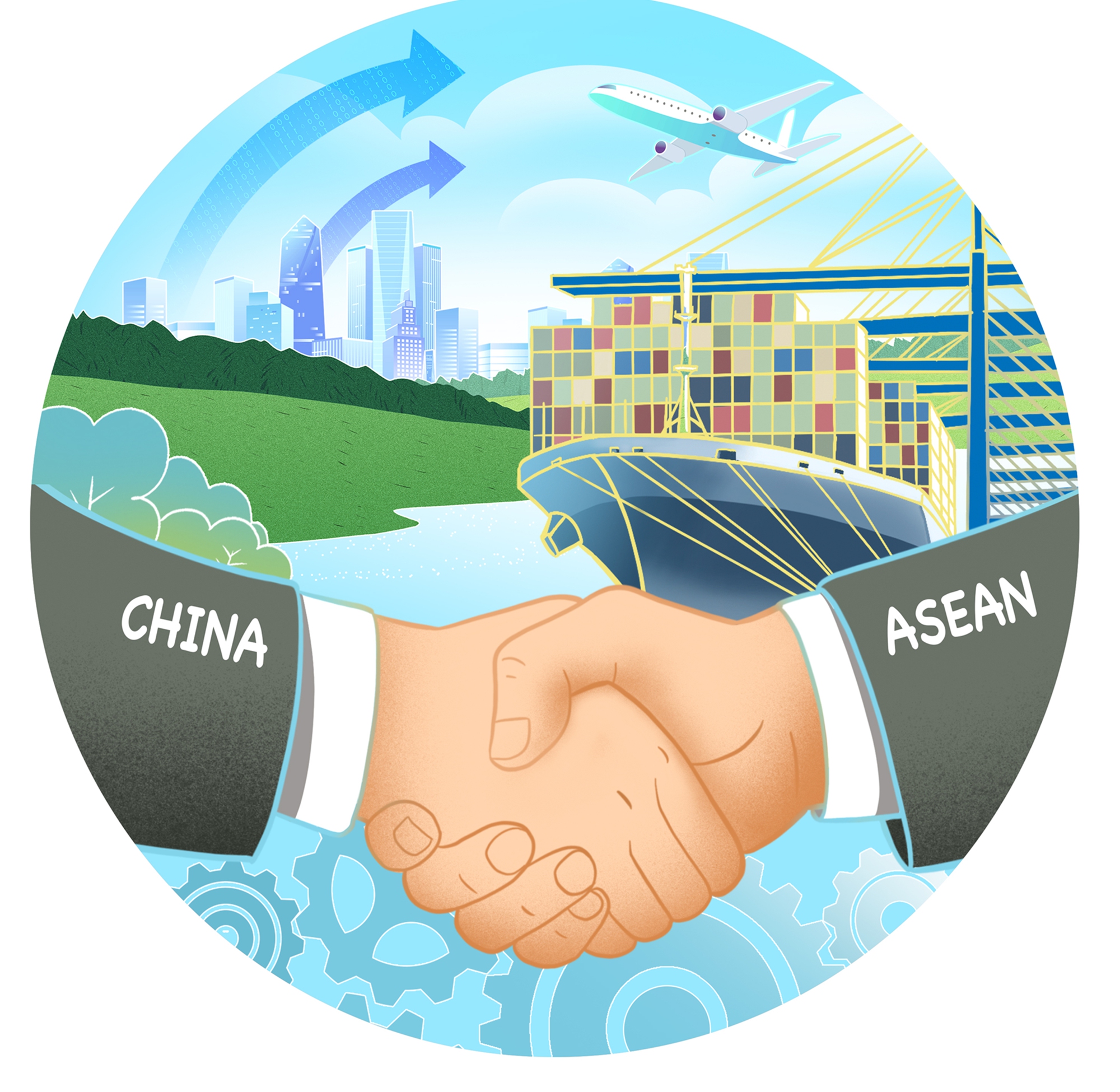
Illustration: Liu Rui/GT
Editor's Note:China and ASEAN signed the Free Trade Area 3.0 Upgrade Protocol in Kuala Lumpur, Malaysia in late October, paving the way for expanded economic and trade cooperation. In today's climate of rising unilateralism and protectionism, how will the upgrading of the China-ASEAN Free Trade Area (CAFTA) promote regional economic growth and inject more certainty into regional and global development? What implications does the CAFTA 3.0 have for the Global South? The Global Times collected the opinions of three experts from Southeast Asian countries to discuss these issues.
Kin Phea, director general of the International Relations Institute of the Royal Academy of Cambodia
The evolving partnership between China and ASEAN has entered a transformative stage now referred to as "China-ASEAN FTA 3.0." This phase moves beyond the initial stage of diplomatic normalization (1.0) and the subsequent period of trade-driven expansion (2.0) under the CAFTA. CAFTA 3.0 represents a comprehensive and forward-looking upgrade - anchored in digital connectivity, green development and innovation. Its strategic significance transcends bilateral engagement, offering a replicable model for inclusive cooperation and sustainable growth across the Global South.
For Southeast Asia, this new framework serves as a strategic roadmap for building resilience and competitiveness in an era of technological and environmental transformation. The digital dimension - spanning 5G networks, artificial intelligence, cross-border e-commerce and digital currency collaboration - promises to bridge developmental divides and foster an integrated regional digital economy. Such progress can enhance financial inclusion, promote innovation and empower micro-, small- and medium-sized enterprises. Parallel to this, the green development agenda - highlighted by joint ventures in renewable energy, electric mobility and climate-resilient infrastructure - reflects a shared commitment to sustainable progress. For a region acutely vulnerable to climate change, these initiatives not only mitigate risks but also position ASEAN as an emerging leader in the global green economy, reducing carbon dependency and nurturing high-value industries.
Beyond regional boundaries, CAFTA 3.0 holds broader implications for the Global South. It exemplifies a cooperative model grounded in mutual respect, equality and shared prosperity rather than conditional engagement. China's approach - emphasizing partnership, capacity-building and South-South cooperation - has strengthened confidence among developing nations in pursuing independent development paths. The refined Belt and Road Initiative with its focus on "small but beautiful" and high-quality projects, alongside the Regional Comprehensive Economic Partnership, underscores how developing economies can jointly shape regional rules, expand market integration and advance connectivity on equitable terms.
Ultimately, CAFTA 3.0 is more than an upgraded partnership; it represents the crystallization of a new multipolar dynamic in the international system. By intertwining their digital futures and green ambitions, China and ASEAN are not only advancing mutual prosperity but also offering the Global South an inspiring model of pragmatic cooperation, inclusive growth and shared destiny. This evolving partnership underscores a vision of solidarity, sovereignty and sustainable development - contributing meaningfully to a more balanced and harmonious world order.
Peter T C Chang, former deputy director, Institute of China Studies, University Malaya and research associate, China-Malaysia Friendship Association
This upgrade constitutes a diplomatic milestone and a strategically vital response to an era of growing trade turbulence and the erosion of the multilateral trade order. At a time when the US has resorted to unilateral tariffs, trade wars and a retreat from multilateralism, this agreement stands as a much-needed anchor for open, rules-based cooperation, offering stability for the Asia-Pacific region and beyond.
First, from a regional and global development standpoint, CAFTA 3.0 is forward-looking. It extends beyond the original focus on tariff cuts to incorporate emerging fields - the digital economy, green economy, supply chain connectivity, and micro-, small- and medium-sized enterprises now have dedicated chapters. We know that supply chains are being reconfigured globally as firms hedge against the US-China trade friction and look for diversified, resilient regional networks. Cementing deeper integration between China and the 11-nation ASEAN bloc will support higher-quality growth, more inclusive development and reduced vulnerability to external shocks.
Second, in context of the US' unilateral approach - aggressive tariffs, trade coercion, sidelining of the World Trade Organization - CAFTA 3.0 sends a signal. The Chinese Ministry of Commerce itself said the pact "demonstrates a shared, firm commitment by China and ASEAN to multilateralism and free trade." By building a higher-level, rules-based trade architecture among large markets - China and ASEAN together represent over a quarter of the world's population and a major share of global trade flows - this upgrade counters the fragmentation risk posed by US protectionism and offers a constructive path forward for global trade governance.
Third, the benefits for development in ASEAN and China matter. The agreement empowers smaller firms, supports industrial upgrading, opens digital and green sectors, and deepens supply-chain linkages. This matters because many ASEAN members remain export-and-manufacturing reliant, and need both access and structural upgrading. In a region exposed to US tariff campaigns and trade policy swings, the deeper China-ASEAN trade and integration route acts as a stabilizer rather than leaving economies at the mercy of unilateral Western policy shifts.
Jayant Menon, a visiting senior fellow at the ISEAS-Yusof Ishak Institute in Singapore, and former lead economist at the Asian Development Bank
Besides the US administration's aggressive protectionist stance, rapid changes in other aspects of the regional and international environment, including the pace of evolution of artificial intelligence, climate change and shifting supply chains, have necessitated the modernization of CAFTA 3.0.
This upgrade introduces new chapters covering areas such as digital economy, green economy and supply chain connectivity.
The digital economy chapter addresses both hard and soft connectivity, dealing with cross-border fiber optics and data centers, as well as harmonizing standards and regulations to facilitate digital trade, respectively. Given the diversity and digital divide in the region, the upgrade seeks to increase collaboration in high-impact technologies such as AI and FinTech. With increasing digitalization comes the need for better consumer protection against online scams and cybersecurity. To ensure inclusivity, micro-, small- and medium-sized enterprises will be supported to use digital platforms to engage in e-commerce and digital finance.
The inclusion of the green economy demonstrates the role that China can play in the region's green transition, as a leading player in the "new three" industries of electric vehicles, renewable energy and battery technologies. The upgrade improves market access and technical cooperation in these environmental goods and services. It also seeks to establish a framework for mobilizing green investment and sustainable finance across the region.
Although regional supply chains remained remarkably resilient in the past few years, it did serve to highlight vulnerabilities and the need for better early warning systems and rapid response mechanisms following disruptions. The upgrade aims to coordinate actions following a disruption to minimize choke points and price spikes.
Now that the US has shifted its interests from the rules-based multilateral trading system that it pioneered toward bilateral deal-making, countries in the region are left to ensure that multilateralism survives. Initiatives like CAFTA 3.0 have an important role to play in the transition to a post-US new world order.
RELATED ARTICLES