China’s 2026 APEC host year can be a pivotal moment to rebuild confidence in intl cooperation
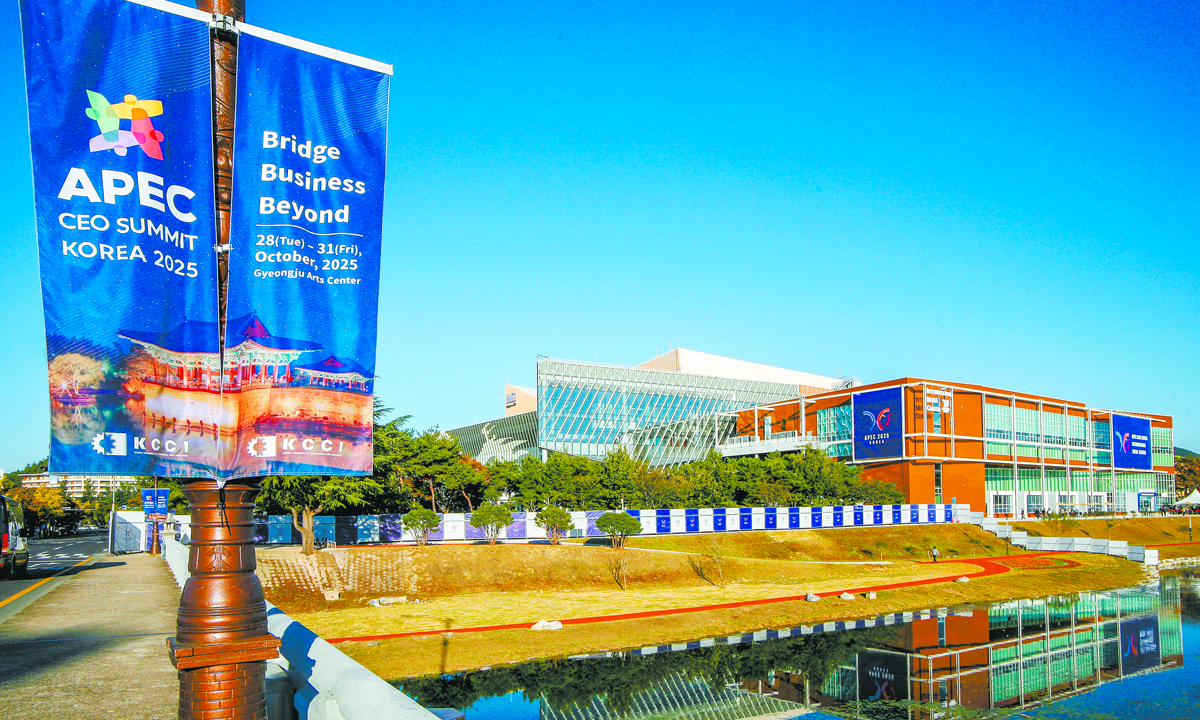
A view of the International Media Center near Gyeongju Hwabaek International Convention Center in Gyeongju, South Korea on October 28, 2025. Photo: VCG
Editor's Note:The 32nd APEC Economic Leaders' Meeting in Gyeongju concluded on Saturday. China, having pledged to build an inclusive open Asia-Pacific economy for all, takes over chairmanship for the 2026 meeting. The Global Times (GT) interviewed Kim Heung-kyu (Kim), director of the US-China Policy Institute at Ajou University, and John W.H. Denton AO (Denton), secretary general of the International Chamber of Commerce who participated in this year's APEC meetings, about the outcome of the gathering and their expectations for China's role as a host for next year's meeting.
GT: The theme of this year's APEC meeting was "Building a Sustainable Tomorrow: Connect, Innovate, Prosper." Under the current turbulence caused by tariff-related disruptions, how did the APEC members work together to achieve this goal?
Kim: The slogan of this APEC meeting reflects the demands of our times. This is an era where disruption, conflict and economic hardship are becoming commonplace. The goal of strengthening interconnectedness, innovating for the future and pursuing shared prosperity is increasingly becoming the spirit of this time. It is crucial for each nation to forge a new order that allows for coexistence, focusing on mutual communication and understanding rather than fragmentation and crashes.
Denton: The world cannot afford another cycle of rhetoric without delivery. With a major increase in the use of trade restrictive measures by governments, the cumulative drag on trade growth is becoming increasingly visible. The forecast for global merchandise trade growth in 2026 has been slashed to 0.5 percent according to the WTO report, following several years of below-trend performance. These barriers - from tariffs and export controls to localization mandates - are eroding business confidence and fragmenting supply chains at a time when predictability is most needed.
This year's APEC demonstrated that cooperation and competition can coexist - and that open markets remain the most powerful engine for inclusive growth. We are working to help restore predictability through practical reforms: from our advocacy for a modernized WTO rulebook to initiatives that digitize trade documentation and strengthen SME participation. What business needs from APEC is clear: stability, transparency and a renewed commitment to multilateral cooperation.
GT: Chinese President Xi Jinping attended the APEC meeting in Gyeongju. This also marked his first state visit to South Korea after 11 years. Kim, how do you assess the significance of this visit for China-South Korea relations?
Kim: The relationship between South Korea and China has become somewhat distant since the THAAD incident. Factors such as former president Yoon Suk-yeol's relatively unfriendly policy toward China, and the weakening connectivity between the Chinese and Korean industries have all contributed to this estrangement. The heads of state of South Korea and China should meet more frequently to communicate and cooperate, not only for the bilateral relationship but also for regional stability, peace and development.
While the Lee Jae-myung administration pursues pragmatic diplomacy, the pressure it faces from the US is beyond imagination due to severe domestic political constraints. This means that the promotion of pragmatic diplomacy espoused by the Lee administration is a tough challenge. The South Korean government under President Lee clearly wants to improve relations with China. The visit by President Xi to South Korea has served as a signal of a more positive improvement in relations for Seoul. We hope that both countries can utilize this opportunity well to engage in deeper strategic dialogue.
GT: Denton, you delivered a presentation at the session "Business Strategies Through Enhanced Connectivity Within APEC." The current concept of connectivity has evolved beyond traditional infrastructure, encompassing deep integration within the digital realm. What new cooperation models do you believe China's vast digital economy ecosystem and market size can create to boost connectivity across the Asia-Pacific region?
Denton: Five years ago, the concept of "connectivity" meant ports, roads and logistics. Today, it means interoperable data systems, trusted digital identities and cross-border regulatory coherence.
China's digital economy - now valued at more than $7 trillion, roughly 40 percent of its GDP - is central to this evolution. It is enabling new forms of regional cooperation: from paperless trade corridors linking customs authorities in real time, to AI-driven supply-chain analytics that make trade more efficient and sustainable.
We're working with APEC economies - including China - to scale the adoption of electronic trade documents, which could save businesses $6.5 billion annually in transaction costs and cut processing times by up to 80 percent. The future of connectivity in the Asia-Pacific lies in this seamless digital integration - and in ensuring that SMEs, not just large firms, can benefit from it.
GT: China will host the APEC Economic Leaders' Meeting in 2026, marking its first time as host since 2014. What are your expectations for it?
Kim: Over the past decade or so, the security environment in the Asia-Pacific region has undergone tumultuous changes. First, the security environment has shifted from cooperation to one where conflict and confrontation are becoming more commonplace. Second, despite the challenging security environment, China has rapidly risen. Third, the nations of the Asia-Pacific region are suffering from greater instability and uncertainty as a new order takes shape. I hope that China can present a new model and vision at next year's APEC where the countries in the Asia-Pacific region can look forward to coexistence and mutual development.
Denton: China's APEC host year can be a pivotal moment to rebuild confidence in international cooperation. The priorities should be practical, measurable and business-relevant. Three deliverables would make a real difference, which will mark not just a successful host year, but a concrete step toward a more stable, predictable and sustainable global economy. First, a regional roadmap for digital trade interoperability, anchored in global standards, ensuring that e-documents and data flows are trusted and accepted across all APEC economies. Second, a financing framework for sustainable infrastructure, aligned with COP30 outcomes, to mobilize private capital at scale - addressing Asia's estimated $1.7 trillion annual infrastructure gap. Third, pathfinder approaches to strengthen trade governance and provide predictability and certainty for cross-border commerce - in areas from cross-border data flows to rules of origin harmonization.
RELATED ARTICLES