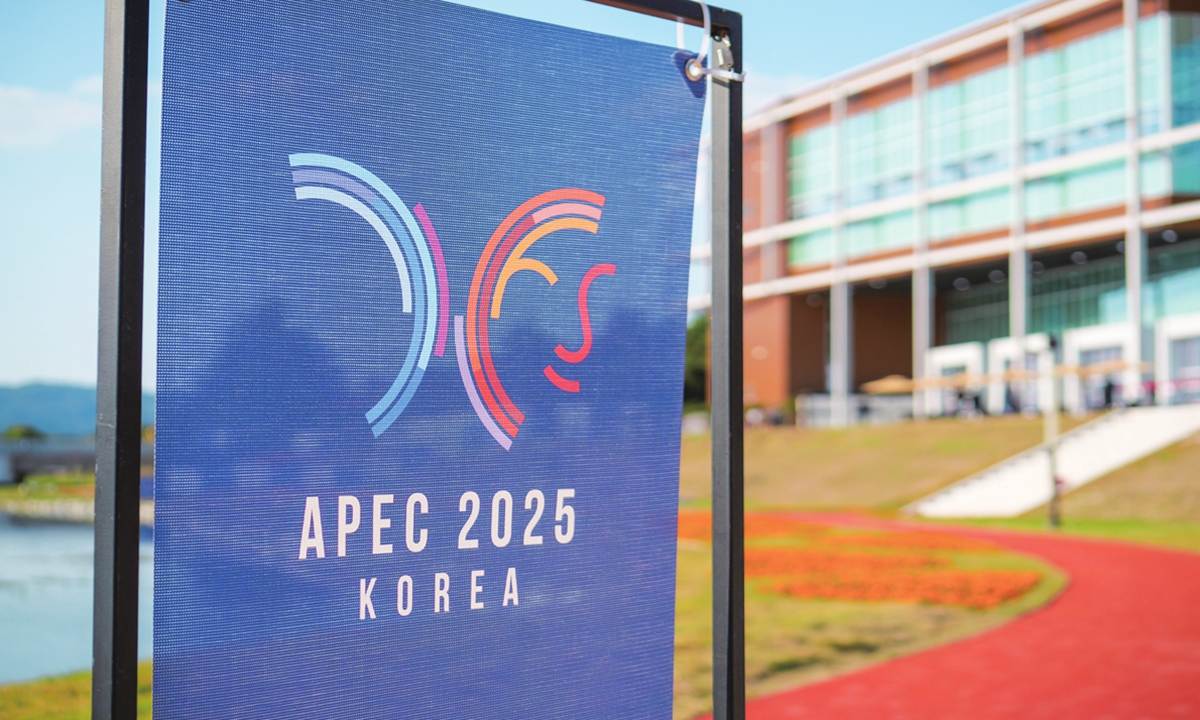
A sign for the 2025 APEC meeting is seen near the Gyeongju Hwabaek International Convention Center on October 29 in Gyeongju, South Korea. Photo: VCG
From October 31 to November 1, the leaders of the 21 APEC member economies met in Gyeongju, South Korea. Against the backdrop of ongoing global changes and increasing uncertainties on the international stage, this meeting served not only as a vital platform for regional cooperation but also as a key node in shaping both regional and global governance. Chinese President Xi Jinping put forward a five-point proposal that once again charted the course for Asia-Pacific cooperation, contributing Chinese wisdom to the building of a universally beneficial and inclusive economic globalization and an Asia-Pacific community.The Asia-Pacific region, recognized as one of the most dynamic areas globally, has seen its cooperation mechanisms evolve closely in line with shifts in the global economic landscape. From the Bogor Goals in 1994, aimed at achieving free and open trade and investment, to recent expansions into new fields such as digital economy, green growth and artificial intelligence, APEC continues to adapt to the demands of the times, promoting connectivity among mechanisms and laying a solid foundation for regional integration and development.
However, the Asia-Pacific region now faces unprecedented challenges. The IMF has previously warned that, the Asia-Pacific remains the fastest-growing region in the world, though higher tariffs and rising protectionism are likely to reduce demand for its exports and eventually weigh on activity. Against this backdrop, the meeting this year, themed "Building a Sustainable Tomorrow," focused on three priorities: Connect, Innovate, Prosper, with key topics covering energy transition, digital innovation and trade facilitation, aiming to anchor more sustainable growth pathways amid an uncertain world.
At the first session of the 32nd APEC Economic Leaders' Meeting, President Xi delivered an important speech under the title "Building an Inclusive Open Asia-Pacific Economy for All." His speech comprehensively depicts China's vision and practical approach for deepening regional cooperation. This provides feasible Chinese initiatives to foster regional partnership consensus, build an open Asia-Pacific economy and lead global growth into a new stage.
China pursues the policy of opening-up, and has taken real steps to promote an open world economy. In the face of unilateralism and protectionism, China firmly advocates for jointly building an open regional economic environment, advancing the construction of the free trade area of the Asia-Pacific. President Xi reaffirmed that "China's door to the world will not close; it will only open wider and wider," sending a clear signal that China will continue to expand high-level opening-up.
Within the APEC framework, China is not only a key participant but also an important leader. In emerging fields such as technology and green energy, China actively promotes innovation cooperation, while supporting regional industrial and supply chain resilience and security. Taking technological cooperation as an example, China elevates artificial intelligence and other frontier fields to the national strategic level, fostering complementary development with other countries in technological R&D and industrial chain. China is also strengthening its independent innovation in science and technology, enhancing core technological capabilities to ensure it maintains the initiative in its development process. This development approach, centered on self-reliance and open cooperation, embodies China's spirit of promoting sustainable development within APEC and beyond.
The APEC meeting in Gyeongju is a platform for countries to coordinate stances and explore consensus, an important opportunity to reshape the Asia-Pacific cooperation landscape. President Xi's proposals and China's concrete actions demonstrate that a China committed to openness, mutual benefit and inclusiveness is becoming an indispensable stabilizing force in the the world.
China will continue to play a vital role in building the Asia-Pacific community with its steady diplomatic policies, unwavering commitment to reform and opening-up, and pragmatic actions for cooperation, making greater contributions toward the realization of a community with a shared future for mankind.
The author is a professor and associate dean of the School of Northeast Asia Studies at Shandong University, and director of the Network of Trilateral Cooperation Think-tanks Weihai Research Base. opinion@globaltimes.com.cn
RELATED ARTICLES