IN-DEPTH / IN-DEPTH
Global South should become the 'main force': expert

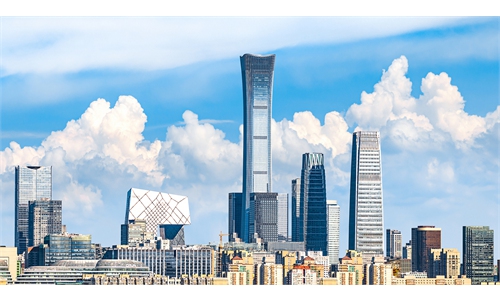
A view of Beijing Photo: VCG
Editor's Note:In an era marked by unprecedented global transformations, the world stands at a critical crossroads, grappling with deepening deficits in peace, development, security, and governance. As humanity faces unparalleled challenges during this tumultuous period, Xi Jinping, general secretary of the Communist Party of China (CPC) Central Committee and Chinese president, has put forth a solemn call to action through the Global Development Initiative (GDI), the Global Security Initiative (GSI), the Global Civilization Initiative (GCI) and the Global Governance Initiative (GGI). The four pivotal initiatives address the pressing issues of our time, offering viable pathways and robust support for building a community with a shared future for humanity. Rooted in the rich historical experiences of the CPC's century-long struggle and infused with the wisdom of China's traditional culture, these initiatives are expected to unite the world in the pursuit of common progress and stability. To offer a deep understanding of the four global initiatives, and elaborate on their significance on a global scale, the Global Times has launched a series of articles.
Recently, the Global Times, Brasil 247, and the Chinese Embassy in Brazil have jointly organized an online dialogue titled "Global South Dialogue: The Global Governance Initiative and New Visions for Cooperation," inviting Chinese and Brazilian guests to discuss these issues. Below are highlights from the speech of Fu Xiaoqiang, president of China Institutes of Contemporary International Relations.
As humanity stands at the historical juncture of the 80th anniversary of the victory in World Anti-Fascist War and the founding of the UN, we face an era of intertwined changes and challenges, where old and new contradictions collide, and the governance deficit continues to widen. The international community, more than ever, needs the wisdom and has a responsibility to transcend zero-sum games.
President Xi Jinping proposed the Global Governance Initiative (GGI) which addresses a fundamental question: How to ensure that the global governance system truly embodies humanity's shared aspirations for peace and development. First, in this profound transformation, Global South countries are no longer mere bystanders in the governance system, but have become key forces in reshaping the governance landscape. The current global governance system faces three major challenges: imbalanced representation, outdated rules, and ineffective action. The most prominent contradiction is the long-standing marginalization of Global South countries, which account for over 80 percent of the world's population. This structural imbalance makes it difficult for the governance system to address cross-border challenges such as climate change and the digital divide. The GGI, guided by the principles of extensive consultation, joint contribution, and shared benefits, provides a platform for Global South countries to pool their collective wisdom.
Second, the Global South is becoming a co-creator of international rules. In the past, developing countries were often relegated to the role of rule-takers. Now, through platforms such as the expanded BRICS mechanism and the Group of 77 and China, Global South countries are collectively voicing their perspectives in shaping rules for emerging domains like artificial intelligence, deep-sea mining, and cross-border data flows. These practices validate the GGI's assertion that international rules should not be unilaterally dictated by the most powerful nations, but should be forged collectively by diverse civilizations within the UN framework.
Third, the Global South is emerging as a driver of governance transformation. In the face of unilateralism and protectionist headwinds, Global South countries are taking action to uphold multilateralism. From Southeast Asian nations advancing the implementation of the Regional Comprehensive Economic Partnership (RCEP), to Latin American countries establishing peace dialogue mechanisms free from external interference, to the African Continental Free Trade Area unlocking a market of 1.3 billion people, and the Alliance of Small Island States pressing developed nations to adopt the 1.5 C temperature control target in climate negotiations - these efforts vividly embody the wisdom of the GGI in seeking common ground while reserving differences.
At the same time, the implementation of the GGI will create unprecedented development opportunities for Global South countries. First, in terms of governance structure, it will promote reforms in the International Monetary Fund's quota system and the World Trade Organization's dispute settlement mechanism, enabling emerging powers such as India, Brazil, and Nigeria to gain influence commensurate with their roles. Second, in terms of resource flows, the establishment of the China-UN Global South-South Development Facility will help channel funds and technology toward key areas such as clean energy and digital infrastructure. Third, in terms of capacity building, by leveraging platforms like the UNDP Global Center for Sustainable Development, it will foster localized governance talent and collectively promote a networked ecosystem for global governance that shares opportunities.
Opportunities always come with responsibilities. Global South countries need to courageously break the "resource curse," transforming mineral wealth into technological competitiveness, forming collective solutions on issues like food security, and engaging with a sense of ownership in cutting-edge agendas such as artificial intelligence and outer space governance to prevent these new domains from becoming sources of global inequality. As a member of the Global South, China has already put into practice its commitment to "no longer building new overseas coal power projects," instead bringing clean energy and technology to developing countries. As the largest contributor of peacekeeping troops, China will continue to safeguard international peace with its blue helmets, increasing the South-South Cooperation Fund to $4 billion and implementing over 180 livelihood projects in more than 60 countries. This unity of knowledge and action exemplifies the action-oriented spirit of the GGI. Let us take the GGI as a bridge to promote global governance from a "Western-centric" model to one of diverse co-governance, shifting from hegemonic dominance to a shared future for all.
RELATED ARTICLES