Why a quadrilateral ‘Indo-Pacific Chiefs of Defense Cooperation Council’ is a security illusion
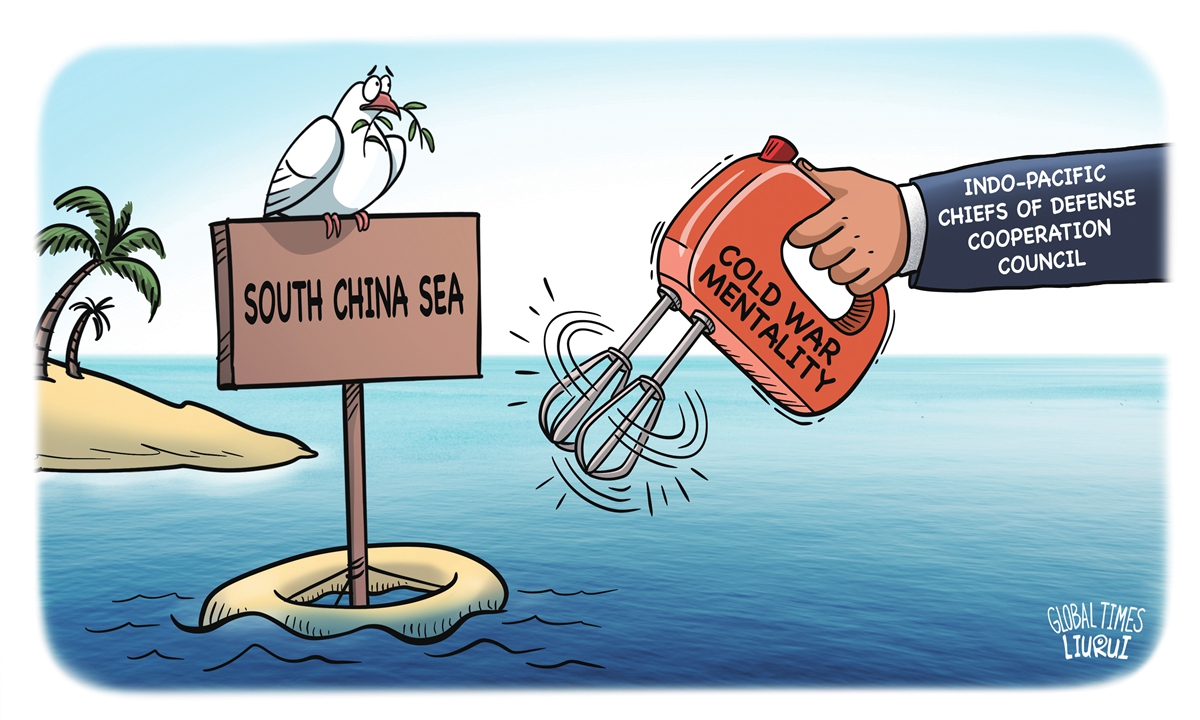
Illustration: Liu Rui/GT
Recently, several Philippine media outlets turned their attention to a "highly ritualized" but security-illusory quadrilateral meeting.On the sidelines of the 12th ASEAN Defense Ministers' Meeting in Kuala Lumpur, Malaysia, Australian Deputy Prime Minister and Minister for Defense Richard Marles, Japanese Minister of Defense Koizumi Shinjiro, Philippine Secretary of National Defense Gilberto Teodoro and US Defense Secretary Pete Hegseth met together on November 1. According to the Joint Readout released by the Australian government, the four sides expressed "serious concern regarding China's destabilizing actions in the East China Sea and the South China Sea" and voiced support for "the framework to establish the Australia-Japan-Philippines-US Indo-Pacific Chiefs of Defense Cooperation Council."
Such a small group symbolizes the further bloc-ization of the South China Sea issue - making it more complicated and tense.
The proposed "Indo-Pacific Chiefs of Defense Cooperation Council" is nothing but a remake of an old script. The Philippine Daily Inquirer quoted a local expert as saying that "it resembles the diplomatic partnership Quad" - a clear revelation of its essence: a "mini-multilateral" mechanism designed to target a specific country under the guise of regional security. It's less about ensuring security, and more about asserting presence.
"This council is essentially the result of the interplay between the US 'Indo-Pacific Strategy' and the current Philippine government's foreign policy," Ding Duo, director of the Research Center for International and Regional Studies at the National Institute for South China Sea Studies, told the Global Times. "Through institutionalized cooperation, it will further bind the Philippines strategically to the US and its allies, expanding bilateral alliances into a more targeted small multilateral arrangement," Ding added.
Recently, the Philippines has been increasingly active on the South China Sea - provoking Chinese Coast Guard vessels, rallying external forces for "joint patrols" and now staging a joint show with the US, Japan and Australia. It portrays itself as a small nation under pressure, using foreign backing to embolden its moves.
A closer look at the other three participants shows they are much more than just allies. The US, under the banner of the "Indo-Pacific," seeks to reinforce its strategic footprint and retain control over regional affairs. Japan hides its path toward military normalization under the label of "defense cooperation." Australia follows Washington's China strategy while trying to boost its own relevance. These countries are far from the South China Sea, yet eager to dictate terms. Their security pledges sound loud but rarely go beyond words. When the Philippines thinks it has found a "protector," it may in fact be inviting in "storm-makers."
"Past experiences with frameworks such as the Quad and AUKUS show that such small-circle politics are of limited effectiveness and dubious purpose. Their core problem lies in their group-confrontation logic, which manufactures and worsens regional insecurity rather than resolving it," Ding said. We can already see fractures within the Quad itself, as trade, tariff and strategic disagreements among the US, India and Japan have cast shadows over its future.
If even the Quad is struggling, what real impact can a "Quad-like" experiment possibly have?
Nonetheless, the ganging up of the four countries will undoubtedly bring turbulences to the region. This meeting announced that all four countries would participate in the "Balikatan 2026" joint military exercise, with Japan and Australia - previously observers - now joining as full participants. "This marks the shift of their military cooperation from intention to substance," Ding noted, "it may send the wrong signal to certain forces in the Philippines, emboldening maritime adventurism and increasing the risk of confrontation."
"Security," in this context, has become a convenient disguise for regional militarization. In contrast, China continues to advocate dialogue and consultation to resolve disputes and maintain peace and order in the South China Sea - a path grounded in cooperation and mutual respect.
The meddling by so-called "Australia-Japan-Philippines-US Indo-Pacific Chiefs of Defense Cooperation Council" will only stir the waters of the South China Sea. The future of the South China Sea is not guaranteed by "small groups," but by cooperation. What the region truly needs is dialogue, trust, and shared development - not the camp of a few self-appointed actors.
The author is a reporter with the Global Times. opinion@globaltimes.com.cn
RELATED ARTICLES