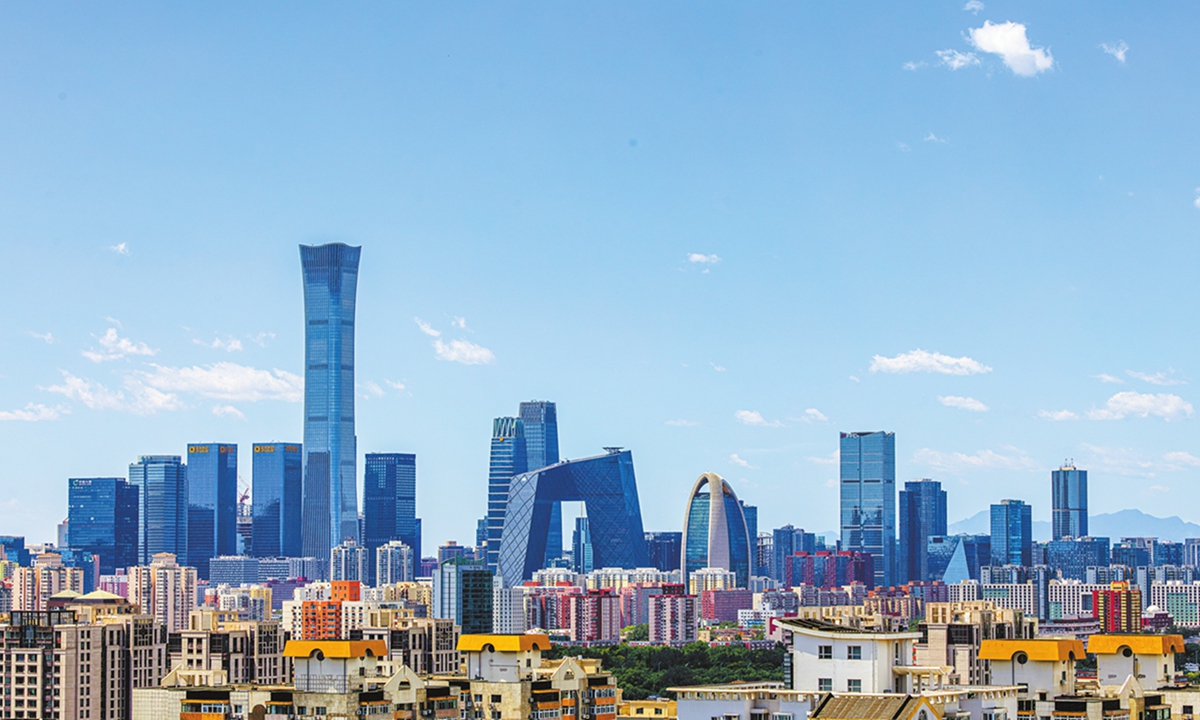
The view of Beijing's Central Business District Photo: VCG
The Fourth Plenary Session of the 20th Central Committee of the Communist Party of China (CPC) offered the world a critical window into China's strategic trajectory. The session has charted the course for the 15th Five-Year Plan period (2026-30) - years likely to define the next phase of China's modernization and its interaction with a fracturing global order.At the heart of this five-year plan mechanism stands the CPC. With over 90 million members and organizational units embedded in every major institution in Chinese society, the CPC is not just any political party, it is the most powerful political organization on earth, leading the Chinese state.
As a sociologist and political theorist, I regard it as a defining fact of contemporary global politics that China, under the leadership of the CPC, possesses an organizational capacity unprecedented in history. It can mobilize resources, steer national initiatives, and coordinate long-term strategies on a scale unmatched in human experience.
A striking case is China's national push in renewable energy, especially in photovoltaics and electric vehicles. The development of these sectors has not been left to market forces alone. They were explicitly prioritized in successive five-year plans as strategic imperatives.
While many countries around the world - especially in Europe - have achieved significant reductions in carbon emissions, it was China that executed the most impressive green industrial strategy. This strategy made it the global leader in critical green technologies of the 21st century. The same pattern is visible in semiconductors, artificial intelligence, and quantum research: fields where strategic patience and coordination matter more than quarterly results.
This capacity for sustained planning is not born in a vacuum. It has been systematically cultivated through a century-long tradition of state coordination. Modern planning is both a legacy and a reinvention of China's administrative culture.
There is, of course, a broader East Asian context. China's developmental model shares affinities with the state-industrial partnerships that powered the meteoric rises of Japan in the 19th and 20th centuries and South Korea in the post-war era.
Europe also engages in extensive planning through its national bureaucracies and through institutions such as the European Commission. Many readers may be aware of the EU's foreign-policy weakness, yet within EU borders, a quiet technocratic competence persists.
The underlying logic of planned development, then, is not unique to the People's Republic of China. But China has scaled it to an unprecedented degree, leveraging its vast domestic market and technological sophistication, as well as the CPC's reach into institutions throughout Chinese society.
It should be noted that China today faces daunting internal and external tests: an aging population, environmental constraints, and a fracturing global economy. China now needs a world-leading private financial sector to sustain economic dynamism. It needs to provide frameworks that enable rather than suffocate initiative; to combine planning with openness, coordination with flexibility. National initiatives in semiconductors and renewables show how long-term planning can guide market dynamism without extinguishing it.
Ultimately, the test of any system lies in its ability to deliver tangible improvements and to adapt intelligently to change.
China's industrialization has laid the foundation for the future. The Chinese people have every reason to trust in their saying yue lai yue hao, that things will keep getting better. More yue lai yue hao is coming the way of the Chinese population, especially if the country's developmental frameworks interact even more effectively with the private market, above all with the nascent financial sector centered in Shanghai.
The financial sectors in Shanghai and Hong Kong must serve and empower the most formidable industrial landscape in the world.
History shows that the winning formula is industrialization and technological innovation, supported by a disciplined, high-capacity state, in combination with a dynamic financial field. In short, the foundations for China's future success are firmly in place.
For the rest of the world, understanding China's institutional reality is no longer optional. It is essential for grasping modernization and world politics in the 21st century.
Leading nations like China will be rewarded not only with prosperity, but also with the honor of bearing the responsibility to help establish a stable world order - one in which nations, large and small, drawn from diverse civilizational traditions, flourish in peace and harmonious diversity.
The author is a Dutch sociologist, director of the Telos-Paul Piccone Institute China Initiative, and a visiting fellow at the Danube Institute, Hungary. opinion@globaltimes.com.cn
RELATED ARTICLES