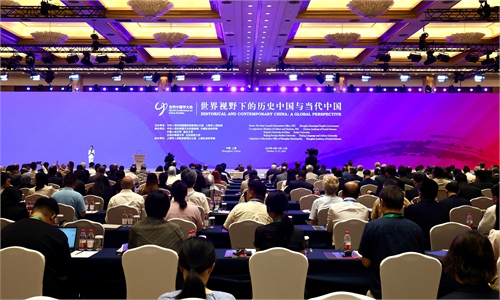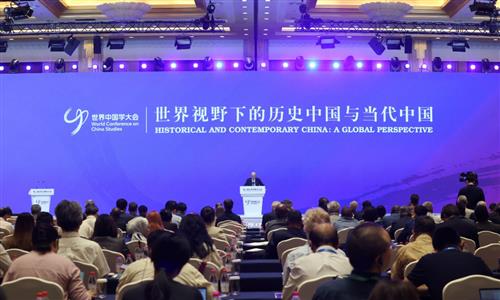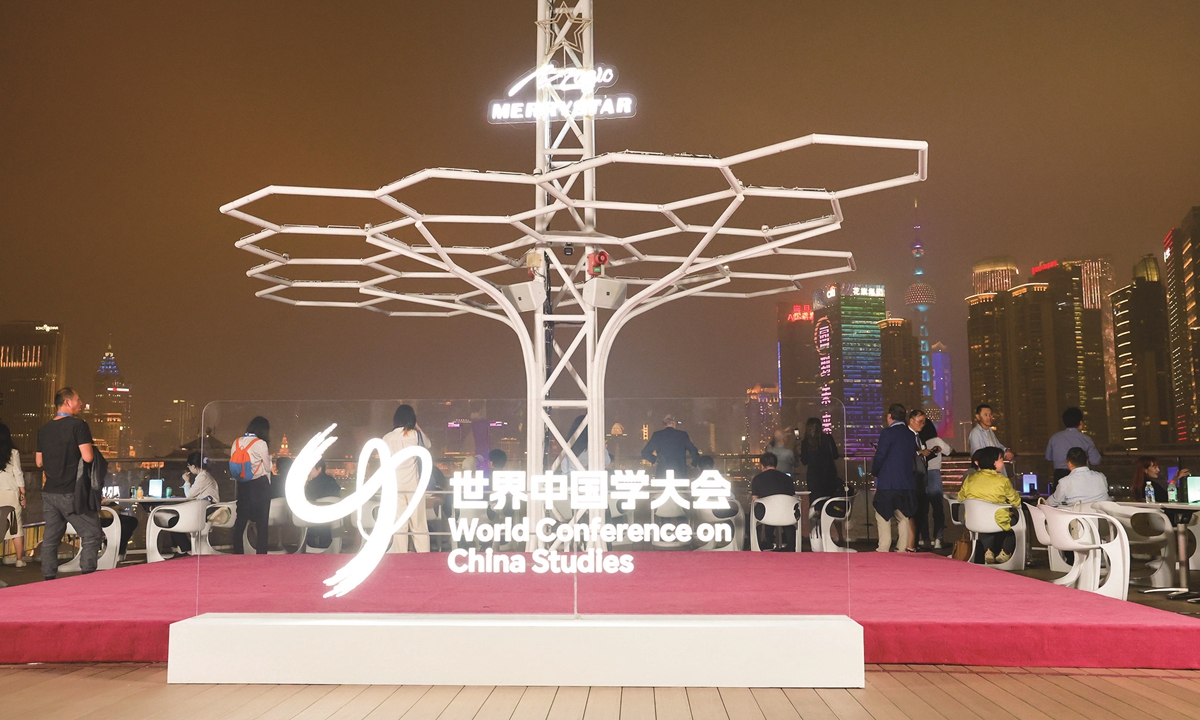
Participants at the 2nd World Conference on China Studies enjoyed a night cruise on Huangpu River on the evening of October 13, 2025. Photo: Chen Xia/GT
Editor's Note:
The second World Conference on China Studies was held from October 13 to 15 in Shanghai. About 500 renowned scholars from around the world participated, engaging in in-depth dialogues and intellectual exchanges under the theme "Historical and Contemporary China: A Global Perspective." Key topics include how to build a global China Studies knowledge system and how Chinese wisdom and ideas can better contribute to the world. This article presents selected highlights from sub-forum one, "China in Global Context: Continuity and Innovation of Civilization," and sub-forum two, "Chinese Modernization: Theoretical Analysis and Empirical Insights."
Modernization is an important topic in China studies
Gao Xiang, president of the Chinese Academy of Social Sciences
The driving force behind a nation's modernization can only be found by delving deep into its own history and culture. Modernization is a key topic in China studies; to truly understand China, one must understand Chinese modernization. Chinese modernization is the socialist modernization pursued under the leadership of the Communist Party of China (CPC), deeply rooted in the fine traditional culture of Chinese civilization, guided by the principle of independence and carrying profound global significance.
Chinese modernization has forged an entirely new path - full of vitality and passion - creating magnificent achievements that Western modernization has often failed to realize. It not only follows the general principles of modernization but also aligns with China's realities, exhibiting distinct characteristics. It expands the avenues for developing countries to achieve modernization, offers new opportunities for global development and brings greater stability to world peace. History has already shown that Chinese modernization can succeed, and it will undoubtedly shape the future.
Today's world is the most complex and rapidly changing in human history. Therefore, in these times, what we need is rational and calm reflection, sincere and constructive exchanges, and a contribution of wisdom and strength to help the world better understand China and Chinese modernization, paving a hopeful and bright path for global modernization.
Chen Zhimin, vice president of Fudan University
President Xi Jinping emphasizes that China studies are not only the studies of historical China, but also the studies of contemporary China and that "only by tracing the origins of history can we understand the reality of the world, and only by following the cultural foundation can we identify present-day China. It is through the mutual learning of civilizations that common progress can be achieved." This provides a fundamental guide for the global development of China studies.
In my view, the two words "continuity" and "innovation" are key to understanding Chinese civilization and contemporary China. Continuity is the unbroken code of Chinese civilization. It shapes the way we view the world and endows today's China with profound historical depth. Therefore, studying China without tracing its historical origins or following its cultural roots means you cannot understand how it flourishes and thrives. Innovation, on the other hand, is the engine driving contemporary China's dynamic development. Today, China is advancing the great endeavor of building a strong nation and achieving national rejuvenation through Chinese modernization. This grand practice itself represents an unprecedented, unparalleled innovation.
Chinese civilization serves as the fertile soil of Chinese modernization
Syed Hasan Javed, former Pakistani ambassador and former director of the Chinese Studies Centre at the National University of Sciences and Technology in Islamabad
Theoretically, Chinese modernization is based on a correct understanding of historical forces. It goes to many generations of leadership from the Communist Party of China and the masses.
Global history, in my view, has already taken a U-turn. It has discarded the erstwhile geopolitics of the Cold War and coalition building. Chinese modernization is no more reversible, as it is based on a scientific view of historical forces and the flow of history. The way ahead for China is evident from the significant progress its modernization drive has already achieved in such a short period.
Li Guoqiang, a member of the Academic Divisions of the Chinese Academy of Social Sciences
From a historical perspective, Chinese modernization is not a blueprint that appeared out of thin air, but rather a magnificent epic - a century-long relay carried forward from generation to generation. To grasp the true essence and significance of Chinese modernization, one must look deep into history to uncover the invaluable lessons accumulated over time.
The extensive and profound Chinese civilization serves as the fertile soil of Chinese modernization, fundamentally determining that the Chinese nation must pursue a path of modernization suited to its own conditions. History has proven that Chinese modernization is the modernization of an ancient civilization's continuation, not one that eradicates tradition; it is a modernization that has grown from the soil of China, not one copied from other countries; it is the result of civilizational renewal, not the product of civilizational rupture.
The path of development a country or nation chooses depends not only on its social system, development conditions and external environment, but also on its historical and cultural traditions. There is no single, universally applicable model or standard of modernization. Every country must find its own path to modernization while maintaining an independent and self-reliant character.
Chinese modernization holds global significance
Yuan Hongying, research fellow at the Shandong Academy of Social Sciences
Chinese modernization is oriented toward the common development of all humanity, aiming to contribute to a vision of global modernization marked by shared prosperity. The historical and cultural origins of Chinese modernization embody a dialectical unity between the general laws of modernization and China's unique national conditions.
From a global perspective, it represents a transcendence and transformation of the Western model of modernization; from the perspective of China's own development, it signifies the creative rebirth of traditional culture; and from a cultural dimension, it reflects the deep integration of classical wisdom and modern values. This process not only demonstrates the historical continuity of China as a civilization state but also highlights the theoretical innovation of the CPC in advancing the "second integration" - the concept of integrating the basic tenets of Marxism with fine traditional Chinese culture.
Louise Edwards, fellow of the Academy of Social Sciences in Australia and professor at the University of New South Wales
As China stabilized after liberation, the CPC was able to roll out programs that provided concrete and immediate benefits for women. China offers a clear example of the advantages gained by lifting the constraints on women's abilities.
At the Global Leaders' Meeting on Women held in Beijing a few days ago, President Xi Jinping announced that China will donate, over the next five years, $100 million to its growing development fund earmarked for women's projects, and another $10 million to the UN. China's global leadership in supporting women promises to spread the benefits of this comprehensive and mature strategy even further around the world with this kind of support. It's truly impressive.
Clearly, there is more to be done, but much has already been achieved. That is a great cause for optimism that China will continue to be a society in which barriers to release capacity to fully contribute to national modernization will continue to be dismantled piece by piece, year by year. And when one considers just how far China has come in such a short historical period, it's clear that there's even more cause for optimism.
RELATED ARTICLES