Second World Conference on China Studies opens in Shanghai amid global exploration in development models
By and in Shanghai Published: Oct 14, 2025 03:27 PM

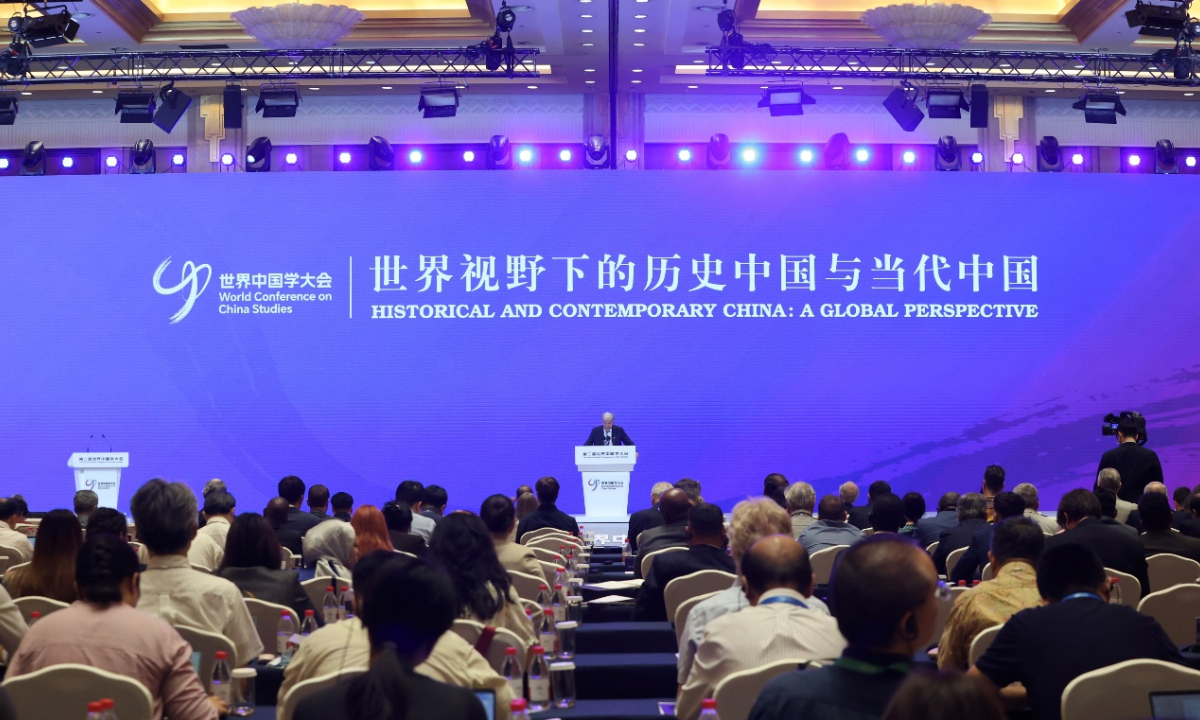
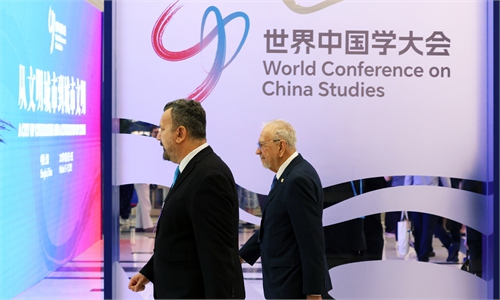
The second World Conference on China Studies kicked off in East China's Shanghai on Tuesday with the theme "Historical and Contemporary China: A Global Perspective."
The second World Conference on China Studies kicked off in East China's Shanghai on Tuesday with the theme "Historical and Contemporary China: A Global Perspective."
About 500 experts and scholars from around the world are set to engage in in-depth discussions on this theme. The conference features forums, side events and an exhibition focused on urban civilization.
In his opening speech, Gao Xiang, president of the Chinese Academy of Social Sciences, said that as realizing modernization is common aspiration of people around the world, for China Studies to play a greater role, it should focus more on the splendid achievements of contemporary China and deepen research on Chinese modernization, providing inspiration for answering the questions of where humanity is headed.
Romano Prodi, former Italian prime minister and former President of the European Commission, who attended the conference, said that "strategic cooperation remains the underlying tenor of China-EU relations," and that any form of decoupling would run counter to the fundamental interests of both sides.
His remarks echoed those of other participants, including Richard Sakwa, a professor of European politics at the University of Kent at Canterbury, who noted that China's growing influence amid the West's relative decline has made China Studies a "key academic field."
Sakwa told the Global Times that as multipolarity deepens, the world is looking to China for a new type of leadership that differs from hegemony. He cited China-proposed Global Governance Initiative as a potential framework for reshaping international institutions.
Several other foreign scholars also pointed to lessons from China's development experience.
Gustavo Alejandro Girado, director of the Sino-Latin American Research Center at the National University of Lanús and president of the Argentina Sinologist Council with 25 years of experience studying China, told the Global Times that the future global order should not be dominated solely by Western values.
He said that the developing world's situation proves that a single Western model is not a universal solution. China's development concepts and governance wisdom offer a different perspective for Global South countries to explore their own paths."
Abdou Gafar Alade Karimou, a lecturer with the University of Parakou in Benin, told the Global Times during the conference that the most significant lesson for African nations is how China has managed to "maintain its cultural identity while pursuing modernization."
He said the Western model often asks developing countries to abandon their cultural traditions, whereas China's practice shows that "development and cultural confidence can go hand in hand."
The conference released the "Shanghai Initiative for Global Mutual Learning and Advancement of China Studies," which called for enhanced civilizational dialogue and academic collaboration.
The conference is organized by the State Council Information Office and the Shanghai municipal government, with co-sponsorship from other government agencies and academic institutions.
RELATED ARTICLES