Promoting China-S.Korea strategic cooperative partnership under framework of neighborhood diplomacy
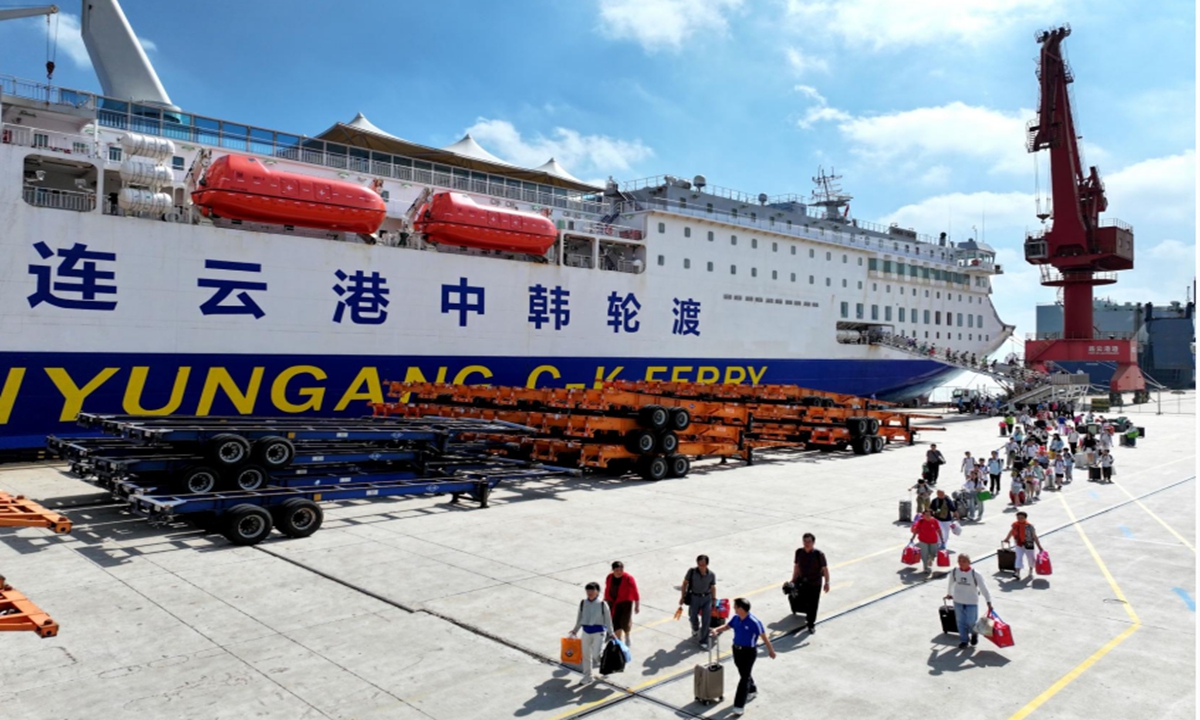
The China-Korea passenger and cargo liner Harmony Yungang at Lianyungang Port in Jiangsu Province Photo: VCG
Editor's Note:Chinese President Xi Jinping paid a state visit to South Korea - his first visit to the Northeast Asian country in 11 years - and attended the 32nd APEC Economic Leaders' Meeting recently. As Xi pointed out during his meeting with South Korean President Lee Jae-myung, China and South Korea are important neighbors that cannot be moved away and cooperation partners that cannot be separated.
To enhance understanding of South Korea and grasp the trajectory of China-South Korea relations, the Global Times, in collaboration with Chinese universities and think tanks, is releasing a series of reports on South Korea.
In the first report of the series, we focus on the factors that affect China-South Korea relations and how to promote the continuous development of the strategic cooperative partnership between the two countries under the framework of neighborhood diplomacy.
"First, strengthen strategic communication and consolidate the foundation of mutual trust. Second, deepen mutually beneficial cooperation and tighten the bonds of interests. Third, strengthen the friendship between the two peoples and bring their hearts closer together. Fourth, enhance coordination in multilateral fora to jointly promote peace and development." Chinese President Xi Jinping put forward this four-point proposal for opening up new prospects for China-South Korea relations on November 1, during his state visit to South Korea and his meeting with the South Korean President Lee Jae-myung in Gyeongju. This proposal not only demonstrates China's determination and confidence in achieving mutually beneficial outcomes with neighboring countries, but also outlines a blueprint and provides direction for ushering in a new phase in China-South Korea relations.
Now, after over three decades since the two countries established diplomatic ties, China-South Korea diplomacy exhibits greater resilience. President Xi's visit has played an irreplaceable strategic guidance role in the development of the China-South Korea relations and in the stability and prosperity of the Asia-Pacific region.
Cultivating mutual understanding, opportunities for cooperation in China-South Korea relations
A healthy and stable relationship between China and South Korea aligns not only with the spirit of the age and the fundamental interests of both peoples but also plays a crucial role in fostering regional and global peace, stability, and prosperity. Over three decades of exchanges and cooperation have shown that the trend toward a deeper strategic cooperative partnership between the two countries remains strong, despite various challenges.
Despite the two countries are now encountering new challenges in how they perceive each other, a foundation for objective and friendly public opinion has been established between China and South Korea. Mutual recognition and amicable attitudes were once prevalent among the populations. However, due to the changing regional and international landscape, new challenges have emerged, leading to misunderstandings in public opinion. For example, differences in the interpretation of Confucian cultural legacies continue to exist. Additionally, while neighboring countries acknowledge each other to varying degrees, there is a lack of consensus on recognizing mutual opportunities for bilateral collaboration.
Under the Yoon Suk-yeol administration, right-wing forces in South Korea intensified their promotion of anti-China narratives, fueling nationalist and populist sentiments and disseminating false and inflammatory claims against China. This has eroded public trust and weakened the foundation for people-to-people exchanges between the two nations. After taking office, the Lee Jae-myung administration condemned rallies and demonstrations against Chinese tourists, describing them as "not freedom of expression, but disturbance." This position reflects a commitment to sustain people-to-people exchanges between the two countries. The South Korean government are expected to continue to take concrete actions to effectively protect the legitimate rights and interests of Chinese citizens in South Korea and actively guide the establishment of objective and rational understandings of China: China's development presents opportunities rather than threats to South Korea.
Another crucial factor is the economic complementarity between the two nations, which has become increasingly vital for sustaining and enhancing bilateral relations. Since the establishment of diplomatic ties, China and South Korea have capitalized on their geographical proximity, cultural affinities, and people-to-people connections - advantages of good neighbors - to achieve fruitful cooperation in trade, investment, institutional frameworks, platforms, and connectivity. This pattern of economic complementarity has become a strong pillar of their strategic cooperative partnership. Over the past three decades, trade volumes between China and South Korea have been remarkable, mutual investments have brought significant benefits to both sides, and cooperative platforms continue to proliferate. China has long been South Korea's largest trading partner and export market, while South Korea has risen to become China's second-largest trading partner.
With President Xi's visit, China-South Korea relations have reached a new historical starting point. The deep-rooted foundation of cooperation, highly complementary economic structures, and long-standing cultural ties between the two countries provide an impetus for the healthy development of bilateral relations.
Efforts to reduce US interference in China-South Korea cooperation are still underway
In the development of the China-South Korea strategic cooperative partnership, the influence of the US is inevitable. Due to the US-South Korea alliance, various issues, from THAAD to nuclear-powered submarines, lie across China-South Korea relations. Currently, South Korea is striving to pursue a pragmatic diplomacy, giving primacy to national interest and aiming to minimize US influence and pressure. How it navigates the clamor surrounding the US will test Seoul's diplomatic acumen.
First, since Lee Jae-myung assumed office, his pragmatic diplomacy, centered on "putting South Korea's interests first," emphasizes flexible adjustment of foreign policy in a complex international environment. It is exemplified in the Lee administration's handling of issues related to China, the US and Japan, which demonstrates its efforts to advance an independent foreign policy. Under Lee, Seoul now advocates strategic autonomy within its alliance with Washington, seeks to deepen cooperation with China and shows a peaceful posture in neighborhood diplomacy.
Second, while attaching importance on the US-South Korea alliance, the Lee administration is also trying to maximize South Korea's national interests in diplomacy, security and the economy. Seoul has demonstrated certain wisdom in safeguarding national strategic interests and critical decisions regarding diplomatic policy, core interests and major strategic directions. However, Seoul still faces numerous tests amid uncertainties, including questions if it can maintain its bottom line in trade negotiations with the US.
Third, the durability of China-South Korea relations over the past 33 years is largely due to their shared memories in modern history and emotional bonds, as well as their pragmatic efforts to build mutual trust and cooperation in politics and diplomacy, and their economic interdependence and mutual benefits. At present, the two countries share historical and contemporary strategic interests, with both sides deepening political trust and increasing economic interdependence.
It is high time to promote steady, long-term development of China-South Korea strategic cooperative partnership
The Gyeongju meeting between the leaders of our two countries showcased China's determination in promoting the bilateral relationship - China values its relationship with South Korea and maintains consistency and stability in its policy toward the country. It is ready to enhance communication with South Korea, deepen cooperation, expand common interests and tackle challenges together. As our world today is living through accelerating changes unseen in a century, political mutual trust and the integration of interests with neighbors increasingly align with South Korea's national interests and developmental interests of both China and South Korea. Against this backdrop, with the vision of building a common home of peace, tranquility, prosperity, beauty and friendship and injecting positive energy into regional peace and development, it is the right time to promote the steady, long-term development of the China-South Korea strategic cooperative partnership.
First, it is now necessary to strengthen strategic communication, solidify the base for mutual trust and reinforce the idea that the neighborhood is a shared home and a joint basis for prosperity for both countries. The two countries should foster strategic trust under the compatibility of China's Five Principles of Peaceful Coexistence and South Korea's pragmatic diplomacy, reduce misperception and intensify high-level exchanges on various issues. They need to enhance dialogue mechanisms, openly exchange ideas that can promote neighborhood development and jointly advance regional cooperation.
Second, the two countries should recognize that the well-being and livelihoods of their people are common pursuits for both sides. Within the framework of building a community with a shared future with neighboring countries, improving people's livelihoods and advancing their well-being should be a shared vision and a priority driving bilateral interaction between China and South Korea. Thus, the two countries need to deepen mutually beneficial cooperation and strengthen their interconnected interests. They can cooperate to provide more employment opportunities for the citizens of both countries and promote higher living standards. They can also seek cooperation potentials from tackling low birth rates and aging populations together by pushing the silver economy. They could adopt innovative policies leveraging AI and other new technologies to promote welfare progress and the development of livelihoods.
Third, deepening the China-South Korea strategic cooperative partnership also requires jointly resisting external interference and discordant noise. The two sides need to protect the foundation of their mutual trust from a strategic perspective, focus on building high-level political trust, and respect each other's core interests and major concerns. At the same time, they need to minimize external factors' impact on bilateral relations, especially those from the US and Japan, and work toward closer economic cooperation, easing tensions on the Korean Peninsula and deepening people-to-people friendships to counter external noises.
Fourth, the two countries should collaborate to advance the idea of building a community with a shared future with neighboring countries. Such a concept provides ample potential for China-South Korea cooperation. The two countries should consolidate strategic mutual trust, consult on resolving differences, enhance public sentiment and promote people-to-people connectivity. Furthermore, they need to build connectivity networks, strengthen cooperation in terms of production and supply chain, address various risks and challenges, and jointly safeguard regional stability. Through high-quality cooperation under regional frameworks and under the strategic support of the Asian security model, China and South Korea can unite in forming a regional cooperation framework that is open, inclusive, balanced and beneficial to all.
Fifth, the two countries should seek closer cooperation under the APEC framework. This year's APEC meeting - focusing on AI innovation, tackling population problems and sustainable development - sent a more explicit signal for Asia-Pacific multilateral cooperation, stimulating cooperation willingness among member states. As China prepares to host the APEC Economic Leaders' Meeting in 2026, South Korea's experience serves as a useful reference in terms of jointly advancing free trade and regional economic integration and intensifying multilateral coordination. In this sense - from Gyeongju to Shenzhen - China-South Korea cooperation under the APEC framework transcends bilateral cooperation. It is expected to provide China-South Korea solutions for building a community with a shared future with neighboring countries and even within the Asia-Pacific, jointly demonstrating a China-South Korea model for regional and global peace and development.
The author is a research fellow at the Institute of Northeast Asian Studies of the Heilongjiang Provincial Academy of Social Sciences and an expert at the China Academy of Northeast Revitalization. opinion@globaltimes.com.cn
RELATED ARTICLES