China's Tianwen-1 Mars probe's orbiter successfully observes interstellar object 3I/ATLAS
By and Fan Anqi Published: Nov 06, 2025 09:09 AM

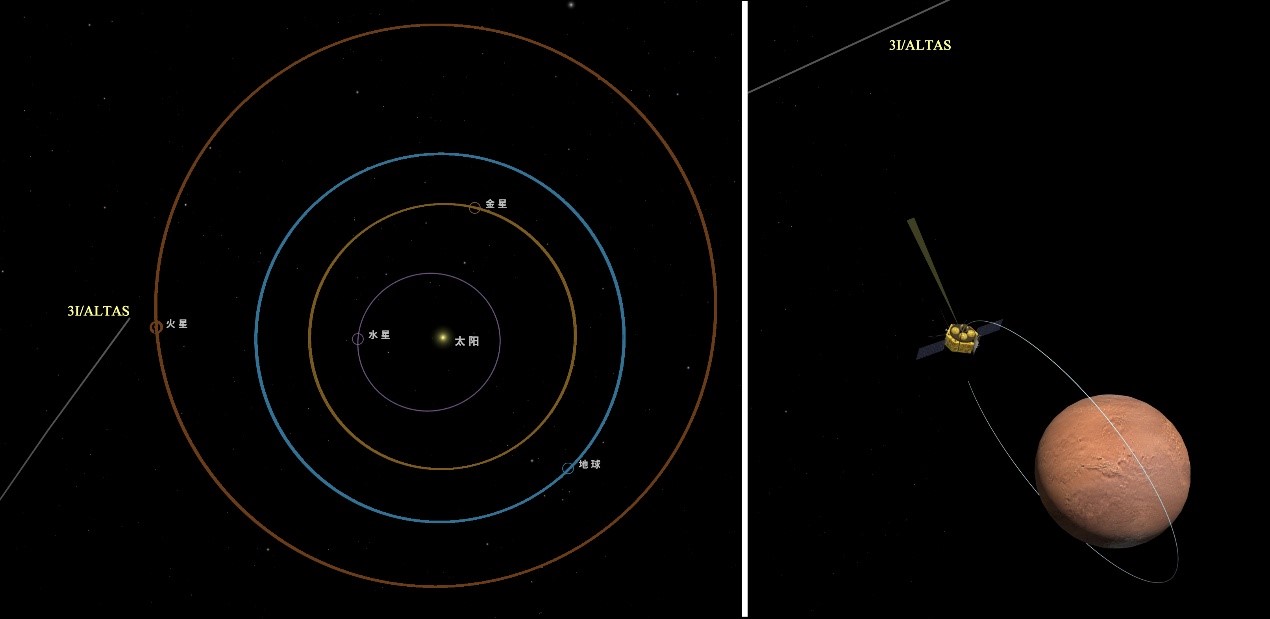
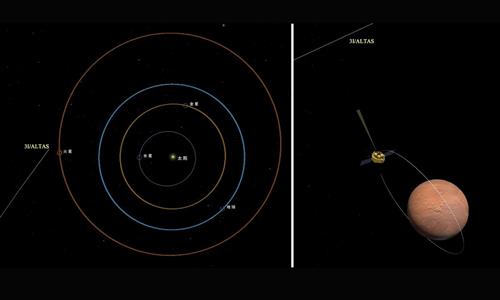
An illustration of the relative positions between Tianwen-1 probe's orbiter and the interstellar object 3I/ATLAS. Illustration: CNSA
China's Tianwen-1 Mars probe's orbiter used its high-resolution camera to successfully observe the interstellar object 3I/ATLAS. During the observation, the Tianwen-1 orbiter was approximately 30 million kilometers away from the target, making it one of the closest detectors to have observed this object to date, the Global Times learned from the China National Space Administration (CNSA) on Thursday.After Tianwen-1's data was received and processed by the ground application system, the images clearly revealed the comet-like features of the object, consisting of a cometary nucleus and its surrounding coma, with a diameter reaching several thousand kilometers, per the statement the CNSA provided to the Global Times on Thursday.
Researchers created an animation using a series of images taken over 30 consecutive seconds, vividly demonstrating the object's trajectory. Based on these observational data, scientists are conducting further in-depth studies on 3I/ATLAS, said the CNSA.

The image of the interstellar object 3I/ATLAS captured by the high-resolution camera onboard the Tianwen-1 probe's orbiter. Photo: Courtesy of the CNSA
The successful observation of 3I/ATLAS marks a significant step for Tianwen-1, read the CNSA statement. By utilizing the probe to observe faint celestial objects, it conducted technical tests for the asteroid exploration mission of Tianwen-2, accumulating valuable experience.3I/ATLAS was discovered on July 1, 2025, by a sky-survey telescope located in Chile. It is the third known interstellar object to visit the solar system, traveling through it along a hyperbolic trajectory.
This object may have formed around ancient stars near the center of the Milky Way, with an estimated age of approximately 3 to 11 billion years - potentially older than the solar system itself. It holds significant scientific value for studying the composition, evolution, and early stellar history of exoplanets, according to the CNSA.
The Tianwen-1 team began preparing for the Atlas observation in early September, the CNSA revealed.
The object's extreme distance (about 30 million kilometers), high motion speed (about 58 kilometers per second), even faster relative velocity to the Tianwen-1 orbiter, which is about 86 kilometers per second, and its small size (cometary nucleus diameter of approximately 5.6 km), as well as the fact that the object appeared extremely faint when observed from Mars orbit, making imaging extraordinarily challenging. This placed stringent demands on the orbiter's attitude pointing control and imaging strategy.
The optical payload aboard the Tianwen-1 orbiter was originally designed to image the bright Martian surface. This was the first attempt to capture such a distant and relatively dim target (10,000 to 100,000 times fainter than typical Martian surface targets).
This mission pushed the high-resolution camera's capabilities to the limit for such faint target's detection, said the CNSA.
Unexpected harvest
The Tianwen-1 probe entered Mars orbit in February 2021 and has been operating stably ever since.
Comet 3I/ATLAS isn't like any regular comet people might see in the solar system, media reported. Its trajectory is hyperbolic, meaning it doesn't follow a closed orbit around the Sun. This tells astronomers that the comet isn't bound by the Sun's gravity and is instead a visitor from deep space, from another star system.
It is massive in size and traveled at the highest speed ever recorded for such a rare interstellar object. Intrigued by its unusual composition and several unique features, astronomers across the world have been studying the comet since its initial observation.
Notwithstanding major disruptions from the US government shutdown, NASA has been monitoring the 3I/ATLAS as it moves through the solar system, per the DefenseScoop, a US tech news source.
Media reported that the comet is being tracked by several of NASA's most powerful instruments, including the Hubble Space Telescope and the James Webb Space Telescope.
Wang Yanan, chief editor of Aerospace Knowledge magazine, told the Global Times on Thursday that the observation made by Tianwen-1, which was "an unexpected harvest," carries great significance for advancing humanity's knowledge for studying exoplanets, and for laying down foundation for future asteroid exploration missions.
"Originally designed for Mars exploration, the Tianwen-1 was able to capture images of such a distant object from its orbit around Mars," Wang said. "This suggests that spacecraft launched to detect exoplanets could serve as new platforms for observing even more remote celestial bodies."
Wang noted that China's space program has consistently upheld the principle of sharing achievements with the international community. By pooling observational resources and information from major spacefaring nations, humanity can better understand this mysterious object.
Furthermore, the expert said in order to enable Tianwen-1 to image a non-primary target, orbital adjustments may be required; or at minimum, attitude adjustments. "Precise attitude control during orbital operations, possibly involving multi-axis coordination, is needed to align the optical sensors accurately with an extremely distant point and re-aim. This represents a comprehensive test of orbital observation and attitude control, which is an 'extra credit' challenge for the Tianwen team," Wang said.
"Such in-orbit precise adjustments of aligning sensors to a designated direction are essential skills for future asteroid exploration missions," the expert added.
RELATED ARTICLES