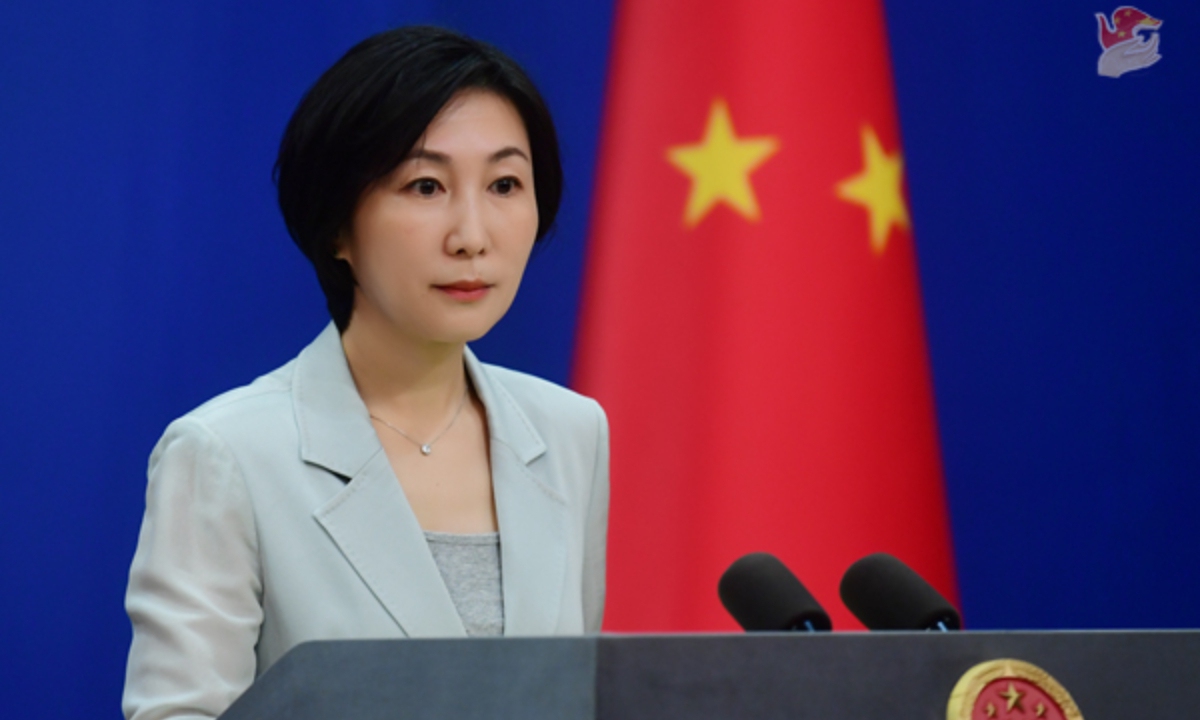
Foreign Ministry Spokesperson Mao Ning Photo: Ministry of Foreign Affairs
China's Foreign Ministry announced on Friday that Espen Barth Eide, Norway's minister of foreign affairs, will pay an official visit to China from November 10 to 11, at the invitation of Wang Yi, minister of foreign affairs and member of the Political Bureau of the CPC Central Committee.At a regular press conference on Friday, FM spokesperson Mao Ning further introduced the visit, saying that China welcomes Eide and sent congratulations to the Norwegian government immediately after it won a second term in power. Eide's visit to China not long after the election shows the importance Norway attaches to its relations with China, Mao noted.
Mao added that during the visit, the two sides will have an in-depth exchange of views on bilateral relations and international and regional issues of mutual interest. The visit will help consolidate mutual trust, enhance common understanding, deepen cooperation, and play an important role for the sustained, sound and steady growth of bilateral relations, said the spokesperson.
Following the Labour-led government's re-election in September, Foreign Minister Eide's swift post-election visit to China underscores Oslo's pragmatic, proactive, and priority-driven approach to bilateral ties, a Chinese expert told the Global Times on Friday, adding that amid global tensions, Norway is determined to maintain its economic independence and separate itself from EU trade barriers.
Sun Yanhong, a senior research fellow at the Institute of European Studies under the Chinese Academy of Social Sciences, told the Global Times on Friday that economic and trade cooperation will be one of the key priorities for the talks, with an emphasis on fishery and agricultural exports, the digital economy, and supply chain stability.
The discussions are also expected to cover investment facilitation, e-commerce and energy transition initiatives, she said.
"We have very positive development in the trade of seafood between Norway and China. China is now our third-biggest market for seafood exports. Now, we hope that we are going to be able to develop trade in agriculture as well," Norwegian Ambassador to China Vebjørn Dysvik told the Global Times during the 8th China International Import Expo (CIIE) in Shanghai on Thursday.
"We are working this week to bring Norwegian cheeses to China," he said. "More than anything we hope to bring our very famous brown cheese, which is sweet. Therefore, we call it caramel cheese, and we think it is going to be very popular in China," he added.
China is Norway's largest trading partner in Asia, according to data from the Ministry of Commerce. In 2024, bilateral trade reached $10.18 billion, a year-on-year increase of 31.7 percent. China's exports to Norway amounted to $4.99 billion, up 41.4 percent, while imports from Norway stood at $5.19 billion, up 23.5 percent.
During Norwegian Prime Minister Jonas Gahr Store's meeting with foreign journalists in Oslo on May 19, he said that Norway hopes to continue developing bilateral trade with China and engage in cooperation on major global issues such as artificial intelligence (AI) governance and climate change, Xinhua News Agency reported.
Previously, Minister of Climate and Environment Tore Sandvik said Norway will deepen its cooperation with China to advance both countries' green transition, Xinhua reported.
During last year's visit by Norway's prime minister, a joint statement establishing a dialogue on a green transition was signed, followed by the signing of a cooperation agreement on green and low-carbon development, Xinhua reported.
"Green development and innovation will also be among the key topics in the foreign ministers' talks, covering climate change mitigation, Arctic environmental protection and sustainable development, joint technological R&D, renewable energy (including offshore wind power and EV batteries), and biotech and health cooperation," Sun noted.
Sun cited electric vehicles as an example: nine out of ten new cars sold in Norway last year were battery-only, according to October registration data, putting the country on track to meet its 2025 goal of exclusively adding electric vehicles to its roads. Meanwhile, Chinese EV manufacturers have overtaken internal combustion engine vehicles in domestic sales and are reaching global markets with record exports.
These areas show the complementarity between the two countries - Norway's rich resources and cutting-edge technology paired with China's vast market and manufacturing capabilities - forming a high degree of synergy.
RELATED ARTICLES