China starts building 400-meter tower for atmospheric environment and meteorological observation, to open to global scientists
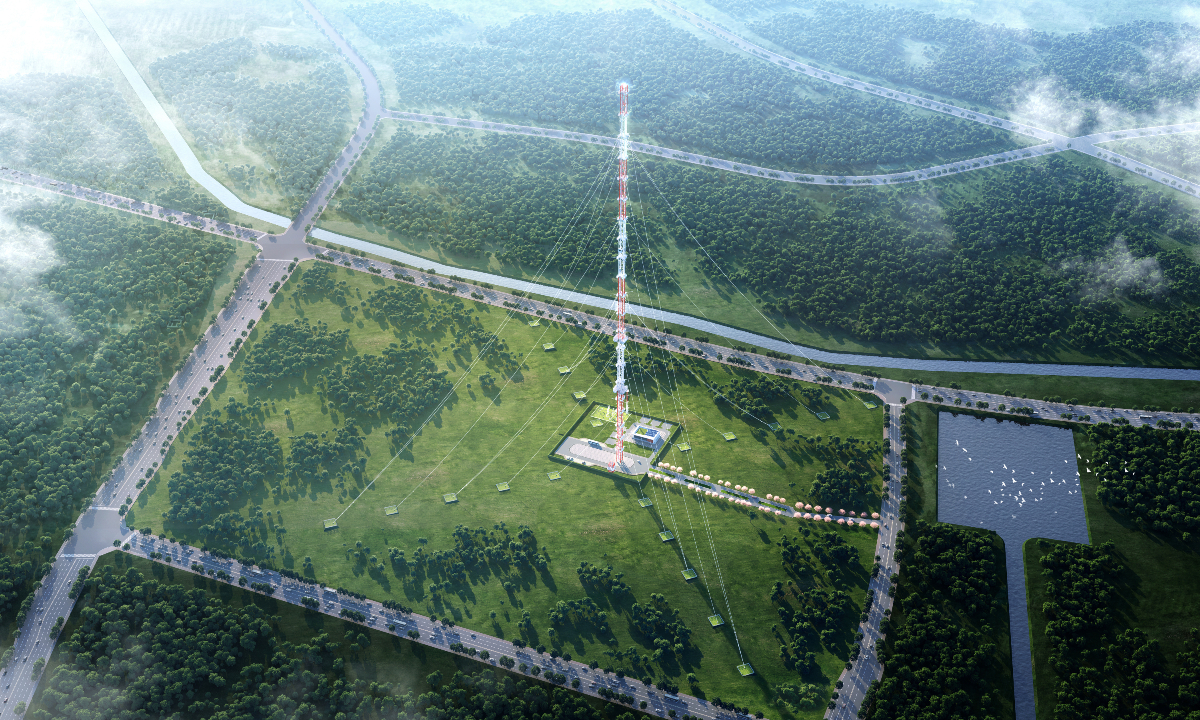
Aerial view illustration of the 400-meter atmospheric environment and meteorological gradient tower Luzhou Tower which begins construction in Hefei, East China’s Anhui Province, on November 9, 2025 Photo: Courtesy of the Hefei Institutes of Physical science, Chinese Academy of Sciences
China launches on Sunday the construction of a 400-meter atmospheric environment and meteorological gradient tower expected to strengthen the nation’s three-dimensional atmospheric observation capacity with the tower’s world-leading comprehensive observation capabilities, Xinhua News Agency reported on Sunday.
The meteorological observation tower is named Luzhou Tower (abbreviation of Laboratory for Unified Zenith & Horizon Observation of the Urban Atmosphere). Luzhou is also an ancient name of Hefei.
The tower is constructed by the Hefei Institutes of Physical science, Chinese Academy of Sciences, is located in the Hefei Comprehensive National Science Center and is expected to be built by September of 2027, according to Xinhua.
Once the tower is completed, scientists will carry out research on the distribution of air pollution and its evolution patterns, which is expected to provide a technical verification platform for the development of ground-based, airborne, and satellite atmospheric observation equipment and support the application demonstration and industrialization of domestic advanced atmospheric monitoring facilities, Xinhua reported.
According to the Hefei Institutes of Physical science, Luzhou Tower is a large-scale research facility with world-leading observation capacity featuring the integration of continuous online monitoring of the gradients of atmospheric pollutants, high-frequency fluxes of greenhouse gases, and most meteorological factors. It will be equipped with 23 fixed observation platforms and one experimental observation cabin capable of continuous vertical movement, Xinhua reported.
Dr. Gui Huaqiao, a fellow researcher at the Hefei Institutes of Physical science, said the Luzhou Tower will be built to the height exceeding 400 meters because near-surface atmospheric conditions are particularly complex. This makes it very difficult for scientists to continuously monitor atmospheric changes from the ground to high altitudes over a 24-hour period by using conventional observation facilities.
Near-surface air is closely linked to human activity, but human’s understanding remains limited due to the complex and variable atmospheric composition and meteorological factors, Gui told the Global Times on Sunday.
Once completed, the Luzhou Tower will allow precise and detailed study of atmospheric vertical structure and its evolution, help analyze regional air pollution formation and dynamics, interactions between air pollution and weather, assess regional carbon sink capacity, and enable precise calibration of atmospheric remote sensing equipment, Gui said.
According to Gui, after the tower is built, it will be open not only to Chinese scientists but also to researchers worldwide.
RELATED ARTICLES