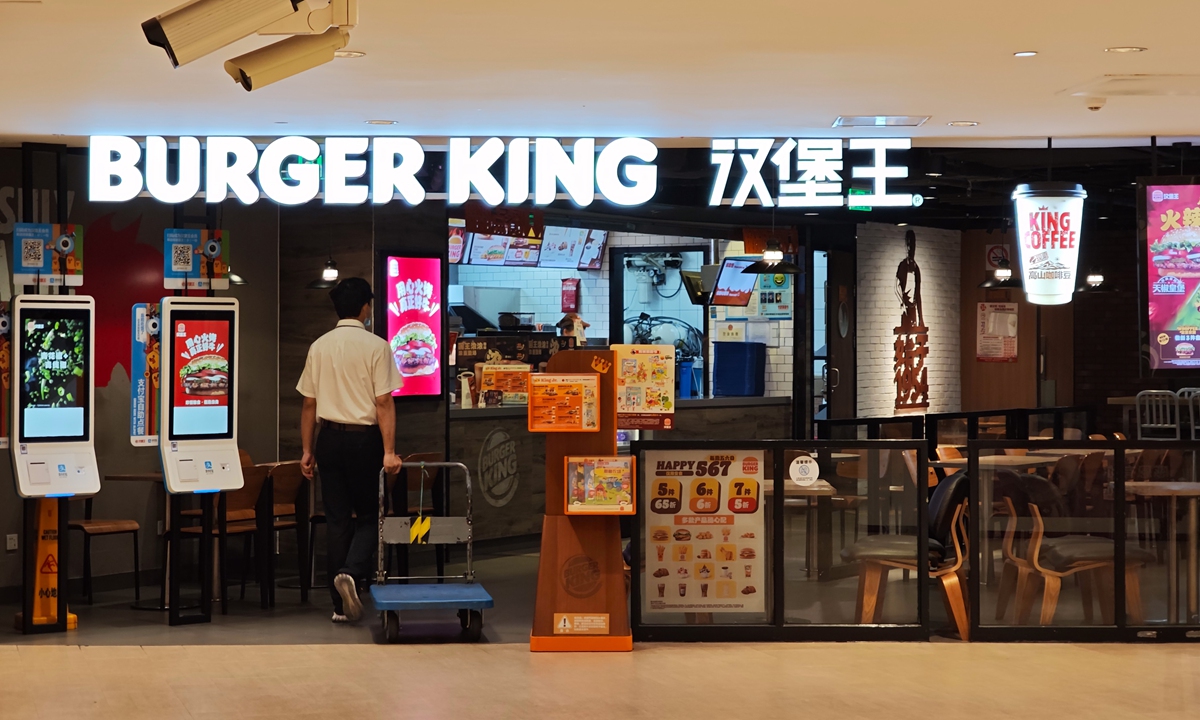
A Burger King outlet in a shopping mall in Shanghai's Huangpu District opens on June 24, 2025. Photo: VCG
CPE, a Chinese asset management company, announced on Monday a strategic partnership with the Burger King brand to establish a joint venture - Burger King China, marking the next phase of the brand's growth in the Chinese market, according to a statement by the company.
The Burger King brand is wholly owned by Restaurant Brands International (RBI). CPE will inject an initial investment of $350 million into Burger King China. Upon completion of the transaction, CPE will hold about 83 percent of the joint venture, while RBI will retain about 17 percent, per the statement published on CPE's official WeChat account.
This deal represents another major instance of Chinese capital partnering with an international F&B brand, following the announcement on November 4 that Starbucks Coffee entered an agreement with Boyu Capital to form a joint venture for Starbucks' retail operations in China.
Analysts suggest that the heightened competition from rising domestic brands and shifting consumer habits is prompting major international players to sell stakes, a strategic move to inject local capital and expertise, thereby boosting market agility and operational efficiency.
CPE's business focus on sectors like technology and industrials, consumer and healthcare, as well as infrastructure. The company has substantial experience in chain consumer services and has invested about 10 billion yuan ($1.4 billion) in related sectors.
Over the past decade, it has invested in several industry leaders including Chinese beverage company Mixue Bingcheng, Aier Eye Hospitacl, Lao Pu Gold, and trendy toy brand Pop Mart, per the statement.
Post-investment, CPE will assist Burger King China in driving product upgrades, brand marketing enhancements, offline store expansion, online channel restructuring, digital system development, and financial optimization to achieve leapfrog growth, the company said.
This year marks the 20th anniversary of Burger King's entry into China. The brand currently operates around 1,250 stores in the market. Under the joint plan, the partners aim to expand the store count to over 4,000 in China by 2035, the statement noted.
The transaction is expected to be completed in the first quarter of 2026, with the specific timing subject to the progress of the regulatory approval process, per the statement.
Mao Wei, Managing Director of CPE, said in the statement that, "Burger King is a globally renowned brand long favored by Chinese consumers. This investment demonstrates our confidence in its long-term growth potential in China."
Joshua Kobza, CEO of RBI, noted that "China remains one of Burger King's most attractive long-term growth markets globally. Our recent investments and this joint venture underscore our confidence in the Chinese market…We believe this partnership will fully unlock the growth potential of the business in China," according to the statement.
Since RBI took full ownership of Burger King China in February, the company has accelerated its localization efforts. Four executives with deep experience in China's F&B industry have joined the core management team. RBI has also completed over $100 million in strategic funding and was seeking a new local partner to invest in and operate the business, China Media Group reported in September.
Facing a highly competitive market environment, selling a stake to introduce local capital has become a common strategy for foreign consumer brands, analysts said. Just days ago, Starbucks announced forming a joint venture with Boyu Capital to operate its retail business in China.
Starbucks will retain a 40 percent stake in the JV and continue to own the Starbucks brand and IP, licensing them to the new entity. Boyu Capital will acquire its stake based on an enterprise value of about $4 billion, the company said in an official statement.
Industry analysis indicates that these moves are not merely changes in ownership structure but signify a deeper level of localization for foreign brands in China. Going forward, Sino-foreign joint ventures established to operate international brands in China could become a new trend.
Global Times
RELATED ARTICLES