Absurdity in global climate politics: West’s double standards on China’s green initiatives
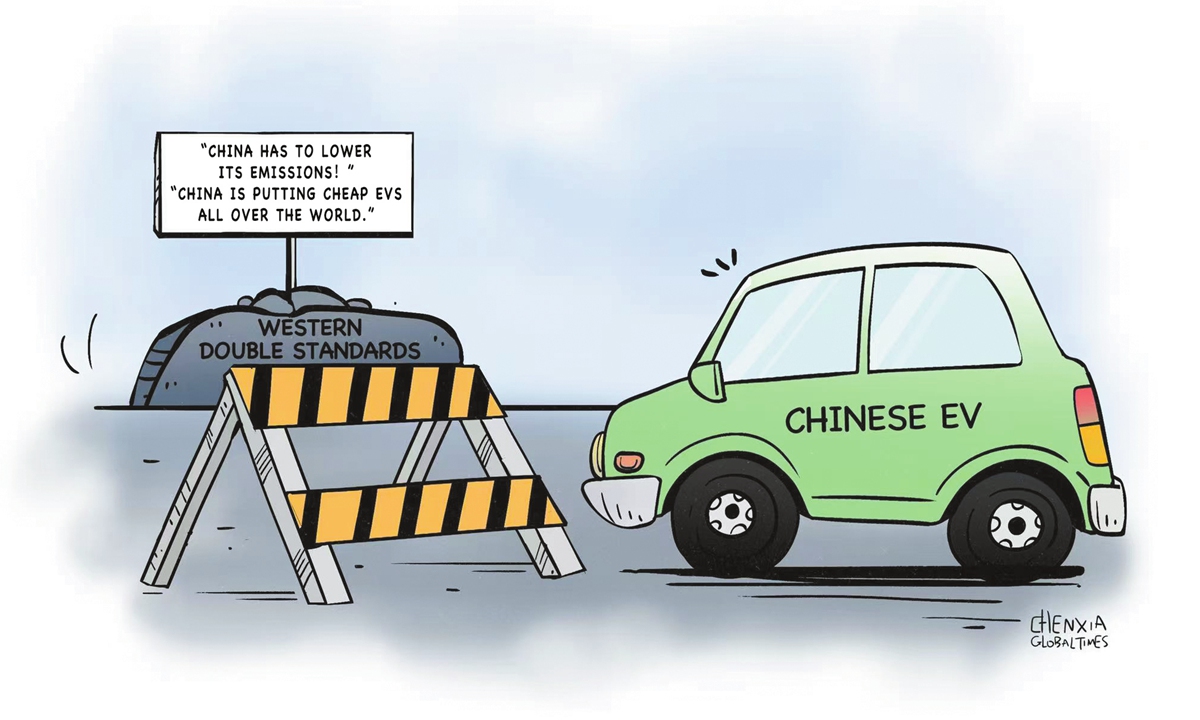
Illustration: Chen Xia/GT
"You can't insist that China has to lower its emissions" and then, later, "complain that China is putting cheap EVs all over the world." These frank words from COP30 President André Corrêa do Lago in a recent interview with The New York Times captures a long-standing absurdity in global climate politics: Some in the West apply blatant double standards toward China's green development, trapped in a self-contradictory mind-set.
In climate governance narratives, the West has long emphasized its historical and capability responsibilities, portraying itself as the architect of global climate rules and a financial supporter of developing countries' green transitions. Yet, years have passed and the gap between promises and action remains significant.
At the same time, these countries frequently demand that emerging economies, including China, "take on greater responsibility," while imposing trade barriers, conducting subsidy investigations and framing negative media narratives to restrict and pressure China's green industries. This contradiction shows that certain forces in the West are less concerned with the global climate future than with protecting their own interests in the emerging green competition.
These double standards stem from both industrial competitiveness anxieties and an institutional "sense of discomfort." On one hand, China's rapid progress in various areas has been considered as a threat to Western dominance in technology and industry, making them feel "surpassed" in the global green race for the first time. Meanwhile, the lack of confidence in the competitiveness of their own green industries has also become increasingly apparent among certain Western countries. As a result, for them, the issue of China's green development has transformed from a matter of global public interest into a weapon wielded to attack China.
On the other hand, certain Western countries, long accustomed to setting the rules and standards of global climate governance, find it difficult to accept that China - an emerging, non-Western country - is leading the green transition in a pragmatic and highly efficient manner. This sense of disorientation traps them in a paradox: They want China to shoulder more responsibility on tackling climate change while simultaneously seeking to curb its influence.
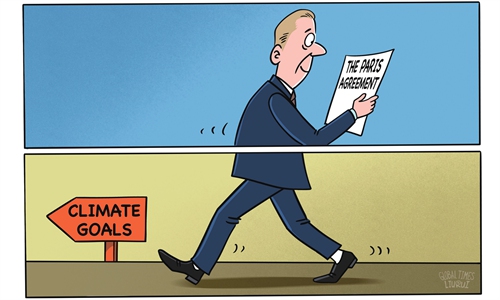
Observers of the current global green transition can see how this cognitive dissonance undermines the mutual trust necessary for climate cooperation and materially slows global progress. China produces more than 80 percent of the world's key solar component materials, and the widespread adoption of its electric vehicles (EVs) has significantly accelerated the decarbonization of global transportation. According to a recent report from the United Nations Environment Programme, to meet the temperature targets of the Paris Agreement, global greenhouse gas emissions must decline by 35-55 percent by 2035 compared with 2019 levels. Against this backdrop, unjustified restrictions on China's green products amount to self-imposed limitations on global emission reductions.
COP30 President Corrêa do Lago also highlighted China's contributions to global green development in his interview with The New York Times. "If you are worried about climate, this [the global expansion of Chinese EVs] is good news," he said. This acknowledgment confirms that Chinese EVs, a representative of China's progress in green industries, carry global value and represent a positive force in the green transition. Yet, as long as some in the West approach this force with skepticism, the path to spreading green technologies "faster, wider and more affordably" remains obstructed.
Corrêa do Lago's frank remarks should serve as a wake-up call. The world's climate governance is entering a critical window, and any politicization or instrumentalization of climate issues is a drain on humanity's collective future. If the West truly seeks progress, it must set aside its double standards, cease politicizing China's green efforts and work with emerging economies to advance a more inclusive and equitable framework for global cooperation.
RELATED ARTICLES