China-Central Asia education, research cooperation deepens as collaborative projects enhance regional friendship
By in Urumqi Published: Nov 13, 2025 03:32 PM

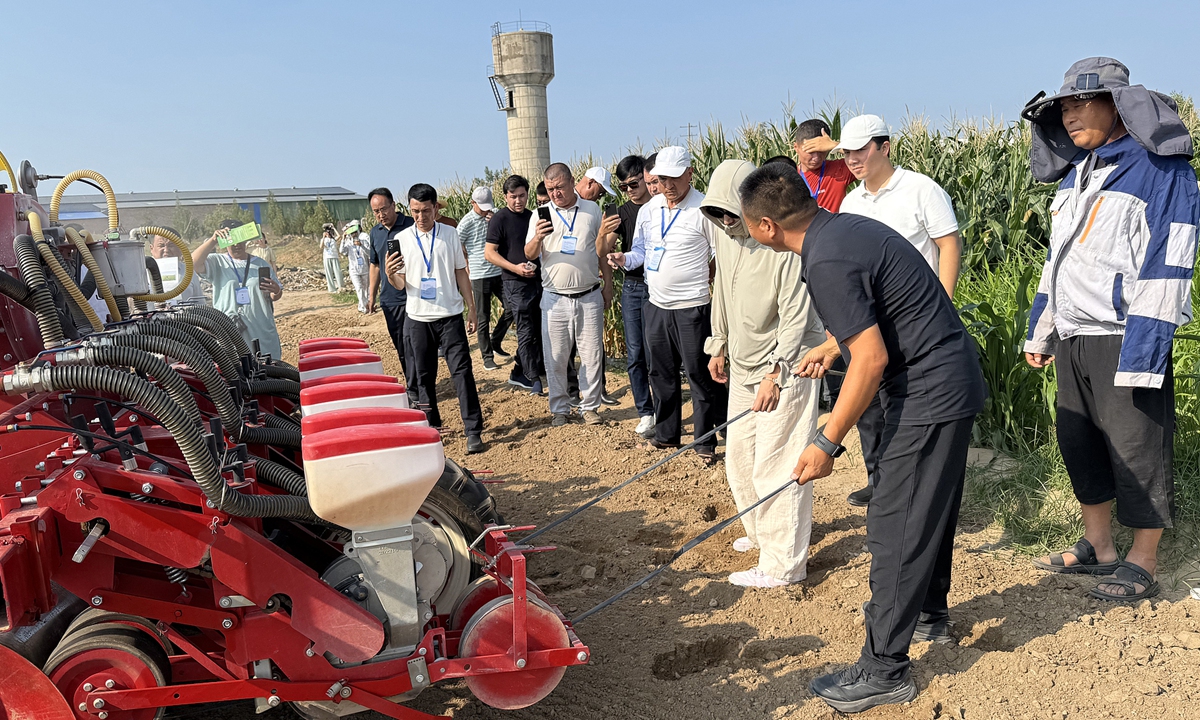
30 professional farmers from five Central Asian countries, including Kazakhstan and Uzbekistan, participated in an agricultural technology exchange at the Lisheng Carrot Cooperative in Dali county, Northwest China's Shaanxi Province, on July 12, 2025. Photo: VCG
When Zuhro Bodurova, a 19-year-old Tajik student, talked about her journey of learning Chinese and studying in China, she recalled that when she was a little girl, her family jokingly said she would be part of China, highlighting the cultural similarities between the two countries.Now, studying at Xinjiang Medical University, Bodurova said she really enjoys her life in Urumqi, Northwest China's Xinjiang Uygur Autonomous Region. For her, life in Xinjiang didn't feel distant or foreign; instead, she finds a sense of familiarity in the language, dance and music, which reminded her of home.
"I noticed that there are more students from my country [coming to study in China] this year. I think they are truly interested in studying abroad to gain better experiences and education," Bodurova told the Global Times.
Bodurova's story of studying in China is a small yet vivid reflection of the broader cultural exchange between China and Central Asia.
Within the flourishing tapestry of China-Central Asia cooperation, the vibrant presence of young people from Central Asia stands out. In recent years, an increasing number of young people from Central Asia have seized the opportunities provided by the growing China-Central Asia partnership to come to China for education and work. They actively participate in the exchanges and interactions between China and Central Asia, helping nurture the blooming friendship.
Closer partnership
Official data reveals that the annual number of Central Asian students studying in China grew at an average rate of 12.33 percent from 2010 to 2018, with the current tally exceeding 18,000, the Xinhua News Agency reported in June.
These students typically favor major cities such as Beijing, Shanghai and Xi'an, as well as the Xinjiang region, which is adjacent to their home countries, according to Xinhua. They engage in a broad spectrum of academic disciplines, ranging from literature, history and social science to natural science, medicine, and agriculture.
At the recently concluded 12th China-Central Asia Cooperation Forum in Urumqi, more than half of the 13 outcomes reached at the forum were related to educational collaboration.
These outcomes include a special agreement between Kashi University and Bishkek State University on undergraduate and postgraduate exchange programs; the establishment of a China-Kyrgyzstan joint laboratory for biological conservation by Xinjiang Agricultural University and the Institute of Biology of the National Academy of Sciences of Kyrgyzstan; and the joint construction of a Luban Workshop Industrial Robotics Training Center by Urumqi Vocational University and the Kazakhstan Academy of Logistics and Transport.
Educational cooperation between China and Central Asian countries spans multiple areas, including education, science, the economy and innovation.
An official from Turkmenistan's Ministry of Education said at the forum that the country is actively engaged in international educational cooperation, aiming to help young talents integrate into the global education system. This includes sending students to top universities in China for further studies. Currently, more than 6,500 Turkmen citizens are studying in China, of whom 250 are enrolled under the intergovernmental agreement between China and Turkmenistan, while the rest study in China through individual arrangements, he said.
Mustafo Safarov, special research assistant at the Xinjiang Institute of Ecology and Geography of the Chinese Academy of Sciences, arrived in Xinjiang earlier this year. "China is very advanced in remote sensing and satellite systems. For example, we've already started using China's BeiDou satellite system in Tajikistan to monitor mountain lakes," Safarov said, noting that he has learned a lot here about conducting field investigations using modern technology and high-quality satellite data, which is very important for Tajikistan's geographic research.
Looking ahead, Safarov sees even greater potential for joint research. "Collaboration between China and Tajikistan in science is expanding," he said. "Recently, the Ministry of Science and Technology of China announced new joint research projects with Tajikistan, which will support scientists from both sides in working together, sharing experiences and publishing high-quality papers. This is very important for scientific development."
Tackle challenges
In recent years, the number of Central Asian students studying in China has grown steadily, demonstrating greater diversity in academic majors, wider regional distribution, and an increasing share of self-funded students, Zhang Yuyan, associate professor of the Institute for Central Asian Studies of Lanzhou University, told the Global Times.
However, challenges persist. For example, changing language policies in Central Asian countries have created difficulties for international Chinese education, especially regarding the choice of instructional language, said Zhang, who has been closely following education cooperation between China and Central Asia.
"Relying on Russian or English as intermediary languages has become increasingly inadequate. Although Kazakhstan and Uzbekistan have incorporated Chinese into their national education systems, localized teaching models remain underdeveloped," Zhang explained.
Additionally, the competition among major powers in culture and education adds further complexity. As a multiethnic and multilingual region, Central Asia lies at the crossroads of influence from Russia, the US, Turkey, Japan, South Korea and others, she noted. "Each of these countries seeks to expand its linguistic and cultural presence through education," Zhang added.
RELATED ARTICLES