China unveils AI-powered tools at global Chinese language summit, eyeing cross-cultural ties
By Published: Nov 14, 2025 08:22 PM

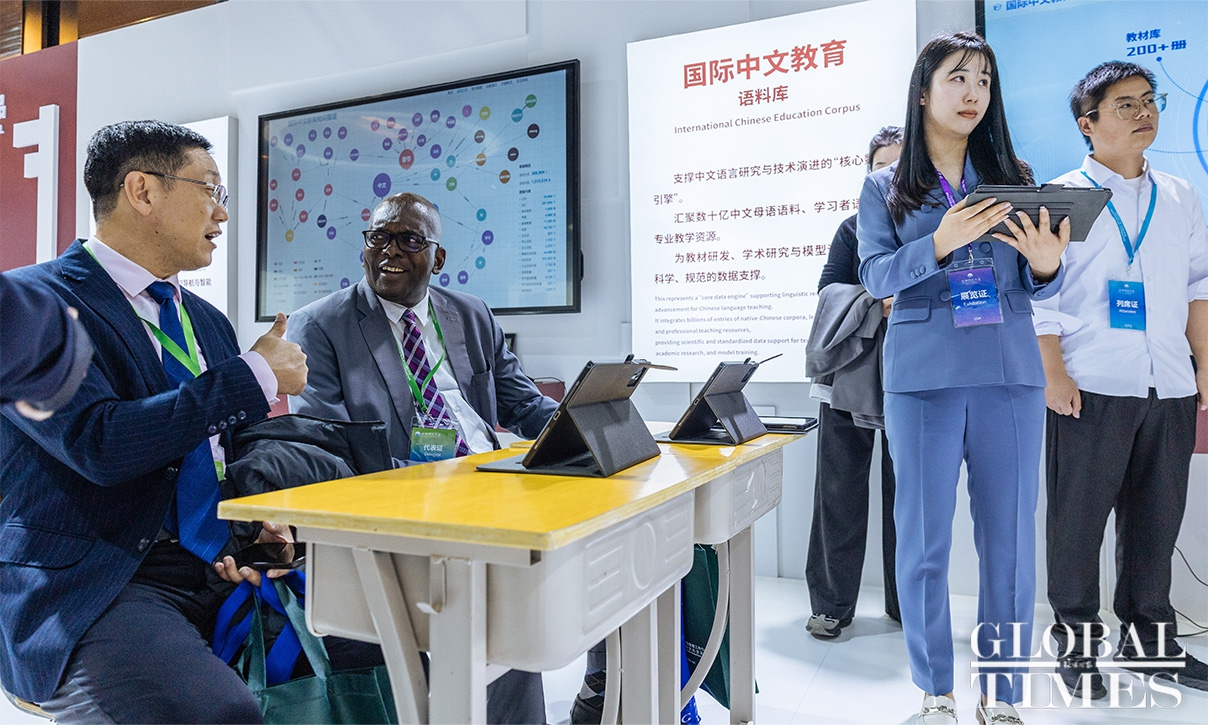
The 2025 World Chinese Language Conference, hosted by the Ministry of Education, kicked off at the China National Convention Center in Beijing on Friday, drawing nearly 5,000 participants from more than 160 countries and regions. Photo: Li Hao/GT
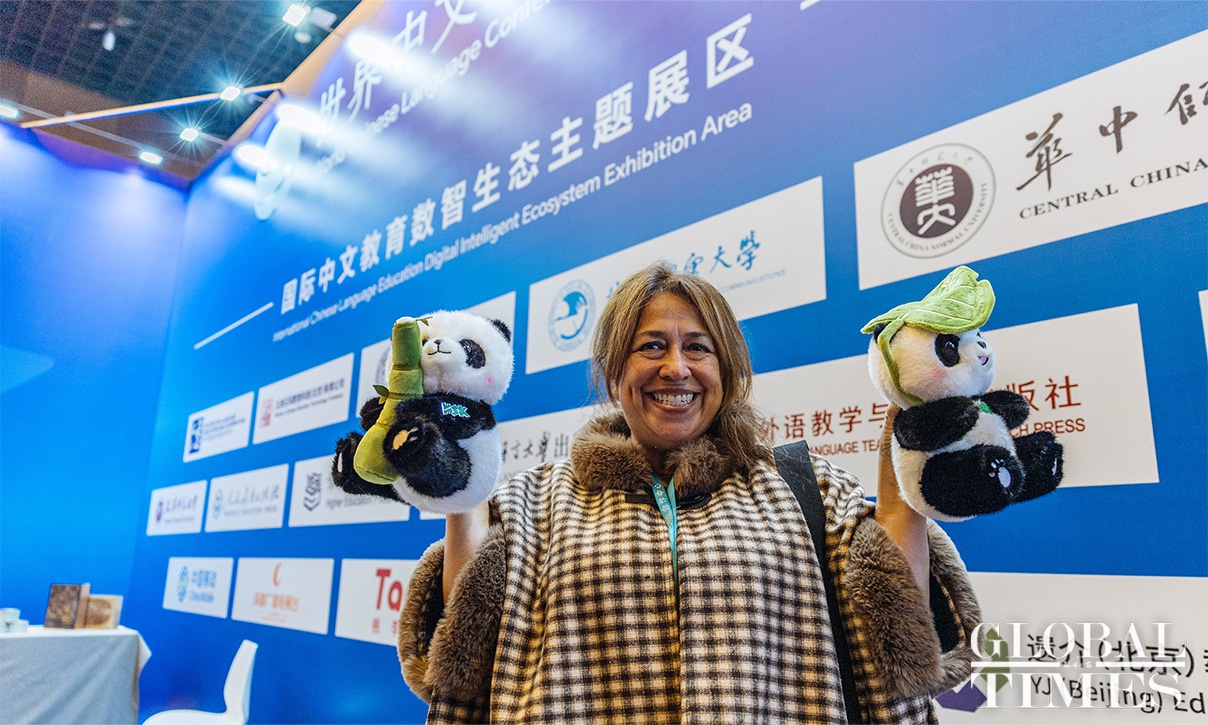
The 2025 World Chinese Language Conference, hosted by the Ministry of Education, kicked off at the China National Convention Center in Beijing on Friday, drawing nearly 5,000 participants from more than 160 countries and regions. Photo: Li Hao/GT
China unveiled a suite of artificial intelligence-driven tools for Chinese language education on Friday, marking a strategic advancement in global language learning technology during the opening ceremony of the 2025 World Chinese Language Conference that kicks off in Beijing, according to a press release that the Center for Language Education and Cooperation (CLEC) sent to the Global Times on Friday.
Under the theme "Innovation Leads, AI Empowers: Learning Chinese Without Borders," the event showcases how digital technologies are reshaping global Chinese education while reinforcing the language's role as a bridge for civilizational dialogue and practical development, per the release.
The conference opened with the demonstration of several groundbreaking technological resources, including the first knowledge graph centered on the standards system for international Chinese education, which integrates 380,000 language nodes and one million semantic relationships, creating an extensive multidimensional knowledge network.
Alongside this, a massive international Chinese education corpus aggregating billions of language data points supports multimodal queries and deep structural analysis, providing unprecedented resources for learners and educators worldwide.
Among the most anticipated releases was "HSK GO," an adaptive Chinese learning assessment product that offers personalized learning paths through AI-driven evaluation systems.
"The AI cloud platform, developed using data from 3,000 Confucius Institutes, generates lesson plans and PPTs instantly once HSK textbook parameters are set," a staff member told the Global Times at one exhibition, where some guests gathered around the demonstration booths.
The smart classroom concept, featuring virtual teacher "Xiao Yu," who can freely interact with international students, represents another significant innovation, combining voice synthesis, virtual humans, speech evaluation, and intelligent assessment technologies to create an immersive learning environment.
Product manager Hu Ziyong told the Global Times that these smart classroom solutions are primarily aimed at international schools and overseas institutions that lack qualified Chinese teachers, with several schools in Southeast Asia and the Middle East already expressing strong interest in their implementation.
Polish sinologist Aleksandra Półchłopek told the Global Times that she hopes China-Poland Chinese education cooperation can grow more open, practical and long-term academic-focused, stressing students' access to scholars, authentic materials and exchanges. She noted that digital tools help European students get previously difficult to access resources and aid scholars' collaboration, while combining traditional sinological training with digital resources cultivates new researchers.
Dario Famularo, an Italian lecturer at Sichuan International Studies University, views AI as a transformative but limited tool for Chinese learning. He told the Global Times that AI, as a "linguistic simulator," cannot replicate the essential human teacher's role. The cultural nuance, interpersonal connection, and guidance that bridge language with lived experience, he argues, remain uniquely human domains.
The opening ceremony also featured addresses from numerous international education leaders who emphasized the role of Chinese language as a crucial cultural bridge.
Eduardo Frei, former President of the Republic of Chile, stressed in his video speech that despite rapid technological advances in machine translation, human interaction through language remains the fundamental bond sustaining international relationships. He highlighted Chile's pioneering cultural exchanges with China, noting that the current enthusiastic participation of Chilean youth in Chinese studies reflects the deepening bilateral relations across all sectors.
Thailand's Education Minister Narumon Pinyosinwat connected Chinese proficiency with economic opportunity, revealing that over 30,000 Thai students are currently studying in China while more than 28,000 Chinese students are pursuing education in Thailand. She outlined ambitious plans to integrate AI into Thailand's national education system, describing artificial intelligence as "a catalyst for a new era of language education" that enables both teaching innovation and educational equity.
Egypt's Ambassador to China Khaled Nazmy drew fascinating parallels between ancient Egyptian and Chinese language as "symbolic systems that shaped civilizational identity." He emphasized the growing enthusiasm for Chinese studies in Egypt, where approximately 5,000 learners are currently studying Chinese, and positioned the emerging "Digital Silk Road" as a modern conduit for AI-enhanced cultural dialogue between the two ancient civilizations.
RELATED ARTICLES