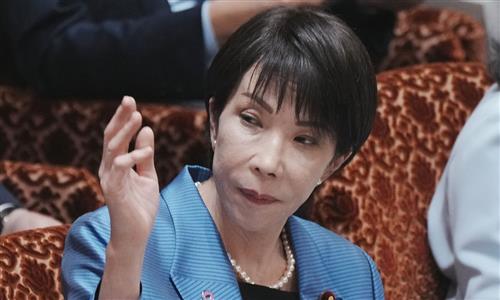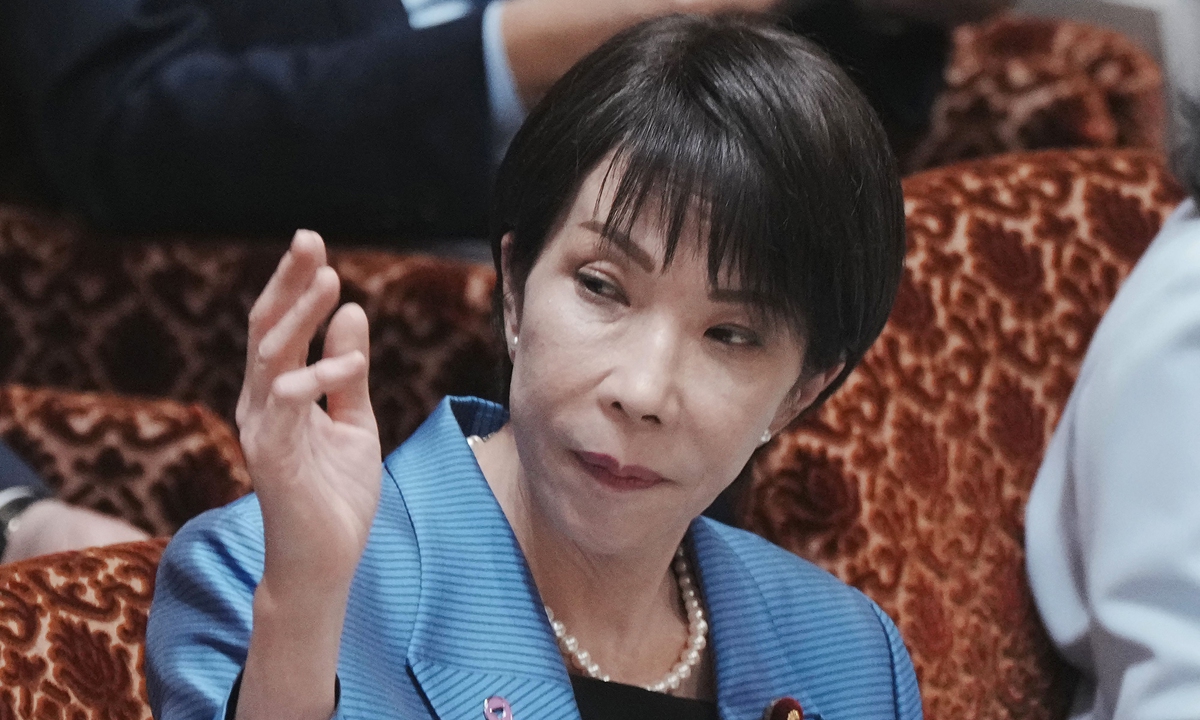
Japan's Prime Minister Sanae Takaichi raises her hand to answer a question during a session of the House of Councillors Budget Committee at the National Diet in Tokyo, Japan on November 12, 2025. Photo: VCG
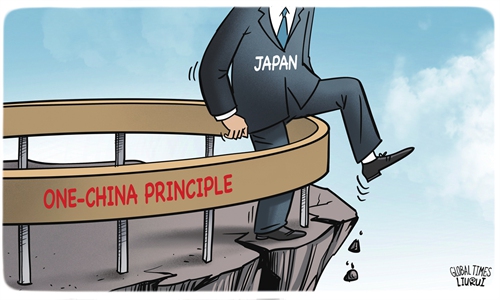
Sanae Takaichi's remarks on November 7 represent the most severe provocation regarding the Taiwan question since Japan's defeat in 1945. They mark the first time a Japanese leader has publicly asserted that a "Taiwan emergency is a Japanese emergency" and tied that claim to the exercise of collective self-defense, the first time a Japanese leader has expressed an ambition for armed intervention in the Taiwan question, and the first time a Japanese leader has issued a military threat against China.When meeting Japanese ambassador to China Kenji Kanasugi, who was summoned on Thursday, Chinese Vice Foreign Minister Sun Weidong sternly pointed out that Takaichi's statements were "extremely wrong and dangerous, which grossly violates the international law and the basic norms of international relations, seriously undermines the post-war international order, seriously goes against the one-China principle, the guiding principles set forth in the four China-Japan political documents, seriously undermines the political foundation of China-Japan relations, and seriously hurts the feelings of the Chinese people. " The use of "seriously" multiple times underscores the gravity of the situation and its consequences, voicing the shared stance of 1.4 billion Chinese people.
Taiwan is China's sacred territory, and Taiwan affairs are purely China's internal affairs - a fact widely recognized by the international community and an integral part of the post-World War II international order. In 1895, Japan seized the island of Taiwan through the Treaty of Shimonoseki and imposed 50 years of colonial rule, inflicting profound suffering on the compatriots of Taiwan. In 1945, after 14 years of arduous resistance, the Chinese people recovered Taiwan and resumed sovereignty over the island. This year marks the 80th anniversary of the victory of the Chinese People's War of Resistance against Japanese Aggression and the World Anti-Fascist War, as well as the 80th anniversary of the restoration of Taiwan. At such a moment, Takaichi's provocative remarks have undoubtedly reopened historical wounds - an act that will never be accepted by the 1.4 billion Chinese people, including our 23 million compatriots on the island of Taiwan.
Takaichi's blatant remarks carry dangerous signs of the resurgence of Japanese militarism. In recent years, Japan has consistently undercut its pacifist constitution, completely abandoning the principle of "exclusively defensive defense", and racing headlong down the path of militarization. Takaichi's linking of a "Taiwan emergency" with collective self-defense is precisely a despicable pretext for Japan's military expansion. Takaichi herself has frequently visited the Yasukuni Shrine, denied the Nanjing Massacre, and persistently promoted the "China Threat" theory. Each of her steps repeats the mistakes of history. How can this not make the peace-loving Chinese people and even the people of the world wary and angry?
Regarding Takaichi's dangerous actions, Sergei Shoigu, secretary of the Russian Federation Security Council, has criticized her, and former Japanese prime minister Shigeru Ishiba also explicitly stated on Thursday that he opposed Takaichi's so-called "survival-threatening situation" remarks concerning Taiwan made in the Diet. Former Japanese prime minister Yukio Hatoyama said on Saturday that "Japan should not interfere in China's internal affairs." Another former Japanese prime minister and now the leader of the Constitutional Democratic Party of Japan, Yoshihiko Noda, stated that he was "deeply shocked" by Takaichi's remarks, saying that he "sensed the danger of her acting rashly on her own." This fully demonstrates that such malicious words and deeds, which interfere in China's internal affairs and undermine regional peace and stability, are unanimously condemned and opposed by China, Japan, and the international community.
From the People's Liberation Army's iron resolve and unwavering will displayed during this year's V-Day military parade to the strategic deterrence embodied by the aircraft carrier Fujian - which signals China's capacity to deliver decisive strikes no matter how far the target is - China demonstrates firm determination, steadfast will, and formidable capability to resolutely defend its national sovereignty, unity, and territorial integrity. These strengths serve not only as a firm guarantee of justice and peace, but also as a powerful deterrent to any provocateur. Through a series of solemn statements, China has made its red lines clear to Japan and pointed the way toward a responsible path forward. China once again urges Japan to engage in deep reflection on its historical crimes, immediately reconsider and correct its errors, and retract its harmful remarks. Should Japan continue down this wrong path, it will bear full responsibility for all consequences. And let this be clear: Anyone who dares to interfere in China's cause of reunification in any form will be met with strong fightback from the Chinese side.
So do not say that we have not said in advance about the implications of this incident. Takaichi should be well aware of it.
The author is a commentator on international affairs. opinion@globaltimes.com.cn