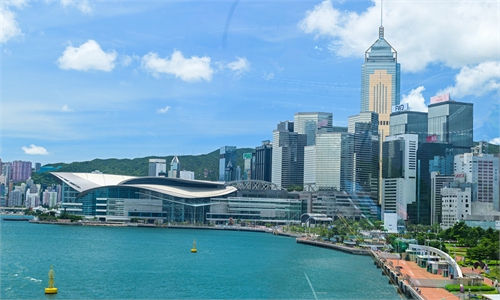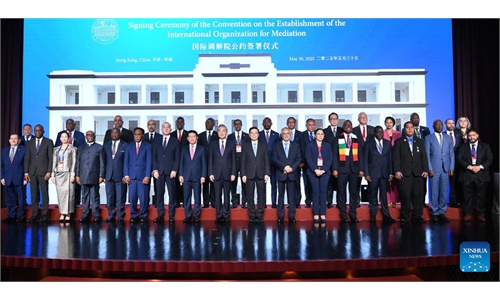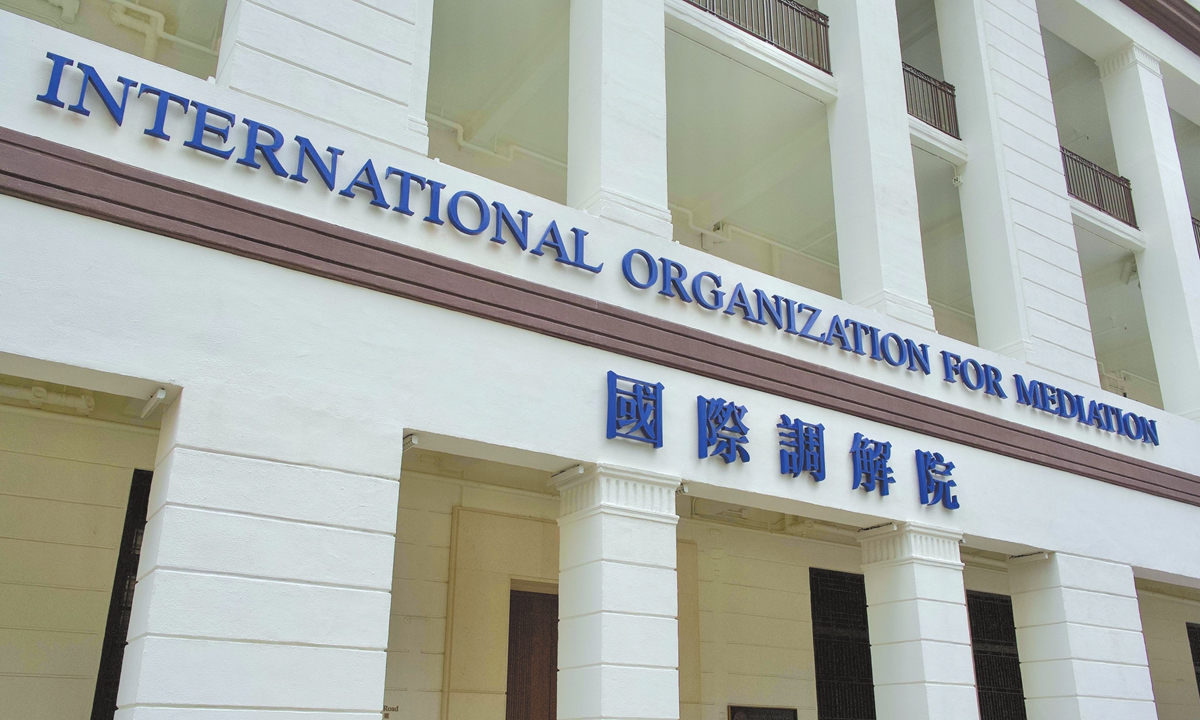
A view of the Interational Organization for Mediation in Hong Kong. Photos: VCG
Since the International Organization for Mediation (IOMed), headquartered in the Hong Kong Special Administrative Region, officially opened, it has drawn widespread attention. What kind of organization is the IOMed? What role will it play in the future global judicial order? Can it protect the legitimate rights and interests of China and Chinese enterprises while being impartial in dealing with disputes between China and other countries? Global Times (GT) reporters Bai Yunyi and Chen Qingqing recently talked to IOMed Secretary-General Teresa Cheng Yeuk-Wah (Cheng) over these issues in an exclusive interview.
GT: As the first Secretary-General of the IOMed, what are your main priorities after taking office? What specific plans or ideas do you have?
Cheng: I am deeply honored to serve as the inaugural secretary-general. My work will be carried out in three stages - short-term, medium-term and long-term.
In the short term, our priority is to strengthen internal organization and staffing. Based on that foundation, we will enhance the organization's recognition and visibility internationally. We plan to actively reach out to different countries and international organizations, and strive to obtain observer status in more multilateral bodies.
At the same time, we will vigorously promote mediation as a mechanism for dispute resolution. This includes improving our regulatory framework, selecting and training mediators, and better introducing and sharing our system and philosophy with the international community.
In the medium and long term, we hope the organization can play a constructive role in advancing the rule of law at the international level. We also aim to foster a "mediation ecosystem" where more people naturally turn to mediation - a peaceful and rational approach - as their first choice for resolving disputes and achieving win-win cooperation.
Finally, since our headquarters is located in Hong Kong, we hope to help the city develop into a global capital of mediation.
GT: The Convention on the Establishment of the International Organization for Mediation (the Convention) specifies three main categories of disputes under its jurisdiction: disputes between states, disputes between a state and a national of another state, and international commercial disputes between private parties. When handling such cases, will there be specific standards or limitations?
Cheng: The essence of mediation lies in mutual consent, so in handling cases, we always adhere to the fundamental principle of party autonomy.
For state-to-state disputes, if both parties agree to submit a territorial dispute to the IOMed, we can accept the case.
For disputes between investors and host states, which often arise in the field of resource development, as long as both sides agree, we can also take such cases.
The third type is international commercial disputes. This is a broader category - as long as the dispute has a cross-border element, it can fall within our jurisdiction.
It's also worth noting that under the Convention, cross-border disputes arising within one country but across different legal systems are also within our scope. For example, in China's Guangdong-Hong Kong-Macao Greater Bay Area, although it operates under the "one country, two systems, three legal jurisdictions" framework, if both parties consent, such cross-border disputes can also be submitted to the IOMed.
That said, the Convention also sets certain limits on our jurisdiction. According to Article 29, each contracting state has the right to establish specific reservations or limitations. In addition, for state-to-state disputes, if the case involves a third country that has not given its consent, we will not accept the case.
This approach not only safeguards the sovereignty of each state, but also fully embodies the IOMed's respect for the principle of party autonomy.
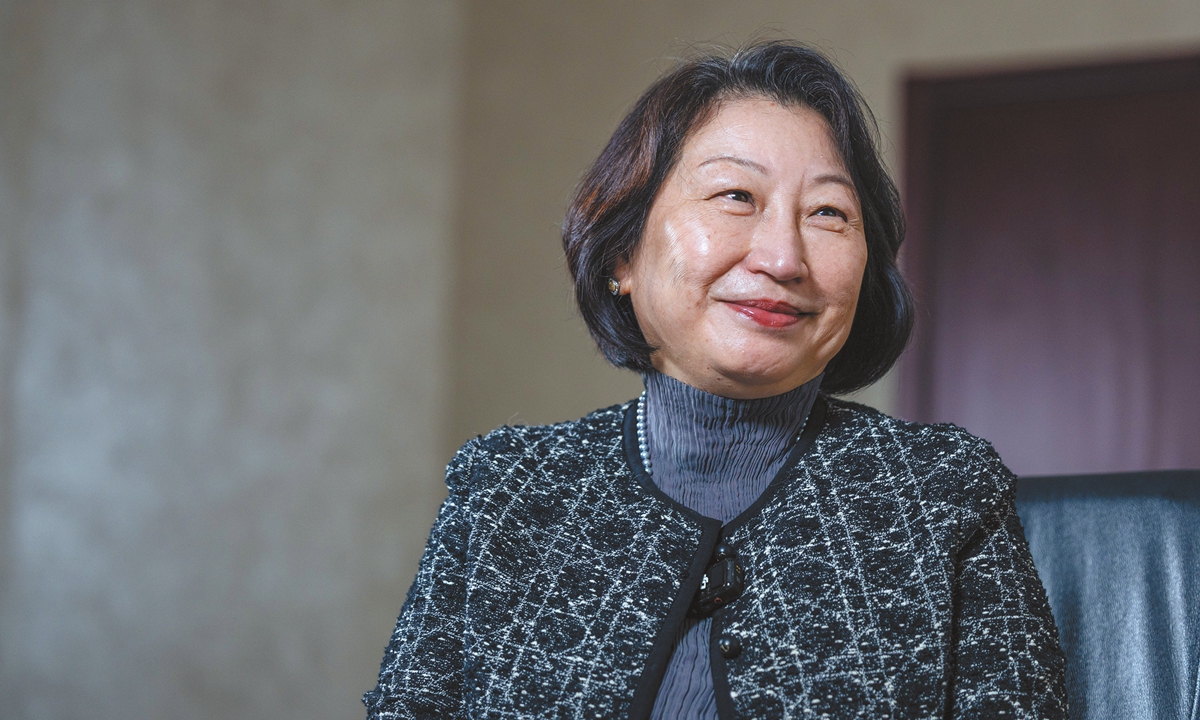
Photo: Li Hao/GT
GT: Will the IOMed prioritize handling disputes in certain areas or regions, such as those involving Global South or Belt and Road countries?
Cheng: We will not set any specific priorities, as we expect to have a sufficient number of mediators in the future. Once a case is submitted to us, we will handle it with full dedication, fairness and impartiality.
That said, in practice, I anticipate that commercial and investment-related disputes may be more common. In particular, for Belt and Road cooperation projects, if disputes arise, we hope to use mediation - in line with the principles of "extensive consultation, joint contribution and shared benefits" on which the Belt and Road Initiative is founded - to help parties find mutually beneficial solutions.
GT: Comparisons have often been made between the IOMed and the International Court of Justice (ICJ) and the Permanent Court of Arbitration (PCA) in The Hague. Given the latter two's long history and global influence, how do you see the IOMed establishing its unique position and competitive edge?
Cheng: As stated in Article 33 of the UN Charter, mediation has long been recognized as an important means of peaceful dispute settlement. Yet, even as the United Nations marks its 80th anniversary this year, the international community has lacked a dedicated institution specializing in mediation. The establishment of the IOMed fills this institutional gap.
Beyond litigation and arbitration, the IOMed provides parties with more options. This means the international community now has three main mechanisms for resolving disputes between states or other parties, offering greater flexibility and better pathways to peace and cooperation.
GT: One persistent challenge faced by institutions like the ICJ and the PCA has been enforcement. Even when rulings or awards are made, they can be difficult to implement. Since the IOMed doesn't have its own enforcement body, how do you plan to address this issue?
Cheng: That's an excellent question - and it highlights one of mediation's greatest strengths: The parties control both the process and the outcome. In other words, a settlement agreement is reached only when both sides agree. This means the final result is one that both parties can accept and feel satisfied with.
By contrast, litigation or arbitration produces a "winner" and a "loser," which can make the losing side reluctant to comply. Mediation outcomes, being voluntary and mutually agreed upon, have a much higher rate of voluntary compliance.
In terms of formal mechanisms, the UN adopted the Singapore Convention on Mediation in 2018, which provides a legal framework for enforcing international commercial settlement agreements. Under this convention, a signed mediation agreement can be recognized and enforced directly in any member state.
Moreover, a mediation agreement itself carries the legal effect of a contract. If one party fails to perform, the other can seek enforcement through national courts based on breach of contract.
GT: How does the IOMed reflect the voice of the Global South? What impact do you think this has on the international rule of law framework?
Cheng: The rule of law in the international community requires a fair and trusted dispute resolution mechanism. The establishment of the IOMed itself is a manifestation of multilateralism. The IOMed provides the international community with a public and efficient platform where all parties can resolve differences through dialogue and consultation.
This is a positive initiative for advancing the rule of law and the development of international relations. Mediation is non- adversarial; it has no winners or losers. Mediation results in a win-win situation. After mediation, both parties can maintain good relations and continue cooperation, which is of great significance for maintaining peace and stability in international relations.
GT: Currently, the member countries of the IOMed primarily come from Asia, Africa and Latin America. As the organization grows and develops, will you consider inviting more developed countries to participate, such as European and North American countries?
Cheng: The IOMed is an open and inclusive international organization, and we warmly welcome more countries to join. At this stage, the institute is still in its early stages of development. As of now, 38 countries have signed the Convention, with eight countries having completed the ratification process. The progress has been quite rapid, which clearly demonstrates the international community's attention to and trust in the mediation mechanism.
One of my short-term priorities is to enhance understanding of the IOMed among more countries. We will actively engage with already contracting parties and those that are yet to join and work to expand the organization's influence and reach.
GT: International public opinion may wonder how the IOMed, initiated by Beijing and established in the Hong Kong Special Administrative Region, will manage to truly maintain neutrality and fairness when handling disputes between China and other countries. How will you and the organization respond?
Cheng: I think the first step is to understand the nature and positioning of the IOMed.
First of all, it is true that the establishment of the IOMed was initiated by China, but after China's initiative, 18 other countries participated in the preparatory work for the organization and the negotiations of the IOMed Convention. Ultimately, through multilateral consultations, the organization was formally established by the Convention. Therefore, it is not an organization led by any one country, but an international organization established through the joint efforts of many countries. The Convention also clearly states that the IOMed is an independent international organization, not subordinated to any single country.
So, if you understand the process of the organization's establishment and its service targets, you will realize that the IOMed is not led by any single country, and the location of its headquarters does not lead to bias. Our mediation services are impartial, and the mediators come from different countries, all being international first-class professionals who adhere to the principles of voluntariness and fairness, helping both parties reach reconciliation through mediation. The IOMed is a fully independent and international organization.
GT: How do you think Hong Kong's "one country, two systems" framework can support the operation of the organization? What else can the IOMed bring to Hong Kong?
Cheng: Hong Kong has many advantages, such as strong international competitiveness, a highly internationalized talent pool and a well-established rule of law. These advantages have made Hong Kong a long-standing center for international law and dispute resolution, and it has implemented various policies to support this. Therefore, Hong Kong is an ideal location for the headquarters of the IOMed.
By having China as the host country and establishing the IOMed's headquarters in the Hong Kong Special Administrative Region, it not only reflects the institutional advantages of the "one country, two systems" framework but also fully utilizes Hong Kong's various strengths.
RELATED ARTICLES