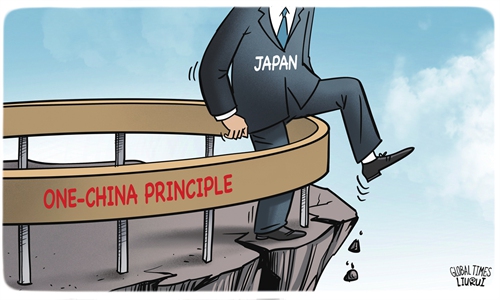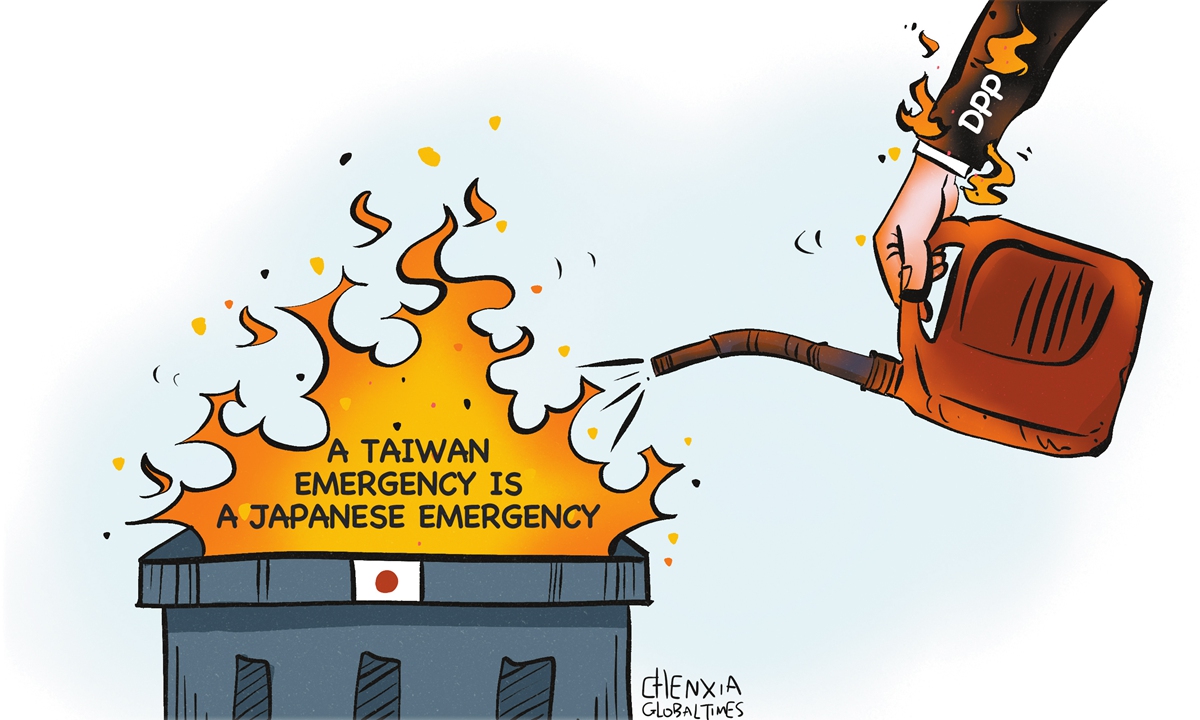
Illustration: Chen Xia/GT
On Monday, when responding to the recent China-Japan spat over Japanese Prime Minister Sanae Takaichi's wrongful Taiwan remarks, Taiwan regional leader Lai Ching-te publicly called on the Chinese mainland to "exercise restraint" and "demonstrate the conduct of a major power." He warned against the mainland becoming a "troublemaker" in regional peace and stability, while urging it to "think twice." Clearly, the Democratic Progressive Party (DPP) has chosen to endorse Takaichi's provocative rhetoric, which is making Taiwan appear increasingly vulnerable in an already precarious regional environment.
Takaichi recently claimed that the Chinese mainland's "use of force on Taiwan" could constitute a "survival-threatening situation" for Japan, implying the possibility of armed intervention in the Taiwan Straits. These remarks constitute a blatant interference in China's internal affairs. As a result, the Chinese mainland has issued strong protests and stern warnings through multiple channels, including summoning the Japanese ambassador to China, conducting a patrol in the territorial waters of China's Diaoyu Islands and warning Chinese students and tourists over rising safety risks in Japan.
On the contrary, instead of expressing proper vigilance, the DPP has downplayed the severity of this threat. Shortly after Takaichi made the inflammatory remarks on Taiwan, DPP "caucus whip" Chung Chia-pin even "thanked" the Japanese leader for "carrying forward former prime minister Shinzo Abe's stance that 'a Taiwan emergency is a Japanese emergency.'" It is clear that the DPP's response is serving as a political megaphone to amplify an improper narrative from Tokyo regarding the Taiwan question, thereby preventing Taiwan society from fully understanding how Takaichi's remarks could push Taiwan toward extreme risk.
The blood-stained memory of Taiwan under decades of Japanese colonial rule underscores how sensitive any foreign military intervention - even an implication - in Taiwan island's security is. Despite this, the DPP has failed to exercise caution, and in some cases has even sought to deflect attention toward the mainland, implicitly rationalizing or softening the implications of Takaichi's claims. This deliberate disregard for Japanese colonization constitutes a stark betrayal of history.
Takaichi's wrongful remarks have also sparked widespread criticism and rebuttal within Taiwan. Former chairperson of the Kuomintang (KMT), Ma Ying-jeou, emphasized that cross-Straits issues should not be subject to foreign intervention. In addition, Hung Hsiu-chu, another former KMT leader, accused Takaichi of making remarks that may push Taiwan to the brink of danger, noting that this reveal the lingering shadow of Japanese militarism. Besides, a joint statement was released by several pro-reunification groupings on the island on Monday, asserting that Taiwan is not Japan's shield and Takaichi's rhetoric serves Japan's strategic escalation, not Taiwan's interests. These voices, in fact, reflect the majority of Taiwan society, which hopes to preserve peace in the Taiwan Straits.
Yet, the DPP has selectively ignored such opposition, with Lai even calling on Taiwan politicians, particularly opposition figures, to "respect Japan's domestic politics." Such a response poses a greater threat to the correct understanding and due focus on the issue. One must ask: Shouldn't Lai, as the Taiwan regional leader, first respect the will of the Taiwan people? Placing "respect for Japan" above "respect for Taiwan" raises serious questions about his real values.
Taiwan's public opinion must cultivate a clear awareness of the risks inherent in Takaichi's remarks. It should recognize that Tokyo's so-called "Taiwan protection" narrative is not intended to safeguard the island but to advance Japan's own strategic ambitions. Taiwan is positioned merely as a forward buffer and a disposable chess piece.
Continuing to endorse the wrongful idea that "a Taiwan emergency is a Japanese emergency" will lead to "Taiwan independence" separatists' illusion of "external protection" and, thus, their continuation of provocations against the Chinese mainland. This will place Taiwan in an increasingly perilous position. In such a dangerous political gamble, can the island withstand the potential consequences that may come? This is a reality that Taiwan society must think twice about.
RELATED ARTICLES