Instead of ‘damage control,’ Japan should seriously reflect on its provocations on Taiwan question
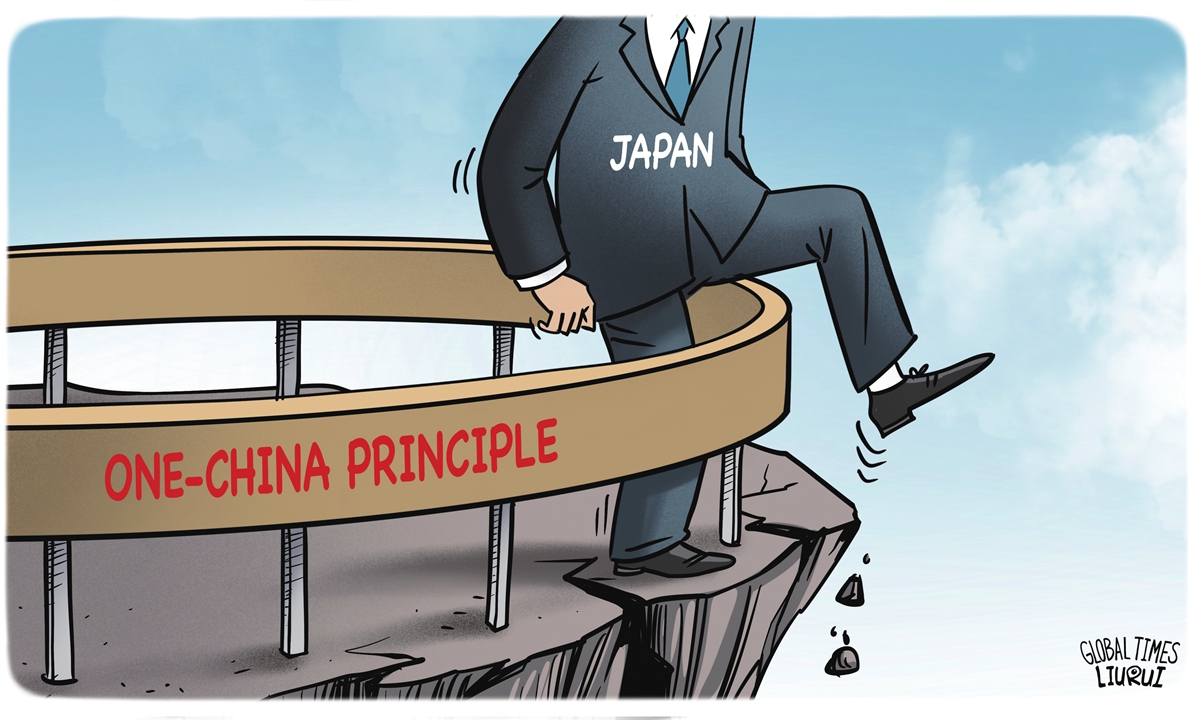
Illustration: Liu Rui/GT
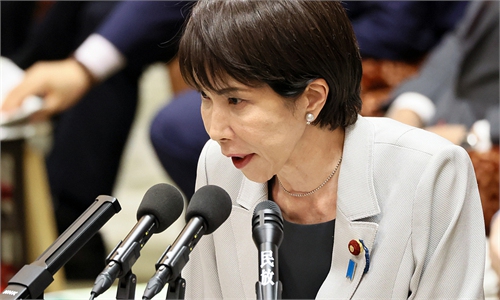
Japanese Prime Minister Sanae Takaichi recently made alarming remarks regarding the Taiwan question, suggesting that Japan might intervene militarily in the Taiwan Straits. These statements drew sharp criticism from some Japanese politicians and major media outlets, as well as strong protests from China. On Wednesday, Chen Binhua, spokesperson for the State Council Taiwan Affairs Office, urged Japan to "deeply reflect on history, draw lessons from history, strictly adhere to the one-China principle and the spirit of the four political documents between China and Japan, honor its political commitments on the Taiwan question, and exercise extreme caution when handling Taiwan-related matters."
Under mounting domestic and international pressure, it seems that Japan's Chief Cabinet Secretary Minoru Kihara swiftly attempted to "put out the fire" on Tuesday, saying that "peace and stability in the Taiwan Straits are crucial for Japan's security and the stability of the international community," and reiterating the Japanese government's "consistent position to hope for a peaceful resolution through dialogue," according to Asahi Shimbun.
Lü Chao, president and associate professor at the Institute of American and East Asian Studies at Liaoning University, told the Global Times that Kihara's remarks were clearly aimed at "damage control" and "cooling tensions," but for the Japanese government, it is imperative that Takaichi formally retract her erroneous statements to mitigate the negative fallout.
The Japanese government should understand the stance it should uphold on the Taiwan question and recognize that the Taiwan question is at the core of China's core interests - a red line that must not be crossed.
Takaichi needs to recognize the importance of her position as prime minister and the responsibilities that accompany it. She should not overstep the line in provoking China, nor should she push Japan toward a strategic confrontation or even a war with China that Japan cannot afford.
Some Japanese politicians have long been "playing with fire" on the Taiwan question, sending mixed signals and flirting with danger, which exposes a troubling pattern of inconsistency within the government and deliberately ambiguous statements toward China.
Noticeably, Takaichi's unprecedentedly wrongful and reckless remarks have also sparked widespread criticism within Japan. Former Japanese prime minister Yukio Hatoyama publicly condemned Takaichi on social media platform X, emphasizing that "Taiwan is an internal political issue for China, and Japan must not get involved." On Tuesday, Japanese media outlet Jiji Press reported that Hiroshi Ogushi of the Constitutional Democratic Party of Japan called on Takaichi to withdraw her remarks.
Nikkei Asia noted that by making such remarks, Takaichi should "be more circumspect" when discussing the matter in parliament. Tokyo Shimbun even questioned whether Takaichi fully understands the severity of a prime minister making such remarks, labeling her comments as "extremely reckless and imprudent."
The criticism from opposition parties and Japanese media underscores two key points. First, there are still some clear-headed voices within Japanese society who fully recognize that crossing China's red line poses serious risks to Japan. Second, in the eyes of Japan's peace-loving public, Takaichi's remarks are both dangerous and unacceptable.
Takaichi's misguided remarks are part of a broader pattern. In recent years, some Japanese officials have repeatedly tested China's red lines. This accumulation of missteps has fueled anti-China rhetoric among domestic right-wing media and opinion leaders. Left unchecked by the government, these extreme voices have proliferated, damaging Japan's reputation and hindering China-Japan relations. What Japan truly needs now is not mere perfunctory excuses, but a clearer, more unified, and responsible stance toward China - one that approaches the Taiwan question with greater caution.
To truly correct its course, Japan must begin with an accurate recognition of history. Japan committed crimes in history against the Chinese people on the Taiwan question; during its 50 years of colonial rule over the Taiwan region, it committed innumerable crimes. Today, the Japanese government should learn from history, cease engaging in dangerous political provocations, and return to a constructive and stable policy toward China.
RELATED ARTICLES