SK assembly speaker urges Japan to show sincere reflection on history, territory issues; experts warn Takaichi's provocations threaten NE Asian peace
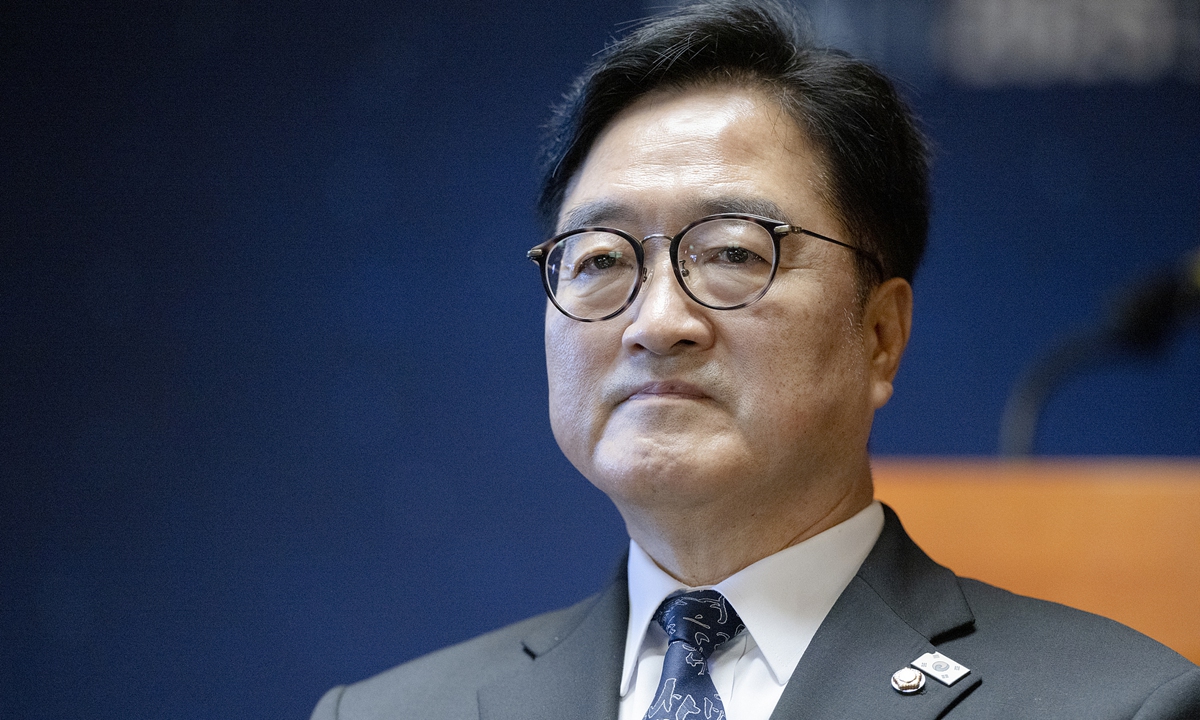
South Korea's National Assembly Speaker Woo Won-shik attends the National Assembly Joint Declaration Ceremony for Social Dialogue at Sarangjae Hall in the National Assembly in Yeouido, Seoul, South Korea, on October 15, 2025. Photo: VCG
South Korea's National Assembly Speaker Woo Won-shik has expressed concern over Japan's recent remarks and actions regarding historical and territorial issues between South Korea and Japan, urging Japan to demonstrate sincere reflection and a responsible attitude. This has drawn wide attention from Chinese media on Tuesday, with Chinese experts saying that Japan's recent provocative actions pose a threat to the momentum of peaceful multilateral development in the Northeast Asian region.
Woo posted on social media X on Saturday, stating that Japan's recent acceleration in advancing constitutional revision will transform Japan into a "war-capable nation," which is concerning. This action undermines the foundation of the East Asian peace order established on the basis of historical reflection, and not only South Korea but also neighboring countries absolutely cannot tolerate it.
We must never forget that without sincere efforts to resolve this issue, all cooperation amounts to nothing more than a castle in the air, he stressed.
In response to Japanese Prime Minister Sanae Takaichi's recent claim that Dokdo is Japanese territory historically and under international law, Woo said on social media that the Japanese government has expanded the "territorial sovereignty exhibition hall," which asserts sovereignty over the Dokdo islets.
Since the opening of the hall in 2018, South Korea has continued to demand its closure, but Japan added an educational space to the hall recently in an apparent attempt to instill incorrect perceptions in future generations, he said.
"For a future-oriented and stable relationship between (South) Korea and Japan, three pillars must stand firm: facing the painful history squarely, deepening economic cooperation and cooperating as partners for peace on the Korean Peninsula and in Northeast Asia," Woo said.
South Korea has long protested against Japan's renewed territorial claims to the disputed islets lying halfway between the two countries, called Dokdo by South Korea and Takeshima by Japan.
South Korea restored its sovereignty over Dokdo after the Korean Peninsula's liberation from the 1910-45 Japanese colonization. Seoul has since been in effective control of the islets, with a small police detachment deployed, the Xinhua News Agency reported.
According to Japanese media NHK news on Monday, Japanese and South Korean government sources have told NHK that Seoul notified Tokyo of its intention to call off a joint maritime drill scheduled for this month. The two countries were planning a search and rescue exercise of Japan's Maritime Self-Defense Force and the South Korean Navy.
Prior to the cancellation, defense authorities of the two countries planned for Japan to support refueling of South Korean air force aircraft at its Naha Air Base in Okinawa Prefecture in early November. But the plan was called off after the aircraft were found to have flown near the Takeshima Islands. South Korea controls the islands. Japan claims them, NHK reported.
Later, the South Korean military told the Japanese side that it would also cancel the dispatch of a military band for an event hosted by Japan's Defense Ministry as part of bilateral exchanges.
The harm of Takaichi's diplomatic provocations against South Korea far exceeds the territorial dispute itself, Xiang Haoyu, a research fellow at the Department for Asia-Pacific Studies of the China Institute of International Studies, told the Global Times on Tuesday.
For South Korea, Dokdo represents a symbol of national dignity to wash away the humiliation of colonial rule, and Takaichi's remarks directly inflict pain on the emotions of the Korean people. More dangerously, her statements link up with Japan's accelerated push for constitutional revision and military expansion, shaking the foundation of East Asian peace, Xiang noted.
On November 14, the South Korean Ministry of Foreign Affairs issued a statement in the name of its spokesperson, stating that the government of South Korea strongly protests the Japanese government's opening of additional halls at the "National Museum of Territory and Sovereignty" in Tokyo with the aim to strengthen unjust claims over Dokdo, and urges the closure of the museum once again.
Da Zhigang, director of the Institute of Northeast Asian Studies at the Heilongjiang Provincial Academy of Social Sciences, told the Global Times that South Korea's message transcends a mere righteous rebuke of Japan in bilateral ties; it also counters the broader negative repercussions of Japan's future moves, which could inject further tensions into the regional peace order across Northeast Asia, even endangering future stability.
Additionally, Yonhap News Agency reported on November 16 that South Korean President Lee Jae-myung's administration has decided to uniformly adopt "South Korea-China-Japan" as the official sequence when referring to the three Northeast Asian countries.
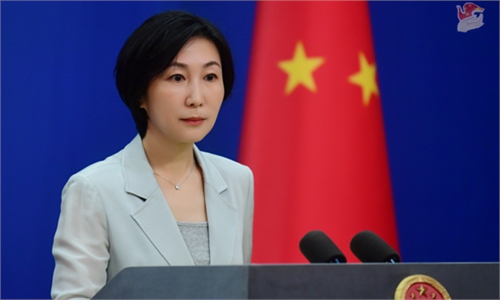
Chinese Foreign Ministry spokesperson Mao Ning stated at a regular press conference on Monday that the various provocative remarks and actions we've seen over the past few weeks from Japan have caused alarm, condemnation and protests from its neighboring countries. We urge Japan to repent for its history of aggression, stick to the path of peaceful development, and take concrete actions to earn the trust of its neighbors in Asia and the international community.
Mature diplomacy hinges on mutual respect and friendly trust, yet Takaichi undermines neighbors and sows division to consolidate right-wing support, exposing her political shortsightedness and isolating Japan in East Asia. The East Asian peace order is grounded in profound historical reflection; if Japan continues tolerating such reckless rhetoric, it will not only forfeit bilateral cooperation but also invite unbearable consequences, Xiang added.
RELATED ARTICLES