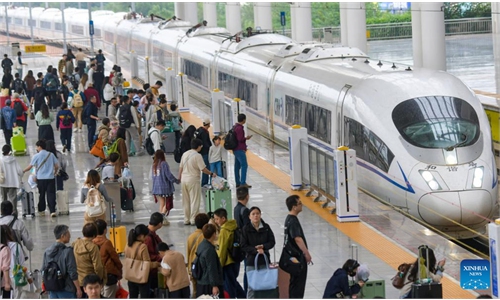
Multiple regions roll out autumn breaks for primary, secondary schools, stimulating local tourism
Educational trips combining study and travel complement classroom learning: expert
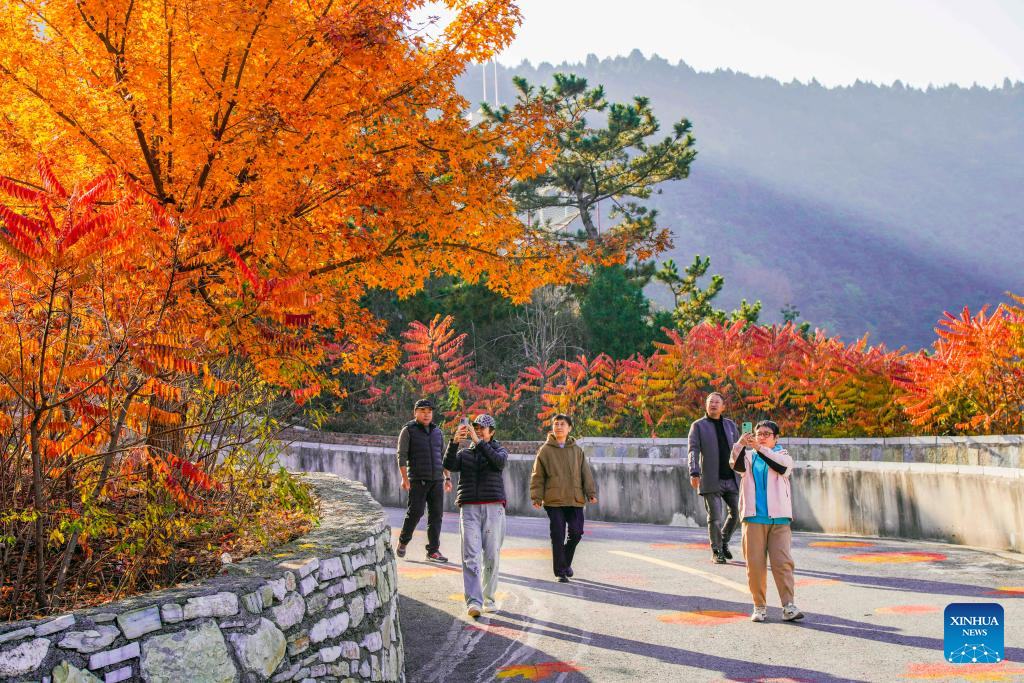
Tourists enjoy autumn scenery in Zunhua City, north China's Hebei Province, Nov. 4, 2025. (Photo by Liu Mancang/Xinhua)
The rollout of autumn holidays for primary and secondary schools in multiple Chinese regions has triggered a tourism surge in some areas. An expert said on Tuesday that these flexible leave policies help stimulate tourism by allowing families to avoid peak travel periods.
Many students in primary and secondary schools in East China's Zhejiang Province started their first statutory autumn break in November, according to the provincial education department. In Southwest China's Sichuan Province and Foshan of South China's Guangdong Province, primary and secondary school students had their first autumn break between November 12 to 14, according to the local education authorities.
East China's Jiangsu Province issued a notice in June to implement a special campaign to boost consumption, encouraging eligible regions to pilot the designation of the three working days preceding May Day holidays and the three working days preceding National Day holidays as spring and autumn breaks for primary and secondary schools.
Several tourist attractions in Zhejiang and Sichuan provinces have implemented visitor flow controls as tourist numbers neared or reached capacity during the autumn break.
According to Chengdu Fabu on Monday, data from platforms such as Ctrip, Tongcheng Travel and Qunar have shown that during the autumn break, bookings for scenic spot tickets, air tickets, and hotels in Sichuan all showed upward trends. The search popularity for travel products in many areas surged by over 50 percent year-on-year, while the overall ticket bookings within Sichuan increased 3.4 times year-on-year and 1.4 times compared with the five days before the holiday. Flights departing from Chengdu saw a 22 percent week-on-week increase.
Jiang Yiyi, a professor at the School of Leisure Sports and Tourism at Beijing Sport University, told the Global Times on Tuesday that the breaks can stimulate tourism industries. Besides, holiday systems such as spring and autumn breaks reflect flexible leave arrangements, and enable people to avoid peak travel times and better organize vacation plans, Jiang said.
Jiang said that spring and autumn are ideal seasons for student outings, and that combining study with travel through educational trips is an effective way to complement classroom learning and deepen students' understanding.
Several parents interviewed by the Global Times expressed support for the autumn break.
Zhou Yuchao, a parent of two primary school children from Hangzhou, Zhejiang Province, told the Global Times on Tuesday that his family traveled to Beijing with several other families, enjoying a five-day trip including the weekend.
"Autumn break is absolutely fantastic. Traveling during off-peak hours made all the difference - places like the Palace Museum and Universal Beijing Resort were once spots we didn't want to visit during major holidays, but now they're perfect destinations with fewer tourists," said Zhou. He noted that it not only lowers transportation and accommodation costs, but also makes sightseeing at attractions more comfortable, improving the family travel experience.
"Thanks to the autumn break, we have the chance to really explore some internet-famous attractions," a mother of a primary school student, surnamed Zheng, from Shaoxing, Zhejiang Province, told the Global Times on Tuesday.
A Hanzhou parent, surnamed Yu, told the Global Times on Tuesday that their family plans to visit historical and cultural sites. "We prefer such destinations because they allow our child to form his own impressions during the trips," Yu said.
RELATED ARTICLES