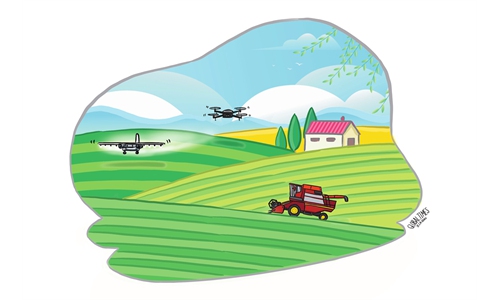
Illustration: Chen Xia/GT
In a strawberry field in Dandong, Northeast China's Liaoning Province, rows of plants grow steadily under the sunlight. At first glance, it may seem like routine farming, yet each fruit reflects a complex interplay of technology, logistics, and streamlined customs processes. Together, these elements offer a window into how China's agricultural sector is experimenting with modernization - enhancing production efficiency while linking local farms more systematically to international markets.
These incremental adjustments have supported a steady expansion of the region's strawberry exports. According to a report from Dalian Customs, Donggang - within the city of Dandong - exported 328.91 tons of fresh strawberries in 2024, an 18-fold increase compared with 2020. Over the same period, Donggang strawberries entered a broader range of overseas markets - including Malaysia, Thailand, Vietnam, and Belarus - bringing the total number of export destinations to 33.
The strawberries' entry into overseas markets points to a broader trend: China is modernizing its agricultural supply chains in ways that influence both trade and cooperation. Improvements in production, logistics, and distribution are creating more integrated systems that support not only exports but also imports of agricultural products. Taken together, these shifts suggest emerging opportunities for two-way agricultural trade.
The journey of a single Donggang strawberry to overseas markets may seem straightforward, but it depends on a long and increasingly sophisticated supply chain. In the cultivation stage, some modern strawberry parks use Internet of Things sensors to monitor temperature and humidity, automated drip-irrigation systems, and controlled carbon dioxide enrichment. These technologies help maintain sugar levels between 12 and 14 degrees, meeting quality standards in markets such as the EU and Southeast Asia.
Logistics form the next stage. Strawberries picked in the morning are sorted and packaged by afternoon and reach airport facilities by evening. Each step from harvest to shipment is closely coordinated, reflecting the efficiency and reliability of transportation and cold-chain systems.
Distribution adds another dimension. E-commerce platforms have become an important channel, with online businesses enabling producers to reach both domestic and international customers. According to a 2024 report by the People's Daily Online, Donggang has more than 6,600 registered e-commerce enterprises and individual operators, operating more than 15,000 online shops. E-commerce accounts for more than 30 percent of total fresh strawberry sales.
The story of Donggang strawberries provides a small but telling glimpse into the broader development of China's distinctive agricultural products. Other regional specialties, from wood ear mushrooms in Heilongjiang to matsutake in Yunnan, are also gradually expanding their presence in domestic and international markets. In 2024, China's agricultural exports reached $103.0 billion, up 4.1 percent year-on-year. Behind these figures are numerous local stories, illustrating how individual producers are modernizing operations and connecting to global trade networks.
In this context, a report by the People's Daily Online highlights a notable development. On Monday, the Middle East Organic & Natural Expo reportedly opened in Dubai, featuring the first participation of China's national agricultural delegation. Nearly 30 Chinese agricultural enterprises from 12 provinces exhibited a wide range of products, including fresh fruits and vegetables, specialty seafood, and tea and dried goods.
As China enters an accelerated phase of agricultural modernization, its products are increasingly reaching overseas markets. This expansion is helping to establish more mature logistics, cold-chain, and sales systems connecting China with foreign markets. These infrastructures facilitate exports, and over time could also support imports, promoting two-way trade and broader international collaboration in agricultural products.
Rising living standards and increasing consumer purchasing power in China are driving greater demand for specialty agricultural products, particularly high-end items such as strawberries that rely on reliable cold-chain logistics. The modern sales and distribution systems developed through China's agricultural modernization not only support exports but also provide channels to facilitate imports, offering Chinese consumers a wider variety of products.
A single strawberry may be small, but it reflects broader dynamics in China's agricultural modernization that deserve attention. The extent to which these developments will shape new trends and opportunities in China's international agricultural trade remains to be seen. Nevertheless, the potential is evident, and realizing it will require sustained effort to turn this promise into tangible commercial outcomes.
The author is a reporter with the Global Times. bizopinion@globaltimes.com.cn
RELATED ARTICLES