Chinese Premier's Moscow trip boosts bilateral, SCO cooperation
High-level engagement highlights mutual trust: expert
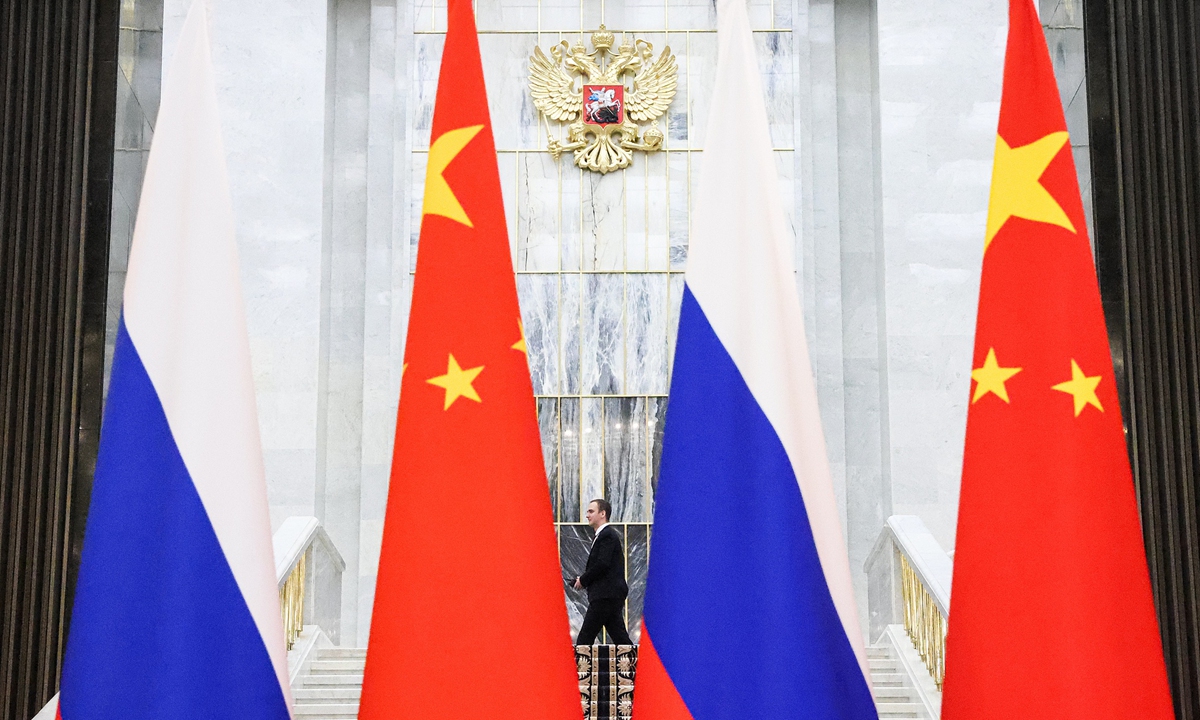
Flags of Russia and China are seen during the 24th meeting of the Council of Heads of Government of the Shanghai Cooperation Organization (SCO) in Moscow, Russia on November 17, 2025. Photo: VCG
Chinese Premier Li Qiang on Tuesday was scheduled to conclude a visit to Russia where he attended the 24th Meeting of the Council of Heads of Government of Member States of the Shanghai Cooperation Organization (SCO), reaffirming the continuing momentum of China-Russia cooperation in meetings with the Russian leadership.
Chinese experts believe the trip to Moscow demonstrates the profound strategic mutual trust between China and Russia. In terms of the multilateral mechanism, cooperation and coordination between China and Russia and with other members in the SCO framework will enable the SCO to enter a new stage of higher unity, greater collaboration, greater vitality and greater achievements, and thus will lead to its high-quality development.
High-level mutual trust
According to the Tass News Agency, Russian President Vladimir Putin held a meeting on Tuesday in the Kremlin with the prime ministers and top officials of SCO member states, who had arrived in Moscow for the Council of Heads of Government meeting.
The news agency singled out Putin's scheduled meeting with Chinese Premier Li Qiang on Tuesday, suggesting the special significance Moscow attaches to ties with China, analysts said.
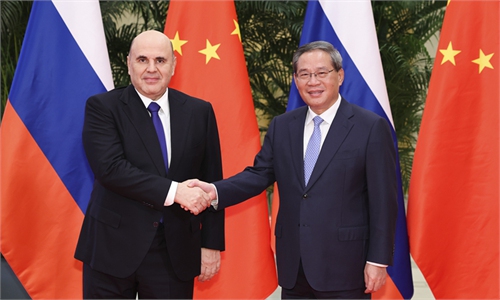
Before that, Premier Li held talks with Russian Prime Minister Mikhail Mishustin in Moscow on Monday, with both sides vowing to bolster cooperation in various fields, according to a statement released by the Chinese Foreign Ministry on Tuesday.
Li said that China stands ready to deepen cooperation with Russia in investment, energy, agriculture and other fields, adding that the Chinese market welcomes more high-quality agricultural and food products from Russia, the Xinhua News Agency reported.
Li said that not too long ago he and Mishustin met for the 30th regular meeting of the Chinese and Russian heads of government in Hangzhou, capital of East China's Zhejiang Province. The meeting focused on the implementation of the important consensus reached by the leaders of the two countries, according to Xinhua.
China stands ready to work with Russia to follow the strategic guidance of the two heads of state, further strengthen communication, continuously deepen mutually beneficial cooperation between the two sides, and create more benefits for the two peoples, Xinhua reported.
Li expressed the hope that the Russian side will provide more convenience for Chinese enterprises to invest and operate in Russia. He also urged both sides to continue to expand people-to-people and cultural exchanges, strengthen cooperation in areas such as culture, education and films, and infuse more humanistic warmth into China-Russia relations.
Mishustin said that currently, the Russia-China comprehensive strategic partnership of coordination for a new era is at an unprecedented high level, Xinhua reported.
Russia is willing to further intensify dialogue and exchanges with China at all levels, deepen cooperation in fields such as economy and trade, energy, agriculture and people-to-people and cultural exchanges, create new growth points for cooperation, and continuously enhance good-neighborly friendship, he added.
Mishustin said Russia is willing to create a favorable business environment for Chinese enterprises investing in Russia, according to Xinhua.
That the Chinese Premier and Russian Prime Minister are meeting once again in two weeks underscores both sides' shared need to continue deepening strategic coordination amid a complex international landscape, Sun Xiuwen, an associate professor at the Institute for Central Asian Studies at Lanzhou University, told the Global Times on Tuesday.
"The high frequency of such meetings stems from the multilayered network of bilateral and multilateral mechanisms the two countries have built. It's no longer just a bilateral relationship, but a web of interconnected frameworks," said Cui Heng, a scholar at the Shanghai-based China National Institute for SCO International Exchange and Judicial Cooperation.
According to Cui, the Hangzhou dialogue took place at the annual regular prime ministers' meeting, and it focused on implementing the consensus reached by the two heads of state earlier this year as well as on advancing practical cooperation. The Moscow meeting, by contrast, took place on a multilateral occasion.
"This exceptionally frequent interaction is a unique strength of China-Russia relations," Cui noted.
The frequency of meetings between Chinese and Russian leaders is so high, highlighting the extremely high level of strategic mutual trust and coordination efficiency between the two sides, especially at the highest levels, Cui said.
New phase
The heads of government of the Shanghai Cooperation Organization (SCO) countries adopted a joint communiqué following their meeting in Moscow, according to Russian media RIA Novosti.
"Importantly, all member states confirmed their commitment and expressed readiness to strengthen the SCO as a leading international platform for cooperation in the economy, trade, security and humanitarian areas. I am confident that the decisions we have adopted today will give a new impetus to the development of trade, economic, and scientific-technological cooperation," Mishustin said.
Forecasts indicate that the share of SCO member states in global GDP will increase to 35 percent by the end of this year, Mishustin said at the SCO meeting, according to Tass.
"We all have one common goal - to increase the authority and influence of the SCO as one of the largest regional associations on the Eurasian continent, and in the world as a whole," Putin said during a meeting with the heads of delegations of the Council of Heads of Government of SCO member states, RIA Novosti reported.
According to another report from RIA Novosti, Putin also said that SCO cooperation is by no means limited to the economic sphere, although that is undoubtedly a priority. "In practice, our organization also contributes to strengthening peace and stability across the Eurasian region, countering a wide range of challenges and threats, and shaping a new balanced security architecture in Eurasia," Putin said.
Next year marks the 25th anniversary of the SCO's establishment. "The SCO is further transforming from a regional security cooperation organization into a comprehensive and global development and cooperation platform. The 25th anniversary represents a milestone where the SCO will enter a new stage of high-quality development featuring greater solidarity, enhanced collaboration, more vitality and greater effectiveness," Sun noted.
Earlier in an interview with Russian media Izvestia, SCO Secretary-General Nurlan Yermekbayev said that the SCO meeting of the Council of Heads of Government will focus on the implementation of decisions adopted at the level of the organization's national leaders, including those made at the summit held in Tianjin on September 1.
SCO Deputy Secretary General TR Midhun noted that the meeting discussed measures for the comprehensive and gradual implementation of the SCO development strategy up to 2035. Significant attention was paid to expanding trade, economic and cultural-humanitarian ties, as well as issues of cooperation in the digital economy, energy, the green agenda, artificial intelligence, science and innovation, education, culture, tourism, healthcare, sports and youth contacts. The outcomes of the meeting are reflected in a signed joint communiqué, according to BelTA, the official media of Belarus.
Yermekbayev said, "I am convinced that the outcomes of the meeting will inject additional practical substance into cooperation. This will help strengthen the long-term stability of the region's economies and unlock new opportunities for effective cooperation among SCO member states," Izvestia reported.
"We did not just hold another meeting of the Council of Heads of Government. We made another leap forward in the SCO's development, reinforcing the unity of our views," Midhun said, BelTA reported.
RELATED ARTICLES