Illustration: Chen Xia/GT
Recently, a series of restrictive measures by the US government against foreign talent are causing chaos and risk undermining one of the pillars of India-US engagement - the vital exchange of human capital and knowledge.
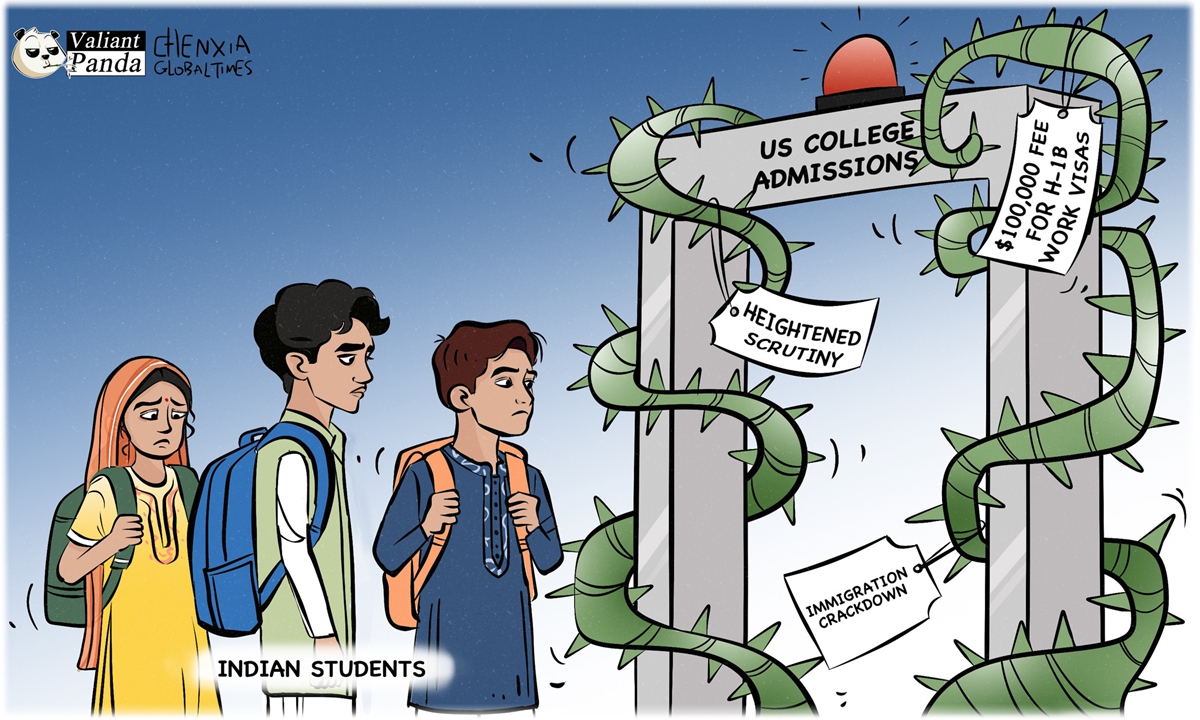
The US has recalibrated its immigration and labor policies to prioritize domestic workforce protection, as evidenced by tighter H-1B visa issuance, steep fee hikes for H-1B talent-recruiting companies and enhanced monitoring of foreign student admissions.
Since August this year, the US Department of Homeland Security (DHS) has intensified its oversight of foreign students (F-visa holders) and exchange visitors. DHS and other agencies stress that they are tightening oversight of international students, their work authorizations including Optional Practical Training (OPT) and transitions to work visas.
Against this backdrop, Indian students in STEM fields - who make up a large share of international enrolment - face in-depth scrutiny. Many Indian students in US universities on F-1 and M-1 visas transition to temporary employment through the OPT route - a critical bridge to securing H-1B work visas and formal entry into the US labor market. The US decision to end automatic extensions of Employment Authorization Documents (EADs) has also triggered widespread uncertainty among these Indian students and their dependents, heightening anxiety over work continuity and legal status.
The control over Indian students' entry into the US is administered at multiple levels, with the first sweeping cuts implemented by these visa application centers. Given the ratio of applications to reduced availability at US universities, the race to clear the interviews looks fierce.
Compared to 2024, these missions have reduced the number of visa application approvals by 45 percent. If one adds the number of EAD lapses, the total number would be even higher.
Such moves risk undermining one of the strongest pillars of India-US engagement - human capital and knowledge exchange - potentially pushing bilateral relations into a prolonged phase of strategic and economic discontent.
The arduous application process, employment insecurities and rising control by the US over research and academic liberty are eroding the country's academic openness and restricting fair access for Indian students and professionals. As a result, the US is becoming a nonviable destination for Indian students.
The trend of Indian students' trust in non-US universities has been steadily growing over the past few years. The case of immigration control is not going to change soon, and hence, the fascination for the Ivy League universities is subsiding fast. Now, a majority of students who once looked up to the US and preferred Anglophone teaching to pursue their dream are looking at Russia and a few other countries in Europe, including France and Germany. Russia saw an approximately 34 percent increase in Indian students compared to 2024.
The depletion of Indian and foreign talent will have a drastic effect on the US economy in the long run. As history shows, major powers may fight tooth and nail to preserve their influence and display hegemonic supremacy, but eventually internal structural maneuvers will lead to the collapse of major states.
Much of the dynamism of the US economy has been shaped by its immigrant population - a cornerstone of its innovation and competitiveness. Among these, the Indian diaspora has emerged as one of the most influential groups, driving the country's technological, entrepreneurial and academic frontiers.
In this case, immigration policies, control over universities and other measures risk undermining the US tech industry, its ability to attract the brightest minds and its dominance in the broader tech ecosystem. The US will lose its tech edge if it does not re-adjust its exclusionary policies, and the pool of talented individuals will start to look elsewhere.
In summary, the tightening of US immigration policies, curbs on global talent inflows and visa restrictions are poised to produce collateral damage across innovation ecosystems. By constraining the very talent pool that fuels invention, scientific breakthroughs and disruptive technologies, the US risks undermining its own internal dynamism. Such inward-looking measures could erode Washington's technological dominance, gradually reshaping the balance of power in international politics and world affairs.
The author is an associate professor at Jawaharlal Nehru University in India. opinion@globaltimes.com.cn
RELATED ARTICLES