Chinese envoy sends letter to UN chief over Japanese PM’s erroneous remarks on Taiwan, to be distributed to all member states
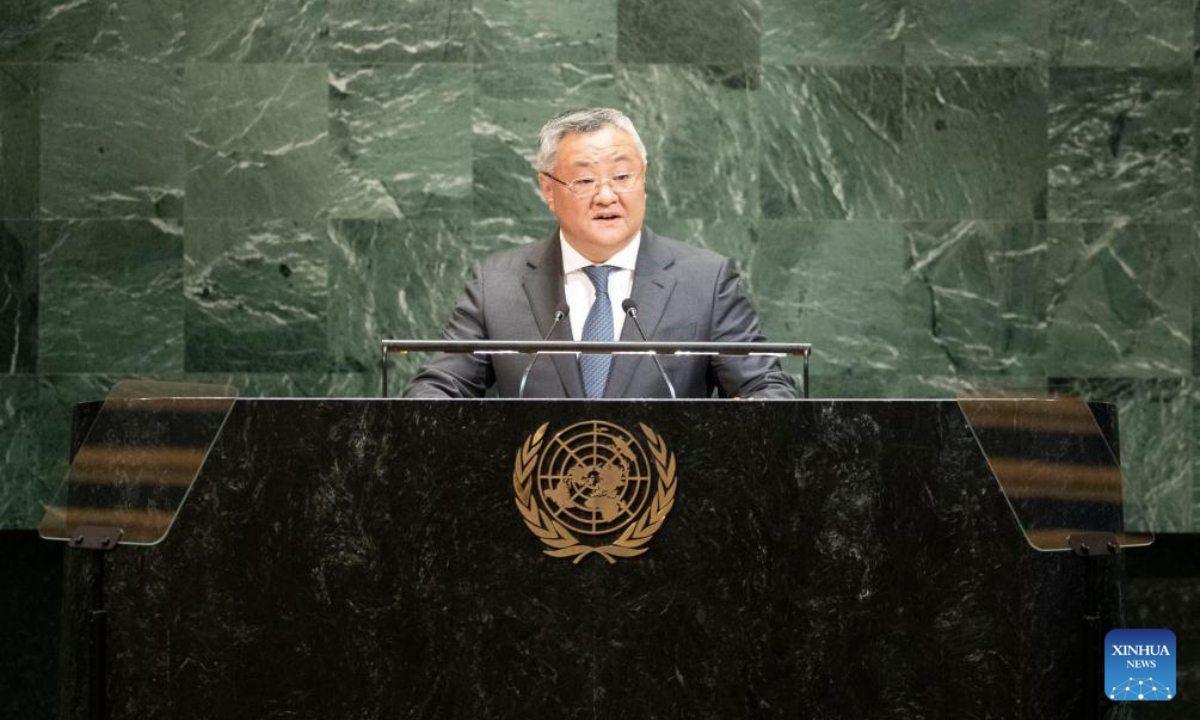
Fu Cong, China's permanent representative to the United Nations, speaks at the UN General Assembly's annual debate on Security Council reform, at the UN headquarters in New York, Nov. 18, 2025. Japan is totally unqualified to seek a permanent seat on the Security Council, said Fu Cong, China's permanent representative to the United Nations, at the UN General Assembly's annual debate on Security Council reform on Tuesday. (Xinhua/Xie E)
Fu Cong, China's permanent representative to the United Nations, on Friday sent a letter addressed to United Nations Secretary-General Antonio Guterres, articulating the Chinese government's position on the erroneous words and deeds of Japanese Prime Minister Sanae Takaichi concerning Taiwan.Takaichi claimed at a Diet meeting on November 7 that the Chinese mainland's "use of force on Taiwan" could constitute a "survival-threatening situation" for Japan. Takaichi refused to retract her remarks, implying the possibility of armed intervention in the Taiwan Straits.
Fu said in the letter that Takaichi's blatant and provocative remarks on Taiwan mark the first time since Japan's surrender in 1945 that a Japanese leader has hyped hypothetical situations on Taiwan at an official occasion, linking it to the exercise of collective self-defense rights. It is also the first time Japan has expressed ambitions of attempting armed intervention on the Taiwan question and the first time it has issued a military threat against China, openly challenging China's core interests. Such remarks are extremely erroneous, highly dangerous, and have an extremely malicious nature and impact.
The letter will be issued as an official document of the UN General Assembly and distributed to all member states.
In the letter, Fu stated that despite China's repeated solemn démarches and strong protests, Japan has shown no remorse and refused to retract its erroneous statements. China expresses strong dissatisfaction and resolute opposition to this, he said.
Fu emphasized that Takaichi's relevant remarks seriously violate international law and the basic norms governing international relations, and severely undermine the post-war international order. They constitute an open provocation to more than 1.4 billion Chinese people and the people of Asian countries that once suffered from Japanese aggression.
Taiwan is an inalienable part of China's territory, and how to resolve the Taiwan question is an internal affair for the Chinese people, admitting no external interference, said Fu, noting that if Japan dares to resort to armed intervention in the Taiwan Straits situation, it will constitute an act of aggression, and China will resolutely exercise the right to self-defense entrusted by the UN Charter and international law, and firmly safeguard national sovereignty and territorial integrity.
As a defeated country in World War II, Japan must deeply reflect on its historical guilt, abide by its political commitments on the Taiwan question, immediately cease provocative acts that cross red lines, and withdraw its erroneous remarks, Fu noted.
Previously, the Chinese envoy also slammed Takaichi's remarks on Taiwan on Tuesday, saying that "They constitute a gross interference in China's internal affairs and a serious breach of the one-China principle and the spirit of the four political documents between China and Japan."
"Such remarks are an affront to international justice, the post-war international order, and the basic norms of international relations, and represent a blatant departure from Japan's commitment to peaceful development," Fu added.
"Such a country is totally unqualified to seek a permanent seat on the Security Council," Fu said.
Global Times
RELATED ARTICLES