Illustration: Xia Qing/GT
After over 20 years in China, my life has been filled with China-focused pursuits with most of my energy devoted to education. I've taught at several universities, delivered lectures at over 80 institutions across different provinces, and served on the judging panels for more than 100 English speaking competitions.
There are occasions when students argue that US universities are superior to China's, citing Nobel Prize tallies as the only proof. My response is always, "why do we equate Nobel Prizes with good education?" The number of Nobel Prizes is not the sole measure of a country's higher education quality.
This year, China saw 21 percent of its universities rise in the Times Higher Education (THE) World University Rankings for 2026. China now has five universities in the top 40 and 35 in the top 500. There's no doubt this new ranking provides evidence that the balance of power in the global research and knowledge economy continues to shift from the West to the East. It is a thought-provoking phenomenon that invites a deep inquiry: what contributes to the remarkable progress in China's higher education.
What I truly admire about Chinese higher education is its emphasis on the "collective good" over individual gain. From university lectures to public discourse, Chinese students are taught that while economic success is acceptable, the true purpose of disciplines like economics is to apply knowledge for the betterment of society as a whole. In this regard, rather than treating education as a means to achieve short-term economic gains, China has aligned its higher education system with national long-term development strategies and public needs.
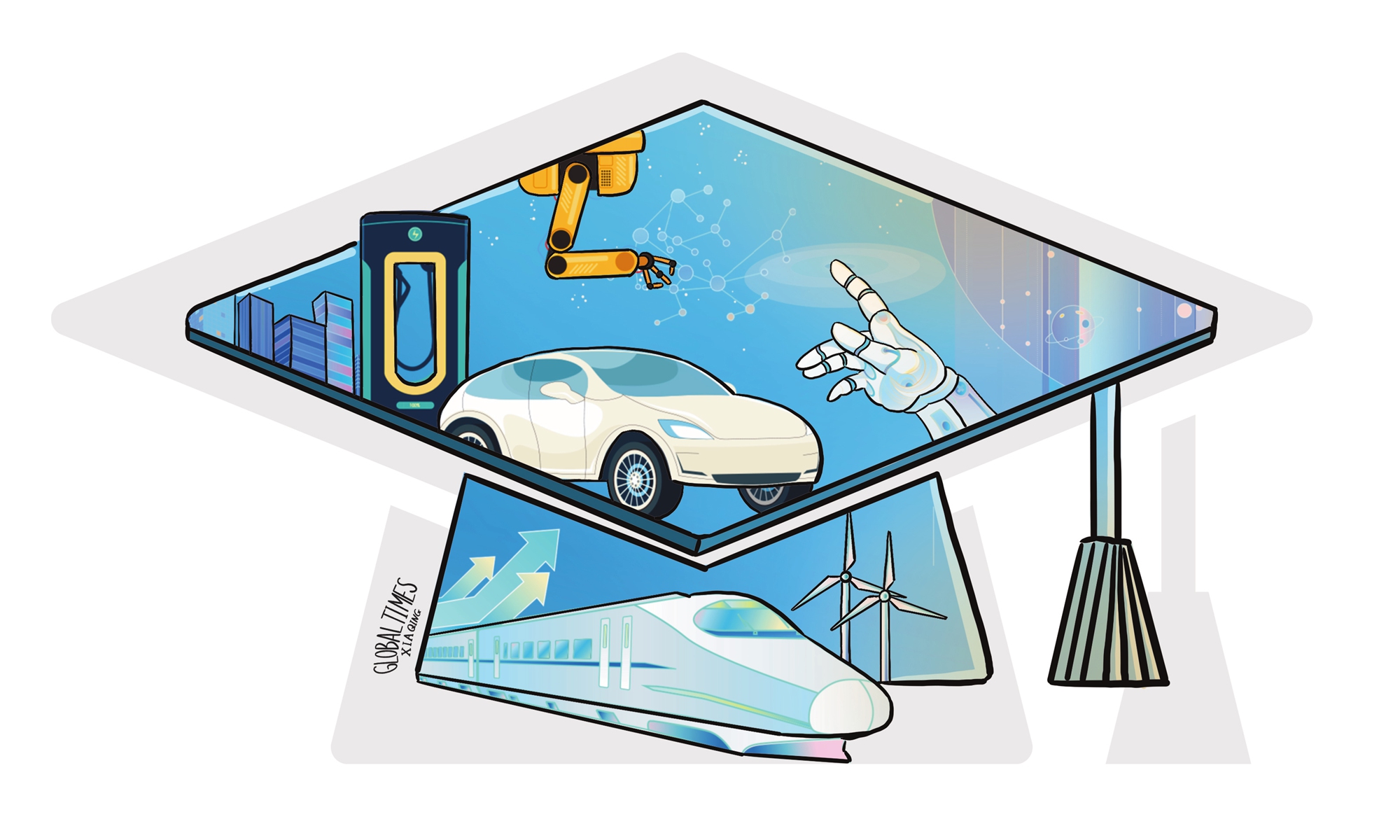
China's emphasis on STEM education has become a powerful catalyst for real-world progress - moving beyond theoretical instruction to generate tangible improvements that benefit people's lives. From high-speed rail systems that connect the country within hours, to electric vehicles leading global markets, and AI technologies transforming fields such as healthcare and agriculture - these achievements all stem from China's sustained commitment to building a robust STEM education ecosystem aimed at elevating living standards. The commitment to advancing national development priorities has been the driving force behind the ongoing success and evolution of Chinese higher education.
The growth of Chinese universities' global standing has also been in large part due to the significant government investment into higher education and the deep-seated social respect for teachers and education. Consistent and substantial funding, particularly in scientific research and technological development, has enabled Chinese universities to attract top faculty, accelerate academic output, and compete internationally for talent. This long-term vision is further demonstrated by the ongoing expansion of educational infrastructure at all levels, from primary schools to universities, broadening access to quality education nationwide. Moreover, in China, respecting teachers is a virtue valued not only by students but by the entire nation. In contrast, US universities face challenges such as declining federal support, contentious debates over academic freedom, restrictions on the international students and politically motivated funding cuts. In recent decades, many US cities have seen public schools close and educational budgets shrink, limiting opportunities for younger generations.
What strikes me most about Chinese government's approach to higher education investment is the principle of equality. Rather than concentrating resources solely in a handful of elite universities, funding has been strategically directed toward a broad range of universities, including those in remote and less developed regions. I've learned that over the past decade, about 1.98 million college teachers in western China have been trained on massive open online courses (MOOC). The substantial figure represents Chinese government's resolve to bridge regional disparities and ensure wider access to high-quality educational resources across the country.
China's commitment to peace offers another clear edge. Chinese students are raised in an environment that actively cultivates expectations of peace, both domestically and globally. This is not merely an abstract ideal but a principle put into practice: through initiatives such as the Belt and Road Initiative, China promotes international partnerships based on mutual benefit and shared progress, rejecting zero-sum outcomes. This stable and cooperative global posture in turn creates a favorable environment for the sustained development of higher education.
Five years ago, I attended an exhibition in China showcasing how virtual reality was changing filmmaking. An American director walked in and said, "The VR equipment here is so advanced, far ahead of what we have in Hollywood. We're still playing catch-up." He was thrilled to be in a country that's moving forward so fast. As an educator who has watched China grow, adapt, and prioritize people over prizes for 20 years, I share his sentiment and understanding. China has showed me an alternative pathway to building a prosperous higher education system - one that differs from Western models.
The author is a US professor at Minzu University of China. opinion@globaltimes.com.cn
RELATED ARTICLES