China’s central bank conducts 1 trillion-yuan MLF operation; move to support growth: expert
Move to support growth, stabilize expectations: expert
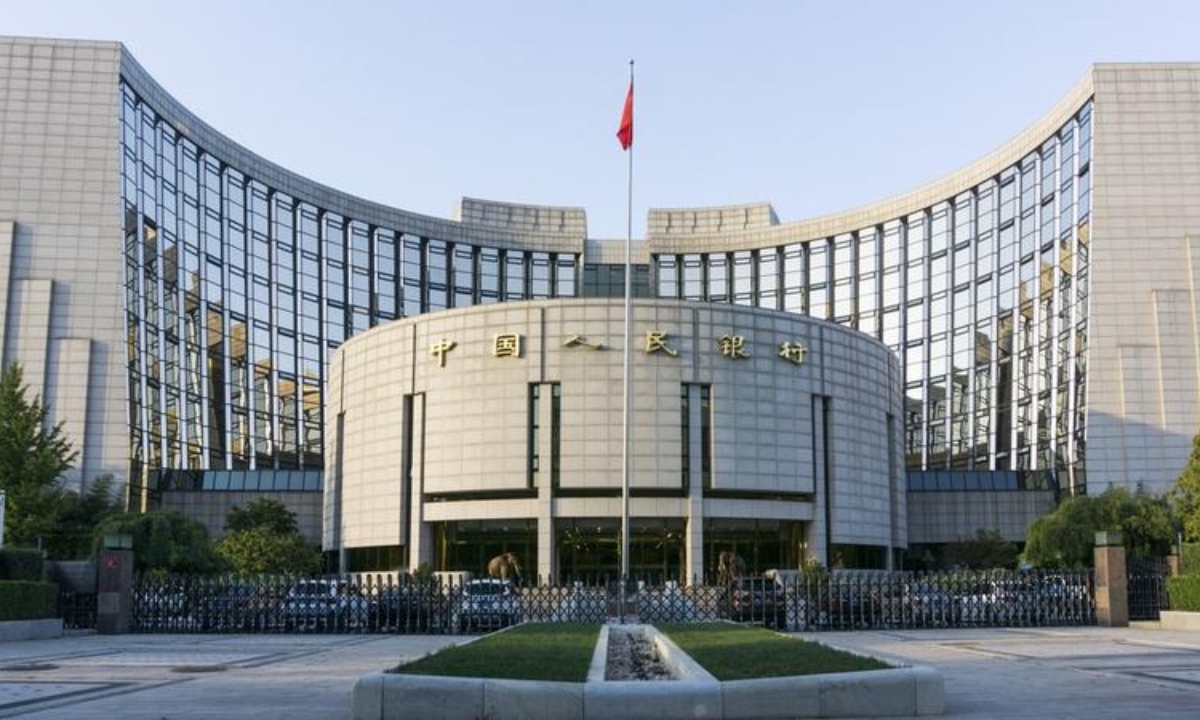
The headquarters of the People's Bank of China in Beijing Photo: IC
The People's Bank of China (PBC), the central bank, on Tuesday conducted a 1-trillion-yuan ($141.15 billion dollars), one-year medium-term lending facility (MLF) operation, in a bid to maintain ample liquidity in the country's banking system.
Chinese experts noted that at a critical point in achieving full-year economic and social development goals, the central bank's use of multiple monetary policy tools to maintain ample liquidity will help guide financial institutions to increase lending, which will support growth and stabilize expectations.
The MLF is a monetary policy tool through which the central bank provides medium-term base money to commercial banks and policy banks that meet macro-prudential requirements, typically via a bidding process.
A total of 900 billion yuan in MLF will mature in November, the China Securities Journal reported on Tuesday, citing data from Wind. Including the 1 trillion-yuan operation, the central bank will achieve a net injection of 100 billion yuan this month, marking the ninth consecutive month of expanded MLF rollovers, according to the report.
"By continuing to inject medium-term liquidity through tools such as the MLF, the PBC is signaling a sustained supportive policy stance, which helps keep funding conditions adequate, facilitates government bond issuance and stabilizes market expectations," Wang Qing, chief macroeconomic analyst at Golden Credit Rating International, said in a note sent to the Global Times on Tuesday.
In addition, the PBC this month conducted 1.5 trillion yuan in outright reverse repos. Outright reverse repo operations are a tool the central bank introduced in October 2024 to manage liquidity in the national banking system and are carried out once each month with a tenor of no more than one year, according to media reports.
After offsetting the maturity of 1 trillion yuan in outright reverse repos, the operation resulted in a net injection of 500 billion yuan.
Overall, the central bank's net medium-term liquidity injection for the month will reach 600 billion yuan, the same scale as in October and remaining at a relatively high level, underscoring its continued preference for an appropriately accommodative monetary policy stance, the Securities Daily reported.
The central bank said in its monetary policy report for the third quarter of 2025, released on November 11, that it would implement an appropriately accommodative monetary policy in the coming period.
The PBC revealed plans to make comprehensive use of multiple policy tools to keep overall financing conditions relatively accommodative, while continuing to refine the monetary policy framework and strengthen policy implementation and transmission.
It will also maintain ample liquidity and ensure that growth in total social financing and money supply is aligned with economic expansion and inflation targets, fostering a stable and supportive monetary and financial environment, according to the policy report.
Meanwhile, the Ministry of Finance has recently been working to ease capital conditions in the market, including by continuing to front-load a portion of the 2026 quota for new local government debt.
Fiscal and monetary coordination is injecting stronger momentum into China's economy, Bian Yongzu, executive deputy editor-in-chief of Modernization of Management magazine, told the Global Times on Tuesday. He said that the improved liquidity environment is also helping to stabilize market expectations, strengthen investor confidence and attract more private capital.
He noted that the recent issuance of 500 billion yuan in new local government bonds - mostly directed toward major infrastructure facilities and key projects - will directly support investment expansion and economic growth.
"The combined force of fiscal and monetary policies will support the economy from both the demand and supply sides, fostering a virtuous cycle of investment, consumption and production that will underpin more sustained economic growth," Bian said.
RELATED ARTICLES