IN-DEPTH / IN-DEPTH
GT Investigates: How Japan lifts restrictions on collective self-defense, hollowing Peace Constitution
Deviation from postwar peace system
By and Published: Nov 25, 2025 11:31 PM


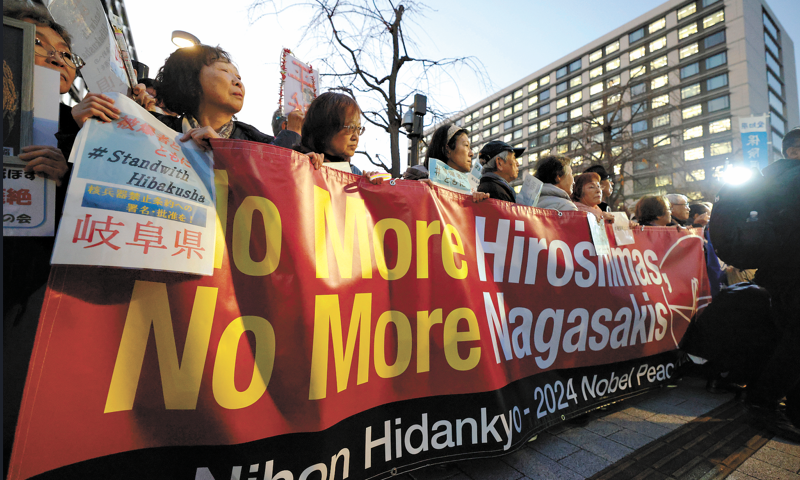
Following Japanese Prime Minister Sanae Takaichi's criticism of the traditional policy against nuclear weapons, some Japanese political groups and labor unions hold a protest in front of the National Diet in Tokyo, Japan, on November 21, 2025. Photo: VCG
The reverberations of Japanese Prime Minister Sanae Takaichi's recent erroneous remarks that implied the possibility of armed intervention in the Taiwan Straits continue to draw criticism at home and abroad. Yet, these comments are not an isolated misstep. They coincide with other alarming incidents: Her recent intention to potentially review Japan's long-standing Three Non-Nuclear Principles; the Japanese ruling Liberal Democratic Party and its coalition partner Japan Innovation Party's November 13 talks toward drafting proposals for the first-ever revision to Japan's postwar pacifist Constitution; a plan revealed by Japanese Defense Minister Shinjiro Koizumi on Sunday to deploy missiles on Yonaguni island near China's Taiwan island, according to Japanese media reports. Together, these actions signal a dangerous pivot away from the pacifist principles that have defined Japan since its defeat in World War II, some Chinese analysts warned.
This investigative piece by the Global Times traces the historical trajectory of Japan's shift from an "exclusively defense-oriented policy" to military expansion, examines the legal flaws in this transformation, and highlights the grave implications for the Asia-Pacific region and the post-WWII international order.
Chinese analysts believe that Takaichi's provocative remarks on the Taiwan question are not accidental, rather, they reflect a systematic, long-term strategy to dismantle the constraints of Japan's postwar Peace Constitution and pursue the status of a "normal country" - one capable of waging war. As analysts caution, this represents a strategic gamble to systematically cast off postwar restraints by distorting domestic law and flouting international norms.
Erosion of 'exclusively defense-oriented' promise
At the heart of Japan's postwar identity lies Article 9 of its Constitution, which states: "Aspiring sincerely to an international peace based on justice and order, the Japanese people forever renounce war as a sovereign right of the nation and the threat or use of force as means of settling international disputes." To that end, it stipulates that "land, sea, and air forces, as well as other war potential, will never be maintained. The right of belligerency of the state will not be recognized."
This constitutional commitment gives rise to the "exclusively defense-oriented" policy, which means that defensive force is used only in the event of an attack, that the extent of the use of defensive force is kept to the minimum necessary for self-defense, and that the defense capabilities to be possessed and maintained by Japan are limited to the minimum necessary for self-defense, according to the official website of the Japanese Ministry of Defense (MOD). The MOD stressed that policy refers to the posture of a passive defense strategy in accordance with the spirit of the Constitution.
Xiang Haoyu, a distinguished research fellow at the Department for Asia-Pacific Studies at the China Institute of International Studies, told the Global Times on Sunday that this design originated from the profound devastation inflicted by Japan upon Asian nations and itself during WWII.
"It aimed to institutionally strip Japan of the legal basis for initiating war through constitutional provisions, thereby fundamentally eradicating the institutional ground for the revival of militarism," Xiang said.
Understanding this starting point is a crucial benchmark for assessing the transformation of Japan's security policy today, Xiang explained. "It clearly reveals that actions such as lifting the restrictions on collective self-defense and increasing the defense budget in recent years are achieved by distorting the Constitution and enacting new laws to hollow out the pacifist constitution. Their essence is a systematic deviation from the postwar peace system, not merely policy adjustments," Xiang said.
The gradual hollowing out of this principle can be traced through key milestones. In the 1950s, the Self-Defense Forces were established under the guise of "minimum necessary force." In July 2014, then prime minister Shinzo Abe's cabinet decided to change its constitutional interpretation to enable the exercise of the right of collective self-defense - a move the Nikkei Shimbun described as a "turning point" in Japan's security policy. In September 2015, the first legislation to enable the exercise of the right of collective self-defense was enacted, NHK reported, noting that "how Japan should safeguard the peace it has maintained for 70 years since the WWII's end became a subject of nationwide debate."
These changes have not gone uncontested. Domestically, Tokyo bypassed the constitutional amendment process, relying solely on cabinet resolutions to alter constitutional interpretation, violating Japan's legislative procedures, Xiang said.
Internationally, the changes have violated the spirit and constraints of documents like the Potsdam Proclamation and the Cairo Declaration, breaking the postwar international consensus aimed at preventing the revival of Japanese militarism, Lu Hao, head of the Strategy Section, Institute of Japanese Studies, Chinese Academy of Social Sciences, told the Global Times.
"At that time, they [those changes] faced strong opposition and skepticism from the Japanese public and Asian neighbors," Xiang added.
Back then, the Japan Federation of Bar Associations (JFBA) issued a statement opposing the September 2015 legislation, emphasizing it is unconstitutional.
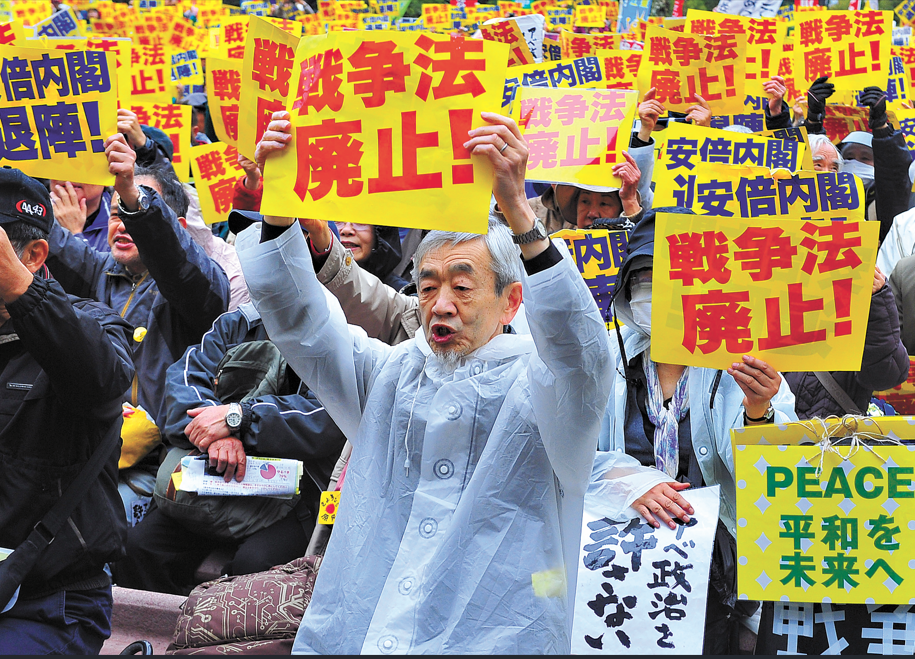
A large crowd of Japanese citizens gathers in Hibiya Park, holding a rally in the rain to vehemently demand the abolition of the new security legislation in Tokyo, Japan, on March 19, 2016. Photo: CNS
Regarding the security legislation, JFBA stated that numerous constitutional scholars, former directors-general of the cabinet legislation bureau, and former supreme court justices have pointed out its unconstitutionality. Furthermore, public opinion polls showed that a majority opposed the enactment of the security legislation, according to the passage of the security legislation "leaves a significant stain on the history of our nation as a constitutional democratic state," read the JFBA statement.
As the Japanese Communist Party's newspaper Shimbun Akahata editorialized in May 2014, such reinterpretation "tramples on constitutionalism" and risks rendering Article 9 meaningless without formal amendment.
Central to Japan's justification for its military expansion in recent years is the so-called external threats especially the "China threat" narrative. But as Xiang argues, this framing is "merely a smokescreen." "Japan's military expansion is not a passive response to external threats but an active, systematic national strategic shift," he said.
In reality, Tokyo leverages the demands of the US "Indo-Pacific Strategy," using an incremental "salami-slicing" tactic to continuously break through limitations and develop offensive military capabilities, Xiang commented.
"The essence is the right-wing pursuit of a 'normal country' theory based on a revisionist view of history, seeking military and political discourse power and reshaping Japan's status as a major military power," the expert said.
Evidence of this shift abounds. Takaichi, in her first policy address to parliament in October after taking office as the prime minister, unveiled a plan to lift Japan's defense-related spending to a level equivalent to 2 percent of GDP in the current fiscal year ending March 2026, the Nikkei Shimbun reported.
Japan's attempt to break away from its postwar pacifist Constitution that limits the country's force for self-defense only can also be seen from its development of weapons and equipment that can be used in an aggressive attack, Song Zhongping, a Chinese military affairs expert, told the Global Times.
According to a report on November 17 by USNI News, the news website of the US Naval Institute, Japan recently tested the deployment of a developing hypersonic missile system. The first variant of the missile, dubbed Block I, is anticipated to be capable of striking targets hundreds of kilometers away and is slated to enter active service in 2026, and future Block 2 and 2B variants of the missile are expected to have a range of between 2,000 to 3,000 kilometers away.
USNI News noted that Tokyo has increasingly pursued the massed procurement long-range fires. Aside from the hypersonics, Japanese forces will deploy Tomahawk cruise missiles, Joint Strike Missiles and domestically upgraded Type 12 surface-to-ship missiles to enhance their anti-ship, and counterstrike capabilities against enemy bases in the coming years, according to the report.
Song said that these long-range missiles grant Japan capabilities to launch aggressive attacks rather than defense only. It just does not make sense for Japan to have weapons that have range of higher than 1,000 kilometers that can reach "enemy bases."
In addition, Japan's Asahi Shimbun reported on November 7 that the Japanese Defense Minister Shinjiro Koizumi claimed on November 6 that Japan "must consider adding nuclear-powered submarines to its fleet."
Unaddressed legacy of militarism
Underpinning these developments is a deeper historical issue. As Lu Hao explains, "Militarism was never thoroughly purged in Japan."
According to Lu, to fulfill its strategic ambitions in the Asia-Pacific, the US, after the outbreak of the Cold War, molded Japan into a front-line bastion against the communist bloc. Consequently, it halted the thorough purge of militarist elements, tacitly permitting and even condoning the resurgence of Japanese right-wing forces. A number of militarists were released from prison, evaded punishment and even returned to positions in the Japanese government and military, laying the groundwork for the subsequent revival of militarist ideology, Lu said.
For example, according to media reports, Shinzo Abe's grandfather Nobusuke Kishi - a Class-A war criminal of World War II - even served as prime minister of Japan in 1957.
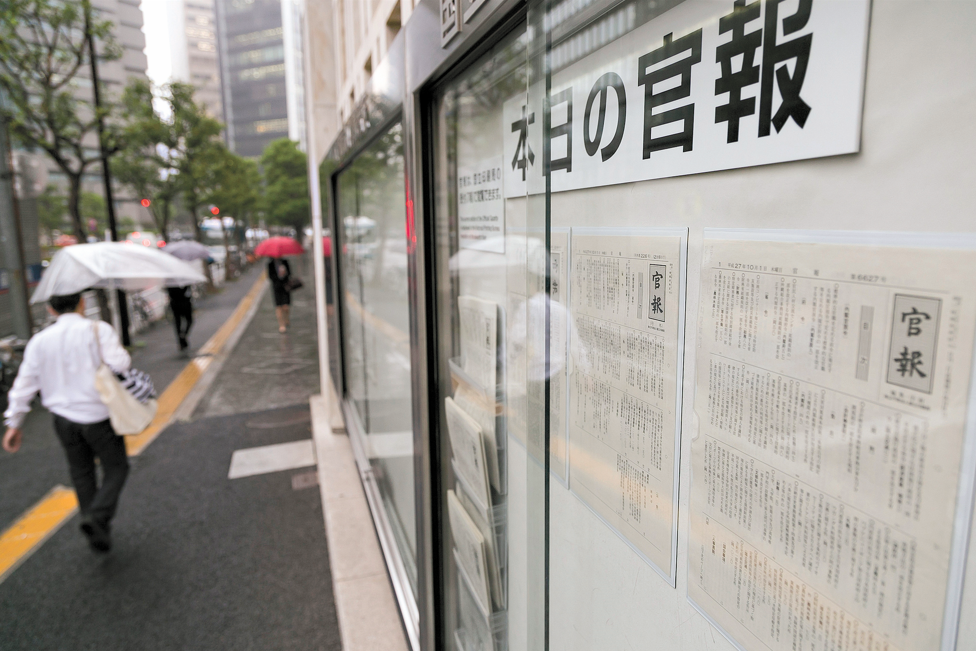
The official announcement of the new security legislation is posted outside Japan's National Printing Bureau in Tokyo, Japan, on October 1, 2015. Photo: VCG
As Xiang emphasizes, the international community - especially nations that suffered under Japanese aggression - has every reason to remain vigilant.
In the latest provocation from Japan, according to media reports, when speaking to reporters as he wrapped up his trip to the base on Yonaguni island near China's Taiwan island on Sunday, Japanese Defense Minister Shinjiro Koizumi confirmed the deployment of surface-to-air missiles on the island.
In response, Chinese Foreign Ministry spokesperson Mao Ning said at a press briefing on Monday that Japan's deployment of offensive weapons on the southwestern islands close to China's Taiwan region is a deliberate attempt to create regional tension and provoke military confrontation. When viewed together with the erroneous remarks on Taiwan question made by Takaichi, this development is extremely dangerous and must arouse high vigilance from neighboring countries and the international community, Mao stated.
Mao pointed out that the Potsdam Proclamation clearly stipulates that Japan is prohibited from rearmament, and Japan's Peace Constitution establishes the principle of "exclusive defense." Yet in recent years, Japan has drastically adjusted its security policies, substantially increased its defense budget year after year, relaxed restrictions on arms exports, sought to develop offensive weapons, and even attempted to abandon the "Three Non-Nuclear Principles."
Japanese right-wing forces are making every effort to break free from the constraints of the Peace Constitution, going ever further down the path of militarism and dragging Japan and the entire region toward disaster, Mao noted.
By emphasizing this year marks the 80th anniversary of the victory of the Chinese People's War of Resistance against Japanese Aggression and the 80th anniversary of Taiwan's restoration to China, Mao said China will never allow Japanese right-wing forces to reverse the course of history, nor will it ever permit external forces to interfere in China's Taiwan region, or tolerate the resurgence of Japanese militarism.
China has both the determination and the capability to safeguard its national sovereignty and territorial integrity, she added.
Deviation from postwar peace system
RELATED ARTICLES