German FM at 'last stages of coordinating' trip to China after previous abrupt cancellation 'harmed own interest'
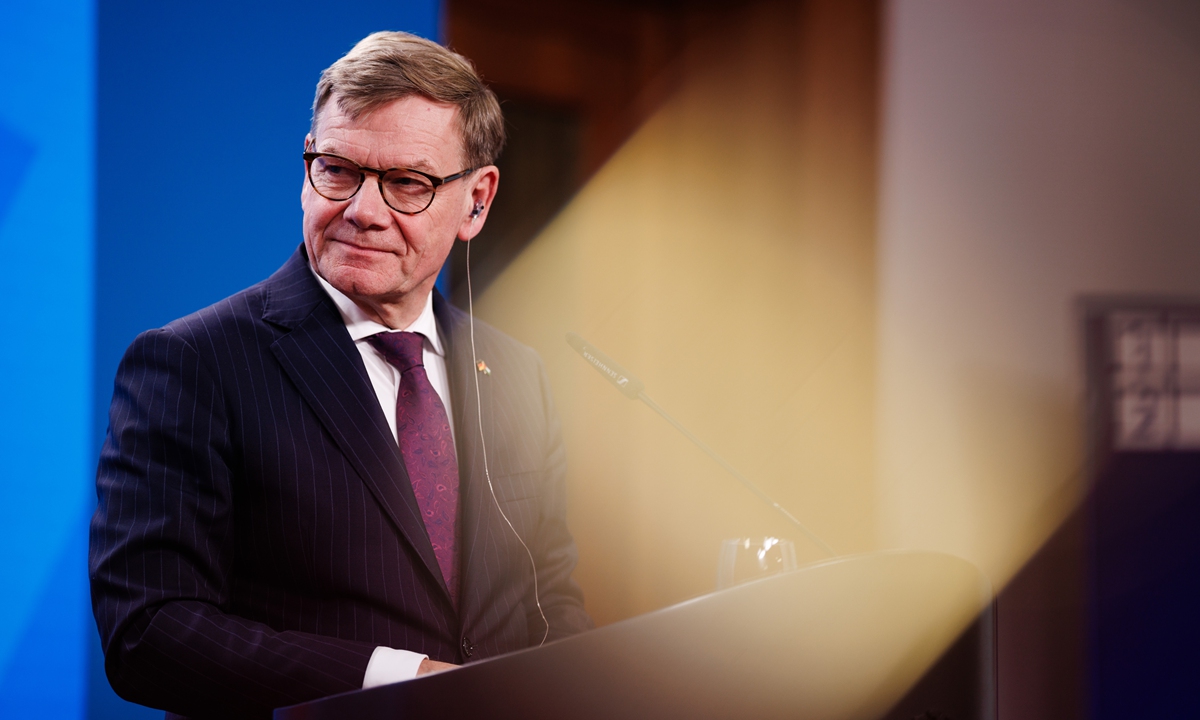
German Foreign Minister Johann Wadephul attends a press conference in Berlin, Germany, on November 25, 2025. Photo: VCG
German Foreign Minister Johann Wadephul plans to visit China before the end of this year, he said at a policy forum in Berlin on Tuesday, after postponing a planned October trip at the last minute, Reuters reported. Chinese experts said the move reflects Berlin's realization that taking a hard line on China ultimately harms Germany's own interests, and its ties with China require sincere dialogue rather than "microphone diplomacy" driven by political calculations.
Wadephul was originally due in the Chinese capital in late October on the first visit by a minister of Chancellor Friedrich Merz's government, but he cancelled at the last minute "after failing to arrange enough meetings," according to media reports.
German Finance Minister Lars Klingbeil embarked on a visit to China on November 16 to take part in the fourth China-Germany High-Level Financial Dialogue, and became the first minister of the new coalition government to travel to China.
Wadephul revealed he is now in the "last stages of coordinating" the trip to China, and that he was "confident" that the trip would be rescheduled soon. It is thought that the minister would be in the Chinese capital in the second week of December, per South China Morning Post.
In his remarks at the policy forum, Wadephul said, "I'll stay with the classic definition in the EU of partner, competitor and strategic rival. At any time, we're prepared to stress the aspect of partnership," Wadephul said, noting that without China, Europe was "not going to achieve goals" on climate protection.
Wadephul's planned trip is seen as a precursor for the first visit to China by Merz since the German leader took office earlier this year.
Cui Hongjian, a professor at the Academy of Regional and Global Governance at Beijing Foreign Studies University, sees the previous last-minute cancellation "an unnecessary interruption" in China-Germany relations.
"Wadephul's trip was meant to be the Merz government's first face-to-face engagement with China and to prepare the ground for subsequent high-level interactions. The abrupt cancellation then reflected the government's attempt to recalibrate its foreign policy, by signaling a tougher stance toward China, which undermined the China-Germany relations," Cui told the Global Times on Wednesday.
"However, the episode made Berlin realize that taking a hard line on China comes with costs: the friction in the relationship ultimately harms Germany's own interests," Cui said.
While Klingbeil's visit was an attempt to repair the damage, but as the saying goes, "the one who tied the knot must untie it," the expert noted. He believes Wadephul's decision to visit now suggests a realization that China-Germany relations require sincere, face-to-face dialogue - not "microphone diplomacy" driven by political calculations.
In an interview with German public broadcaster Deutsche Welle on Monday, Merz confirmed that he planned to visit China in January or February next year.
Merz also praised China as Germany's important trading partner, and an important force in international order, according to a report by China Media Group (CMG) on Monday.
Not only in the region, but across a much broader scope - including the emerging global order unfolding before our eyes - China holds significant influence, Merz was quoted as saying in the CMG's report.
Cui noted that the recent statements from Merz also show that Germany understands it must maintain engagement and dialogue with China, which is a prerequisite for any adjustment to its China policy.
That said, the Merz government still faces pressure from domestic politics, the US and Europe, and uncertainties still remain in the relationship. The expert urged Germany to steer ties back onto the right track and a more stable footing as soon as possible.
Earlier, Wadephul's postponed visit to China drew criticism from German lawmakers and media.
Soon after the postponement, German foreign policy spokesperson for the Social Democrats (SPD) Adis Ahmetovic called for a change of China policy, stressing "direct dialogue with China" and the need for "an active, strategic foreign policy that focuses on dialogue, clarity and long-term interests," per Reuters.
German magazine Focus wrote that Wadephul moralizes against China like his predecessor Baerbock, adding that there is a much better strategy - to learn from the country instead of "punishing it."
RELATED ARTICLES