Hospitals in multiple regions upgrade medical services to tackle peak influenza season
Online and offline platforms boast ample supply of medications
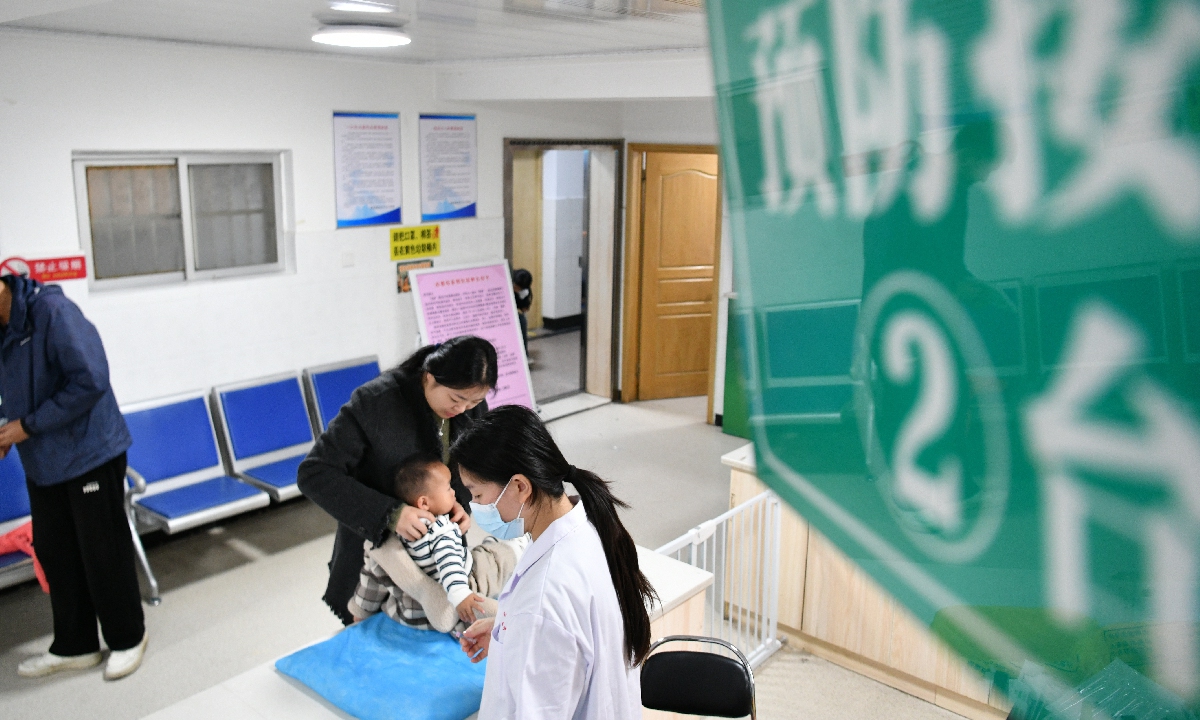
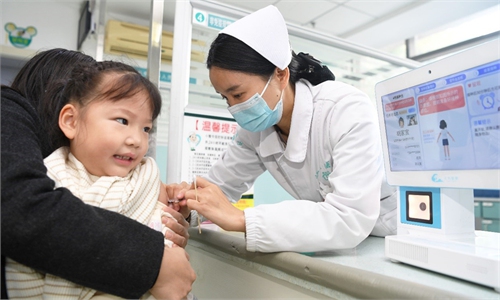
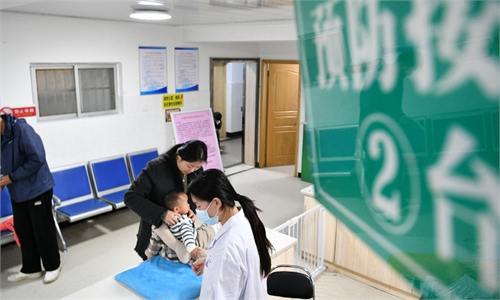
Medical staff at the Funan County Center for Disease Control and Prevention in Fuyang City, Anhui Province, provide autumn and winter flu vaccinations to young children on October 25, 2025. Photo: VCG
As influenza enters its peak season, Beijing Children's Hospital has initiated open-registration outpatient services, extended consultation hours, and provided pre-consultation testing services to address the seasonal surge in patient visits, Beijing Broadcast Television (BRTV) News reported on Thursday.The latest influenza surveillance weekly report released by Chinese Center for Disease Control and Prevention (China CDC) shows that influenza A (H3N2) holds an absolute dominance among the circulating strains, the Xinhua News Agency reported.
The number of reported influenza cluster outbreaks in childcare facilities and schools nationwide has shot up, and the positive detection rate of influenza viruses in the 5- 14 age group is higher than in other age groups, the report said.
Li Tongzeng, the chief physician of the infection department at Beijing You'an Hospital, told the Global Times on Thursday that for children born after 2020, their exposure to influenza A (H3N2) has been relatively limited as the last wave occurred in 2023, resulting in comparatively weaker immunity against it.
The annual influenza vaccine tends to be slightly less effective in preventing influenza A (H3N2) compared to its protection against the other two strains, which may contribute to a higher likelihood of infection, Li added.
To cope with peak season, Beijing Children Hospital decided not to limit registration numbers in its internal medicine and fever-and-cough outpatient departments, ensuring round-the-clock medical care, according to BRTV News.
In addition, due to increased demand for respiratory pathogen testing, the hospital has extended the operating hours of its throat swab sampling services, the report said.
Li Yuchuan, director of the outpatient department of Beijing Children's Hospital, said there has been an increase in children presenting with influenza-like symptoms at the hospital, which aligns with the level of influenza virus activity monitored by CDC.
Compared to the same period last year, there has been no significant rise in the number of children seeking treatment for respiratory infections, Li Yuchuan noted.
"The vast majority of pediatric flu cases are mild, and effective medications are available for all age groups," explained Yao Yao, deputy chief physician of the respiratory center at Beijing Children's Hospital.
Xi'an Children's Hospital in Northwest China's Shaanxi Province has implemented segregated treatment areas for respiratory infection patients and other cases, along with a triage system, local media outlet Shannxi Daily reported.
The outpatient and emergency departments are monitoring patient flow in real time and dynamically adjusting doctor schedules to ensure timely treatment while reducing waiting times and cross-infection risks, according to the report.
Xi'an People's Hospital and Xi'an Children's Hospital have also launched online consultation services to cope with the influenza season, the report said.
According to data from China CDC, influenza activity has surged, with most provinces reaching a medium epidemic level and some a high epidemic level, Xinhua reported.
Health authorities in multiple regions have issued influenza safety advisories. The Anhui Provincial CDC said on its official WeChat account on Wednesday that it has developed a flu index based on provincial monitoring data, establishing a tiered flu alert system with corresponding prevention priorities and recommendations.
It said that the province is currently at the highest flu activity level, with a significantly higher number of influenza cases than during non-epidemic periods, indicating high flu transmission intensity and a confirmed flu epidemic.
The Henan Provincial Health Commission issued a health reminder on its official WeChat account on Monday, stating that according to monitoring data from the provincial CDC, influenza in Central China's Henan remains on the rise recently, noting that this is generally consistent with the national trend and aligns with the pattern of high incidence of respiratory infectious diseases during past winter and spring seasons.
With the current high prevalence of respiratory infectious diseases like influenza, the demand for flu medications continues to rise, China National Radio (CNR) reported on Tuesday.
Data shows that sales of oseltamivir, a medication for treating and preventing influenza, have increased by 237 percent over the past seven days, while sales of a similar drug baloxavir marboxil have risen by 180 percent, the report said.
A pharmacy staff member said that although flu medications have been selling quickly recently, the supply remains sufficient, and there have been no instances of these drugs selling out entirely, according to the report.
"Despite the recent increases in demand for oseltamivir and baloxavir marboxil, stock availability remains stable," the staff member added.
On some e-commerce platforms, flu medications are also not out of stock and can be ordered, CNR reported.
In addition to maintaining personal protective measures, receiving the influenza vaccine is one of the most effective preventive approaches, Li Tongzeng said, adding that it is advisable to complete vaccination before November, as it takes approximately two to four weeks after inoculation for the body to develop adequate protection.
RELATED ARTICLES