Environment quality of China’s Huangyan Dao remains excellent, report shows
‘Healthy and stable’ condition underscores effectiveness of governance, conservation efforts: expert
By and Fan Wei Published: Nov 28, 2025 10:38 PM

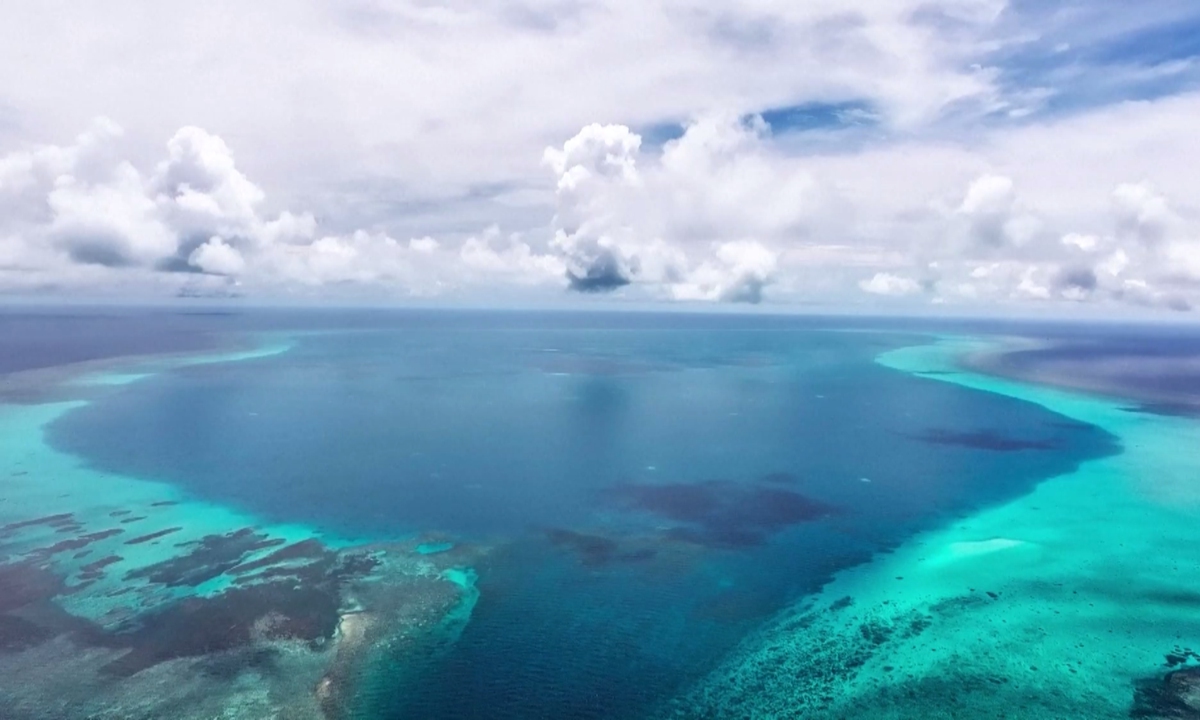
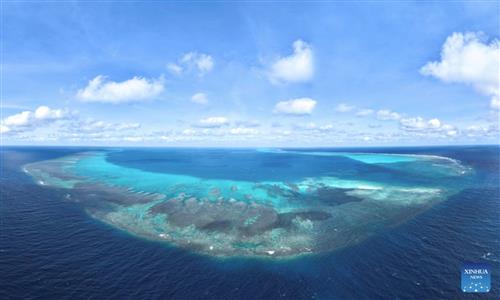
An aerial drone photo taken on June 30, 2025 shows a panoramic view of China's Huangyan Dao in the South China Sea. Huangyan Dao is part of China's Zhongsha Qundao with diverse natural ecosystem. Photo: VCG
China's Ministry of Ecology and Environment on Friday released the 2025 survey and assessment report on the ecological environment of the waters around China's Huangyan Dao in the South China Sea, saying that the island maintains excellent marine environment quality.
The report notes that seawater and marine sediments both met Class I standards, while concentrations of pollutants such as heavy metals and petroleum hydrocarbons in fish samples remain below evaluation thresholds. No cyanide has been detected in seawater, sediments or fish samples.
According to the report, Huangyan Dao has a natural ecosystem with good diversity, stability, and sustainability, which provides an important habitat and shelter for marine life in the South China Sea, and also serves as an important natural archive for recording global climate change and environmental evolution.
The report was released about two-and-half months after China's State Council approved the establishment of the Huangyan Dao national nature reserve, which serves as an important institutional guarantee for conservation of the diversity, stability and sustainability of Huangyan Dao's natural ecosystem in the South China Sea.
China released the first investigative and assessment report on the ecological environment near Huangyan Dao in July 2024. The Friday's report edition is the second of its kind.
Yang Xiao, a maritime issues expert at China Institutes of Contemporary International Relations, told the Global Times on Friday that the report reflects China's sovereignty over the Huangyan Dao and the effectiveness of its governance conservation efforts.
Yang personally took part in compiling the 2025 report. He said the scientific expedition itself serves as the important support for the environmental protection cause, providing policy recommendations through data.
He emphasized that such comprehensive reports will become a regular, ongoing practice in the years ahead.
Encouraging findings
According to the report, the coral reef ecosystem of Huangyan Dao remains healthy and stable. The on-site surveys recorded 134 species of reef-building corals from 14 families and 39 genera, an increase of 25 species compared to the 2024 survey.
In addition, the average live coral cover has reached 29.8 percent. Coral communities are also showing strong resistance and tolerance to rising sea temperatures.
The report also suggested a rich reef-dwelling biodiversity, with surveys recording 145 species of reef fish from 24 families, an increase of 20 species from 2024. Three species of giant clams were found, together with crustose coralline algae, coralline coral, soft corals and sea lilies.
The report said no phase shift from corals to macroalgae was observed, and no coral diseases were detected. Numbers of Acanthaster and other harmful organisms remain low. Surveys also found three species of seagrass inside the lagoon: Halophila ovalis, Cymodocea rotunda and Syringodium isoetifolium.
On the other hand, the report warned that as climate change accelerates, the coral reefs of Huangyan Dao are facing increasing heat stress, and the potential risk of coral bleaching cannot be ignored.
The report is the result of a comprehensive assessment by the scientific expedition team, based on a series of activities, including sampling, underwater investigations, drone deployments, satellite imagery analysis, and other integrated research methods, Yang said, noting that the number of survey sites, vessels deployed, and the duration of the operation all significantly exceeded last year's efforts.
He attributed the encouraging quality of the ecosystem around Huangyan Dao to China's effective conservation and management measures, including the delineation of territorial sea baselines and the conduct of regular law-enforcement patrols. "Only a few years ago, destructive illegal fishing activities carried out by the Philippine side inflicted severe damage on the local marine environment."
China has established a comprehensive, long-term, and stable fishery conservation system, and China's summer fishing moratorium policy plays a pivotal role in the recovery of marine ecosystems, Chen Xiangmiao, a research fellow at the National Institute for South China Sea Studies, told the Global Times.
The South China Sea summer fishing moratorium system, which was officially implemented in China since 1999, has been in effect for 26 years.
This fully demonstrates China's commitment to safeguarding the ecological environment of the South China Sea and reflects the responsibility of a major country, as the protection of the South China Sea's ecological environment is vitally important to global marine security, said the expert.
Chen Xidi, an expert at the China Institute for Marine Affairs at the Ministry of Natural Resources, told the Global Times that the successful experience China has gained in ecological protection at Huangyan Dao can also be extended to conservation efforts in other parts of the South China Sea to better protect the region's biodiversity.
"The experience from Huangyan Dao offers valuable reference points. Across the South China Sea, factors such as marine heatwaves and outbreaks of crown-of-thorns starfish are threatening the ecological environment, particularly affecting the growth of reef-building corals," Chen said.
Speaking with facts
In addition to the ecosystem report of Huangyan Dao, in April this year, China's Ministry of Natural Resources issued a survey report on the coral reef ecosystems of Tiexian Jiao and Niu'e Jiao.
The report was released mainly to debunk "sea reclamation" allegations from the Philippines. The document noted that tropical cyclone strikes and frequent human activities, especially the Philippines' persistent and illegal construction on Zhongye Dao are also causes of the deterioration of the coral reef ecosystem of Tiexian Jiao.
It said that fishing vessels were found operating in waters around Tiexian Jiao and Niu'e Jiao, warning that such fishing activities and anthropogenic disposals would threaten the health of the coral reef ecosystems.
Efforts will be made to further intensify the survey, research, evaluation and protection of Tiexian Jiao, Niu'e Jiao and their adjacent waters, according to the report.
Since 2024, the Philippines has tirelessly but groundlessly smeared Chinese vessels, accusing them of using "suspected cyanide" in waters of Huangyan Dao.
"The Philippines has repeatedly sought to brand China as the destroyer of the South China Sea environment," said Chen, "But China's latest scientific report, grounded in rigorous evidence and irrefutable data, has effectively debunked these baseless allegations and laid bare the Philippines' malicious smear campaign."
Yang Xiao disclosed that the Chinese scientific expedition team observed a clear trend: the closer the sampling sites were to the Philippine side, the higher the concentrations of marine plastic debris and microplastics detected. This particular finding was ultimately not included in the final published report, as the Chinese side aims to ensure a high level of scientific rigor.
Analysts said that over the years, China has actively participated in regional cooperation on environmental protection in the South China Sea including joint scientific expeditions, joint law enforcement patrols, and releasing fish fry. In the negotiations on the Declaration on the Conduct of Parties in the South China Sea (DOC) and the Code of Conduct in the South China Sea (COC), China has proactively worked at the institutional and regulatory level to advance marine ecological conservation.
China remains committed to regional ecological cooperation, said Chen, reiterating that the country has both the capability and the willingness to continue investing in marine environmental protection in the South China Sea and welcomes joint monitoring and research initiatives with other regional countries.
Scientific cooperation rather than confrontation is the most effective way to protect this shared marine ecosystem, the expert said.
RELATED ARTICLES