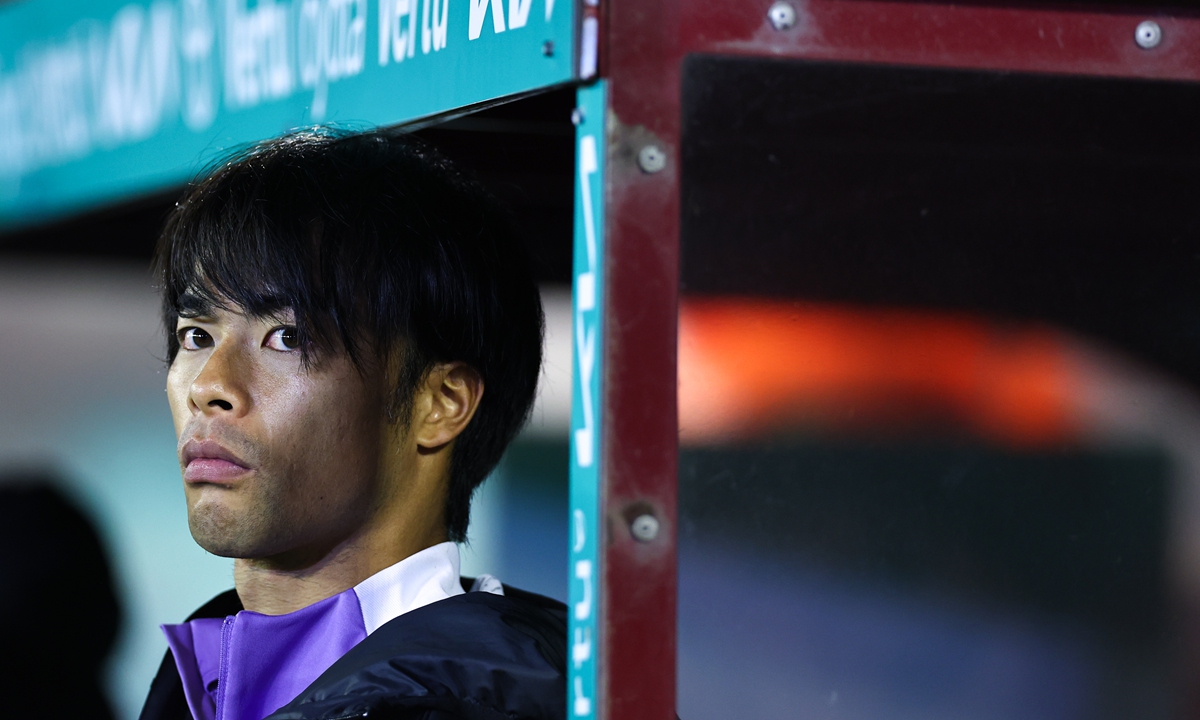
Kaoru Mitoma of Brighton and Hove Albion during the Carabao Cup Third Round match between Barnsley and Brighton & Hove Albion at Oakwell Stadium on September 23, 2025 in Barnsley, England. Photo: VCG
British football club Brighton apologized after a club social media post featuring Kaoru Mitoma and an academy player holding up an image of a Japanese WWII soldier. The post sparked anger and disappointment among fans in Asia, which suffered under Japanese atrocities during WWII.
The post was first published on the Brighton & Hove Albion Academy X account, officially affiliated with Premier League club Brighton & Hove Albion. It showed Mitoma and a youth player posing with a football card featuring Hiroo Onoda. Onoda was the last Japanese soldier to formally surrender, 29 years after the country's defeat in the war. He was a member of the Japanese imperial army, and was accused of killing up to 30 Filipinos on the island of Lubang, according to BBC.
The controversial post was later deleted.
The Japanese Imperial Army, an aggressor in the Pacific region during WWII, committed numerous atrocities in China and elsewhere during the war, which is why the post had the reaction it did, noted Football news site Goal.com.
Goal.com called it "a significant PR crisis." However, as of Sunday evening, Brighton had yet to explain how the error occurred, although an apology was issued on the Brighton & Hove Albion Academy X account. In the post on Saturday, the Academy apologized, writing that "The club sincerely apologises for any offence caused in China by a recent post about our Academy's participation in the Premier League Christmas Truce Tournament."
"We hugely value our fans in China and had no intention of causing any offence."
The post is still restricted to "accounts @BHAFC_Academy mentioned can reply," meaning no users are currently able to leave public comments.
Under other posts on Brighton & Hove Albion's official X account, some fans have called on the club to issue a statement or offer a further apology over the incident.
In response to the enquiry from the Global Times, the English Premier League stated that Brighton has issued a response to the matter and included the club's full statement in its email to the Global Times. It added that Brighton's now-deleted post was not part of any official league education materials, had not been approved by the Premier League, and that the league was unaware of the specific details or individuals featured in the club's project.
BBC Sport quoted Brighton officials as saying that "it was a genuine error" and the controversy was not known to the club or the Premier League.
Observers noted that both the Premier League and Brighton should provide a detailed explanation of how the incident occurred and outline measures to ensure that similar mistakes do not happen again.
Social media Outrage
Anger and disappointment were ignited after its original post was shared on the Chinese platform Weibo by an account widely followed by Premier League supporters in East Asia, The Sun reported.
A Weibo user posted that "It should not only apologize to China, but also to all the countries that have suffered from Japanese fascist aggression."
An X user Yichen asked "You apologized for offending fans in China. Just that? This man you commemorated was also involved in killing Filipino civilians during and after WWII for 30 years. What a club. Brighton."
The post was also widely criticized by football fans outside China.
Goal.com quoted one staging that, "I thought this was photoshopped. One of their players is pro war criminal?!? "
"Yes it blew up in China more than anywhere else because there's more Chinese PL and Brighton fans, but the Japanese Army committed atrocities all over Asia, only apologizing to Chinese fans make it seem like they still don't understand the severity of the situation," an X user and also a Brighton fan, named Jack posted.
"We Are Brighton," an X account run by a supporters' website, wrote: "The WAB Twitter account has posted some questionable things at times, but I'm not sure it has ever besmirched the good name of Brighton & Hove Albion as badly as posting a photo of our star Japanese winger holding up a picture of a Japanese World War II soldier. Need to up our game. #BHAFC."
Under the post mentioning the incident, a fan using the handle "BennettsFieldBunny" questioned why the club did not also apologize to British supporters, writing: "Why are they not apologising to British and UK fans as well? The Japanese carried out terrible atrocities against UK prisoners of war, including the Sussex regiments that served in the Far East. Shambles by the club," while tagging @OfficialBHAFC.
South Korean media also took note of the controversy. The Chosun Daily commented that "this incident is not just a social media error but a failure to meet the minimum standards expected of a global club."
However, as of press time, Mitoma has not commented.
British tabloid The Sun, while noting in its report that "the Japanese Imperial Army committed numerous atrocities in China during WWII," it wrote that Brighton was "forced" to issue an apology to "the entirety of China."
Fascist background
Such incident came amid Japanese Prime Minister Sanae Takaichi's recent remarks on Taiwan, in which she claimed that a "Taiwan contingency" could constitute a "survival-threatening situation" for Japan, implying the possibility of armed intervention in the Taiwan Straits.
Her remarks, together with her consideration of revising Japan's "three non-nuclear principles" and Article 9 of the Japanese Constitution — which bans Japan from possessing nuclear weapons and maintaining armed forces — have been viewed by many in China as a concentrated reflection of the country's broader rightward shift.
According to Goal.com, Onoda, who was printed on the football card, served in the Japanese army between 1942 and 1974. He had retreated into the jungle in the Philippines following the end of the WWII, refusing to accept his country's surrender and that the conflict was over.
Onoda was alleged to commit atrocious violence in his years after the WWII, according to BBC, there are accounts of up to 30 killings of Lubang islanders.
However, Onoda returned to Japan and received a hero's welcome. But anger remained in the Philippines. When he returned to Lubang in 1996, relatives of people he was accused of killing gathered to demand compensation, according to CNN.
"With nationalist sentiment on the rise again in Japan," James Lattimer wrote, in a review published shortly after a film about Onoda premiered in Cannes in 2022, "making a film that essentially celebrates someone who appeared to fully assimilate its imperialistic ambitions is naive at best and insulting at worst; it's telling here that the Filipinos who appear are little more than cannon fodder."
Onoda exemplified a generation of Japanese soldiers deeply immersed in the militarist ideology of wartime Japan, upholding a blind loyalty to the Japanese emperor and misguided patriotism, Xiang Haoyu, a distinguished research fellow at the Department for Asia-Pacific Studies of the China Institute of International Studies, told the Global Times.
Onoda was essentially a personification of militarism, and Mitoma's actions reflect how younger generations in Japan have long lacked a correct understanding of the country's past aggression and imperial expansion, Xiang said.
Against the backdrop of a growing right-wing presence in Japan, the neglect of wartime aggression and the spread of right-wing narratives have increasingly shaped mainstream discourse, contributing to a worrying revival of militaristic thinking among the younger generation, Xiang said.
Notably, Japan has long downplayed and even whitewashed its massacres and wartime atrocities in Southeast Asian countries, at times portraying them as efforts to "liberate" the region from European colonial powers. The Philippines, for geopolitical reasons, has also rarely highlighted these issues, allowing cases like Onoda's to evade proper criticism, Xiang noted.