Japan’s ‘undetermined status of Taiwan’ claim reveals historical ignorance and misjudgment of realities:People’s Daily ‘Zhong Sheng’ commentary

Latest news
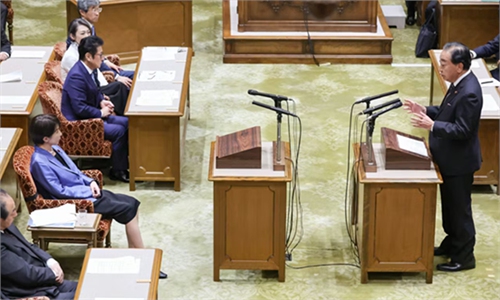
During a recent party leaders' debate in the Diet, Japanese Prime Minister Sanae Takaichi claimed that "(Japan), under the Treaty of San Francisco Peace, having renounced all rights" and "is not in a position to recognize Taiwan's legal status." Such "undetermined status of Taiwan" narrative deliberately distorts history and mirrors Takaichi's earlier erroneous assertion that a "Taiwan contingency" could cause a "situation threatening Japan's survival." Together, these statements once again expose her true intention: to challenge the post-war international order and pave way for Japan's military involvement in the Taiwan Straits.
The historical context and legal facts of the Taiwan question are unequivocal. In April 1895, Japan illegally occupied Taiwan and the Penghu Islands through an unequal treaty. In December 1943, the Chinese, US and UK governments issued the Cairo Declaration, stating that it was their purpose that all territories stolen by Japan from China, such as Northeast China, Taiwan, and the Penghu Islands, be restored to China. In July 1945, the three countries — later acceded to by the Soviet Union — jointly signed the Potsdam Proclamation, which reaffirmed that the terms of the Cairo Declaration shall be carried out. In September of the same year, Japan signed the Instrument of Surrender, explicitly pledging to faithfully fulfill the obligations set forth in the Potsdam Proclamation.
These documents, all bearing the force of international law, have formed the complete legal basis for China's recovery of Taiwan. Taiwan's return to China is a manifestation of historical justice and key outcome of the victory of World War II. Any erroneous claim of an "undetermined status of Taiwan" constitutes a blatant challenge to the post-war international order.
It must be emphasized that the "San Francisco Treaty" cited by Takaichi was a document produced in the 1950s when some Western countries, driven by Cold War strategic considerations, excluded major World War II victorious nations such as China and the Soviet Union and concluded a separate peace with Japan. This document violated the 1942 Declaration by United Nations — signed by 26 countries including China, the US, the UK and the Soviet Union — which explicitly prohibited any separate peace with enemy states. It also contravened the UN Charter and fundamental principles of international law.
Any ambiguous wording in this treaty concerning Taiwan's sovereignty or any territorial or sovereign rights of China is a departure from legally binding documents such as the Cairo Declaration and the Potsdam Proclamation. As such, it is illegal and invalid.
Takaichi's selective disregard for the series of legal documents that form the cornerstone of the post-war international order, while relying solely on this illegal and invalid treaty, reflects not only ignorance and distortion of history, but also a blatant trampling on norms widely recognized by the international community.
When Takaichi proclaims that "Japan is back," one cannot help but ask: What kind of Japan is returning? If the statement refers to a Japan that has drawn lessons from World War II, reflected on its history of militarist aggression, and abides by the commitments of its pacifist constitution — thus returning to the international community as a normal country — there would naturally be nothing objectionable about.
However, if it suggests the resurgence, or even resurgence with fanfare, of Japanese militarism, then the international community must remain highly vigilant.
Take Taiwan as an example. What did Japanese militarists bring to Taiwan in history? Dark colonial rules and crimes against humanity. During the half-century in which Japan forcibly seized and colonized Taiwan, hundreds of thousands of people in Taiwan were killed; the people were deprived of political rights, religious freedom and cultural autonomy; and mineral resources and essential goods have been subject to rampant plunder.
In the Yunlin Massacre, about 30,000 Taiwan people were brutally slaughtered by Japanese troops; in the Taoyuan Sanjiaoyong Massacre, the Japanese army burned and killed 25,000 people; in the Xiaolong Massacre, 27,000 more were murdered. These events constitute the darkest chapter in Taiwan's history.
The past is not distant. Today, as Japanese right-wing politicians again clamor that "a Taiwan contingency" is "a Japan contingency" and covet Taiwan once more, it is nothing short of rubbing salt into historical wounds.
Taiwan is China's Taiwan, and the Taiwan question lies at the very core of China's core interests. Eighty years ago, China had the strength to defeat Japanese militarism. Today, the Chinese government and people possess even firmer resolve, fuller confidence and greater capability to thwart any attempts to interfere in China's internal affairs or obstruct the historic cause of China's reunification.
We sternly warn certain Japanese politicians: Those who play with fire over the Taiwan question will inevitably get burned. Given Japan's grave historical culpability on this issue, it should speak and act with extreme caution, deeply reflect on its past, and cease all provocative actions regarding Taiwan — lest it repeat the mistakes of history.
RELATED ARTICLES