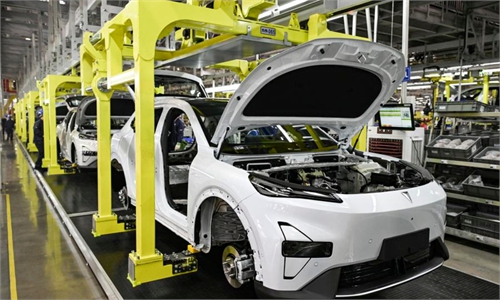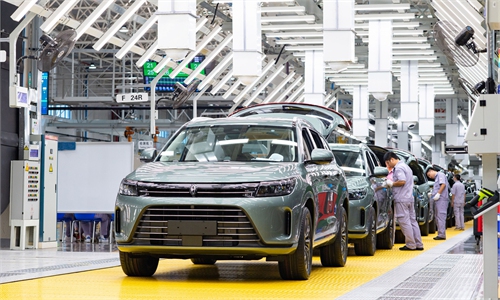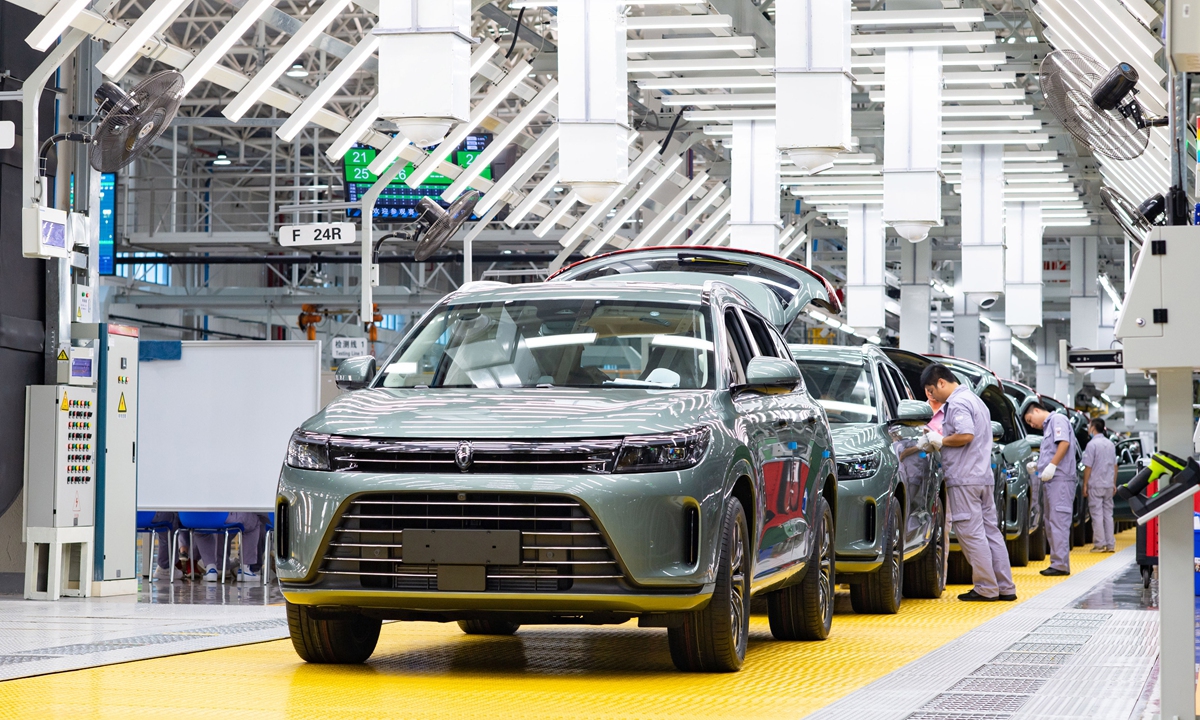
An NEV manufacturing line in Southwest China's Chongqing Municipality Photo: VCG
Multiple Chinese new-energy vehicle (NEV) brands released their November sales and delivery figures on Monday, showing robust year-on-year growth. A Chinese expert noted that this reflects the continued momentum of NEVs, driven by policy support, technological advancements and the expansion of battery-swap networks as the nation pushes for a green transition.
Huawei's Harmony Intelligent Mobility Alliance announced the delivery of 81,864 vehicles across its lineup last month, up 89.61 percent year-on-year and marking a new monthly record for its deliveries, according to the company's official WeChat account.
Also on Monday, Xiaomi Auto said that its deliveries in November continued to exceed 40,000 units, according to the official WeChat of the company, maintaining a similar level compared with October and September.
Domestic NEV brand Voyah announced the delivery of 20,005 vehicles last month, up 84 percent year-on-year, setting a new record with monthly deliveries surpassing 20,000 units for the first time and achieving 10 consecutive months of growth, according to China Automotive News.
As a representative state-owned enterprise undergoing a new-energy transformation, Voyah continues to innovate technologically and expand its product lineup, reaching its 200,000th vehicle in April and crossing the 300,000-vehicle milestone in November, the report said.
Also on Monday, Leapmotor announced through its official WeChat account that it delivered 70,327 vehicles in November, a new high and an increase of more than 75 percent year-on-year. The company continues to set monthly sales records and has maintained strong growth for nine consecutive months, it said.
The strong sales growth of NEV brands demonstrates that market demand remains robust, with many new brands ramping up efforts to gain an edge in the booming sector, Cui Dongshu, secretary-general of the China Passenger Car Association, told the Global Times on Monday.
The NEV Industry Development Plan (2021-2035) set a target for NEVs to account for about 20 percent of total new vehicle sales by 2025, a goal that has already been exceeded ahead of schedule, the Xinhua News Agency reported, noting that behind this surge lies a series of systemic breakthroughs across the entire NEV industry chain during the 14th Five-Year Plan period (2021-25).
Continuous advances in NEV technology, along with the nation's sustained push for green transformation, have helped brands secure a solid foothold in the market, Cui said.
In addition to policy support that empowers high-quality industrial development, other areas such as expanding charging and battery-swap networks, along with intelligent road infrastructure, have advanced in a coordinated manner, creating new opportunities for the industry's growth, the expert said.
Global Times
RELATED ARTICLES