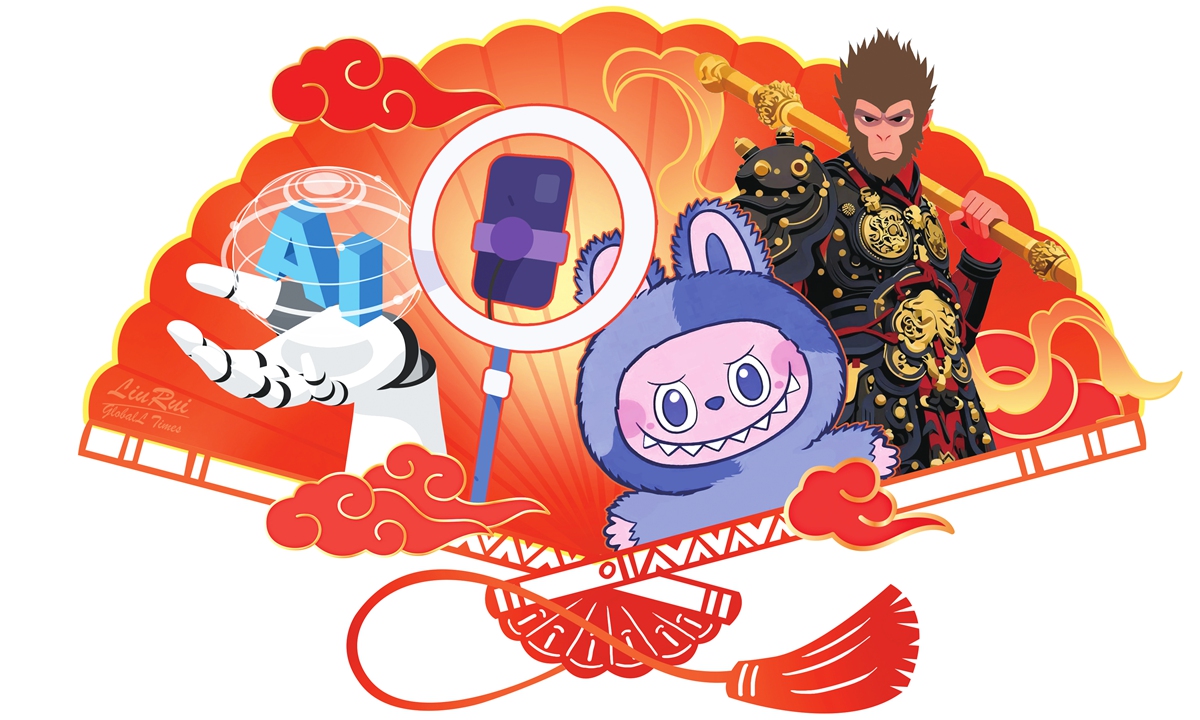
Illustration: Liu Rui/GT
Recently, "Cool China" has emerged as a new label used by some Western media outlets to describe the country. From The Economist asking "How did China become cool?" to outlets like Reuters, The New York Times, and Germany's Die Welt picking up the concept for discussion, "Cool China" has been gaining momentum in the international discourse.
In English, "cool" typically connotes "fashionable" and "attractive." For years, Western conservative media outlets have frequently used ideologically biased vocabulary to portray China. Yet now, "cool" has entered their lexicon. So, what has led foreign media to begin describing China with the word "cool"?
If we examine the origins of this concept, we will find that "Cool China" didn't emerge from a top-down promotion, nor was it manufactured by foreign media. Rather, it grew out of the spontaneous and genuine reactions of the overseas public, especially young people, who, after looking beyond layers of preconceived "filters," are finally seeing China as it is.
Nie Shujiang, an associate professor at the Guangming School of Journalism and Communication of China University of Political Science and Law, told Global Times that he studied the concept of "Cool Britannia" in his doctoral dissertation in 2012. He never imagined that, years later, Western media would begin applying the word "cool" to China. In his view, "Cool China" is essentially the result of Chinese modernization development over the years, evoking a heartfelt admiration from international audiences when they witness the progress firsthand.
The rapidly evolving technologies, including open-source model DeepSeek, Huawei's tri-fold smartphones, urban drone-delivery networks, and a well-developed new energy vehicle infrastructure, have become an integral part of daily life in China. These everyday technological scenes continue to amaze the overseas public, especially younger generations, eliciting genuine admiration.
Meanwhile, the contemporary creativity of Chinese culture forms another core dimension of what makes China "cool." As Zhang Yiwu, a professor of Chinese language and literature at Peking University, notes, by creatively transforming traditional culture and drawing inspiration from contemporary lifestyles, China is producing a range of "cool" cultural products that resonate beyond its borders, gaining popularity among young people in the West.
The Chinese top-tier video game "Black Myth: Wukong" sold more than 10 million units globally in three days, Labubu dolls sparked long queues on the streets of London, and Chinese cross-border e-commerce live streams and micro-drama exports have reached scale - all of which underscore China's rising cultural influence.
"Cool China" also benefits from an "open and confident China." In recent years, China has significantly relaxed visa restrictions for foreign citizens traveling to the country. Data shows that China's Beijing ports observed a notable rise among foreign tourists, with entries and exits totaling 5.78 million - a sharp increase of over 35 percent. Approximately 60 percent of these foreign travelers benefited from China's visa exemption or temporary entry permit policies. It is because China insists on sharing more opportunities and benefits with the world that people from all countries have greater access to experience an increasingly "cool" China. This also reflects China's deep-seated confidence, which is embodied in its willingness to allow content creators, entrepreneurs, and innovators from around the world to freely observe, authentically document, and engage in candid exchanges here.
A "cool" China is awakening global interest to rediscover China, significantly enhancing the international visibility and positive perceptions of Chinese culture. In the future, China will open wider, broaden our vision of innovation, and deepen cooperation to share more opportunities and benefits with the rest of the world, and let people all over the world see and experience an ever-cooler China. We look forward to more international friends breaking through the information cocoons created by algorithms and the narrative traps set by media, personally experiencing a vibrant, open, and innovative China, and expressing that heartfelt admiration - "China is Cool!"
RELATED ARTICLES