Chinese youngsters prone to low alcohol, ‘enjoy the moment, not regret it tomorrow’
By Published: Dec 04, 2025 02:33 PM

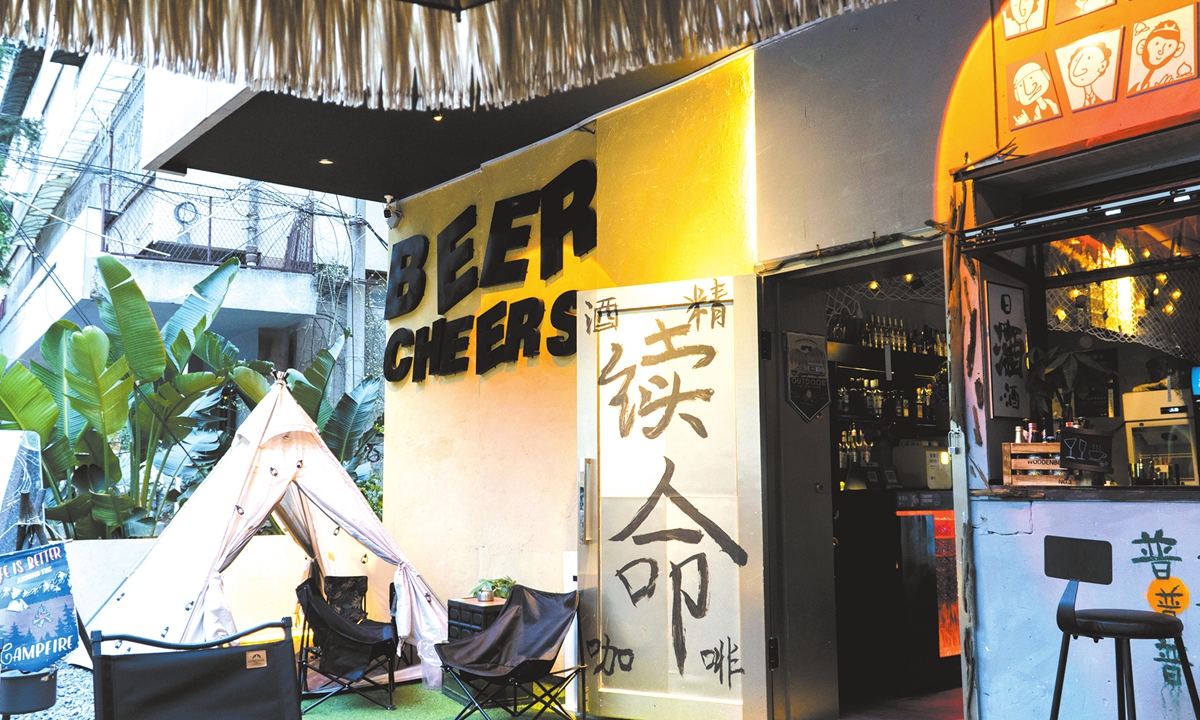
A venue in Kunming, Southwest China's Yunnan Province, operates as a café by day and transforms into a bar by night since April 1, 2023. Photo: VCG
For some time, a fashionable mantra among young Chinese has been "Morning C, Night A" - coffee to start the day and alcohol to "call it a night."
But while coffee still reigns in the morning routine, many young people appear to be quietly distancing themselves from the strong nightly drink.
In a pub named Fuyidabai in Beijing's Daju hutong area, a few groups of people in their 20s and 30s clustered around casually arranged tables, speaking in low voices, brightly coloured drinks lay out before them.
"This is a baijiu-flavoured cocktail - you can still detect the baijiu, but only just," said a customer giving his surname as Xia. On a Friday night when many might opt to drink themselves senseless, Xia and his friends prefer a gentler approach, seeking only a mild buzz. "That way," he said, "we don't lose the entire weekend to a hangover."
"I used to think low- or no-alcohol drinks were a bit sissy. But when I hit 30, I began to wonder why I was using alcohol to numb my feelings. It simply isn't healthy," said Xia.
The bar's owner, Wei Xiao, told the Global Times that young patrons today favor a more "artsy vibe": Rather than knocking back strong spirits, they opt for fruit-flavoured cocktails and prefer to spend their evenings lingering over low-alcohol drinks and good conversation.
Low-alcohol new beverages such as fruit wine, tea-based alcohol and sparkling alcoholic drinks have become some of the fastest-growing categories in China's instant retail market.
According to a report on consumption of low-alcohol published in June by Chinese e-commerce giant JD.com, the share of low-alcohol products in instant retail continues to rise: Fruit wine accounts for 38 percent (with annual growth of 72 percent), tea-based alcohol 25 percent (up 65 percent) and sparkling alcoholic drinks 17 percent (up 210 percent).
Products such as Meijian plum wine, Nayuki's alcoholic tea drinks and Moutai's blueberry sparkling alcohol have become the favorites among young consumers, China News Service reported.
Enjoy the moment
In May this year, remarks made by then chairman of Kweichow Moutai Zhang Deqin went viral on social media, in which he claimed that young people are not against drinking, they just dislike the flattery-filled banquet drinking culture.
"Drinking out of social obligation is outdated," said Francis Fan, a Chinese office worker in Beijing. "Older people [in the office] often pressure the young to drink and treat it as a test for newcomers. When drinking becomes a duty, it takes away the pleasure of enjoying it."
He noted that younger people are increasingly unwilling to submit to such meaningless tests, and that the practice is not healthy.
A year and three months have passed since Da Ya (a pseudonym) gave up alcohol. Once a heavy drinker who poured herself a glass of wine each day, or more, she describes the process of loosening her dependence as "a gentle breakup with my past self."
Since cutting back, she told the Global Times, her skin has improved and her body feels lighter. "I've started exercising more, and my mind works better on the job. Life now has anchor points that pin down the urge to drink, and I feel myself slowly returning to something real."
"The phrase I hear constantly is weixun - that pleasant, slightly tipsy feeling without losing control. Young consumers specifically tell me they want to 'enjoy the moment, not regret it tomorrow,'" Dan Siebers, brand marketing director of a large comprehensive wine service group, told the Global Times.
Siebers described three forces driving the shift - a rising health consciousness among young Chinese who want to socialize without sacrificing their performance the following day; a change in drinking occasions as formal, toast-heavy banquets give way to relaxed, longer gatherings where people prefer to pace themselves; and the rise of an "experience economy," in which consumers value memorable, high-quality drinks and conversations over consuming strong spirits for social obligation.
To ensure that their legacy continues, more Chinese liquor brands are innovating their products, with an increased focus on low-alcohol, fruit-flavored beverages instead of grain-based baijiu.
In August, Chinese liquor maker Wuliangye launched its new low-alcohol products tailored to younger consumers' tastes and aesthetics, including a 29 percent ABV (alcohol by volume) variant.
Another well-known Chinese liquor producer Luzhou Laojiao announced at its 2024 annual shareholders' meeting that it had developed a 28 percent ABV version of its flagship Guojiao 1573, which will be released to the market at an appropriate time, according to Beijing Business Today.
Siebers said the young people's change in drinking behavior is "a generational transformation." This is a more confident generation that doesn't need alcohol to lubricate social or business interactions, and puts greater emphasis on individual well-being over collective rituals. They're comfortably saying no, or saying "just one," he told the Global Times.
RELATED ARTICLES