Japan job posting seeking writers to praise Japan and criticize China taken down; move exposes sinister intentions of certain Japanese forces: expert
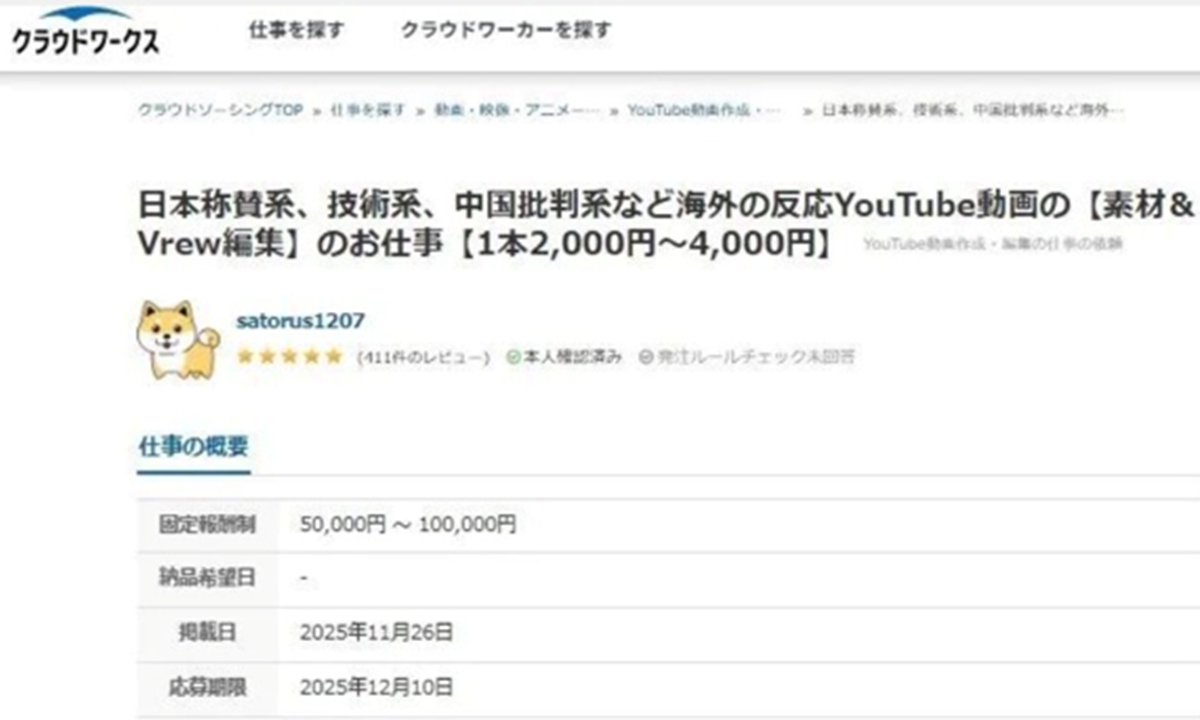
Photo: Screenshot of the recruitment post released on November 26, 2025
Japan's crowdsourcing platform CloudWorks took down a recruitment post on Wednesday that sought creators for "YouTube videos on overseas reactions that praise Japan and criticize China," Japanese media outlet J-Cast reported.
Regarding the reason for its removal, the company's public relations department explained that the content was determined to likely violate the platform's work request guidelines, the report said.
The recruitment post was published on November 26, offering a reward of 2,000 to 4,000 yen ($12.87 to $25.74) per video for creating "praise-Japan type" and "criticize-China type" YouTube videos, J-Cast reported.
In the application requirements section, in addition to conditions such as "individuals capable of working online" and "capable of maintaining smooth communication," it specifically noted that applicants "must have a strong affinity for Japan."
The job requirements also stipulate those screenwriters should create a wide variety of works to engage and move the audience, read the screenshot.
According to the screenshot of the job posting page, the poster of this recruitment is a netizen named "satorus1207," who is verified as Japanese on the platform.
Recruiting scriptwriters to produce content that smears China demonstrates the existence of certain sinister forces in Japan who attempt to defame China through unscrupulous means and are intent on waging a public opinion war against China, Da Zhigang, director of the Institute of Northeast Asian Studies at the Heilongjiang Provincial Academy of Social Sciences, told the Global Times on Thursday.
These forces have penetrated into the field of social media, seeking to shape erroneous perceptions of China and mislead the public, he added.
Against the backdrop of tensions in China-Japan relations triggered by Japanese Prime Minister Sanae Takaichi's erroneous remarks on Taiwan, Japan has intensified its discourse contestation targeting China, Da said.
Some right-wing forces in Japan have fueled this trend, malignantly stoking tensions, damaging bilateral relations, and fostering erroneous perceptions of China, Da added.
The November 26 post was not the first of its kind. According to a screenshot of a previous recruitment post, a job listing for "scriptwriters to produce YouTube videos that praise Japan and discredit China" was also published on May 28.
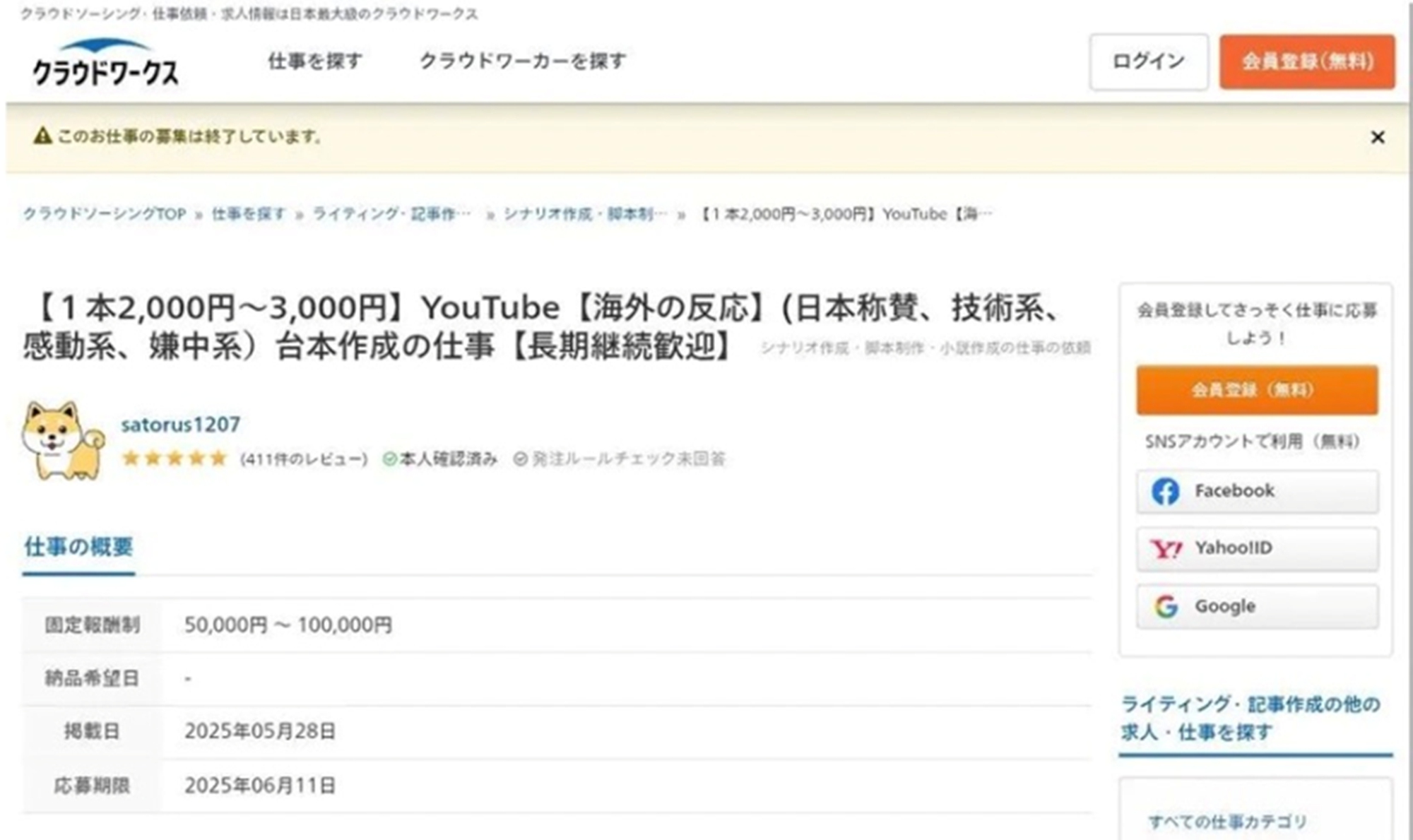
Photo: Screenshot of the recruitment post released on May 28, 2025
The recruitment requirements stated that video scripts should "be based on factual depictions of Japanese companies and outstanding technologies," while using "fabricated portrayals" to frame the "moral corruption and self-serving behaviors of the Chinese people."
At the time, this recruitment post attracted 15 applicants, with five of them being successfully recruited.
In a post in August 2024, it also explicitly mentioned producing "criticize-China and South Korea" YouTube videos, per the report.
The recruitment notice has not imposed any restrictions on the nationality of scriptwriters. Da said that the intention behind not setting nationality limits for recruits is to allow anyone to participate in building the rivalry against China, which indicates certain Japanese forces' sinister intentions.
The public relations department stated on Wednesday that the recruitment content has been made non-public because it likely violates the platform's regulations, especially the prohibited items listed in the company's regulations, including "requests that could lead to factual misrepresentation or manipulation of public perception regarding specific organizations, professions, individuals, products, customs, cultures, politics, countries, or other entities," as well as "requests that may result in factual misrepresentation or manipulation of public perception."
The public relations department also stated that it is having AI learn data on detected violations and expressions that have been viewed as problematic. Through this, it aims to improve the accuracy of detecting future violation cases.
Da said that the tendency of certain segments in Japan to stoke tensions is partly fueled by the rise of right-wing thinking within Japanese society, which could lead to miscalculations in national strategic decision-making.
RELATED ARTICLES