Japanese leader should explain Taiwan-related policy honestly, accurately, completely
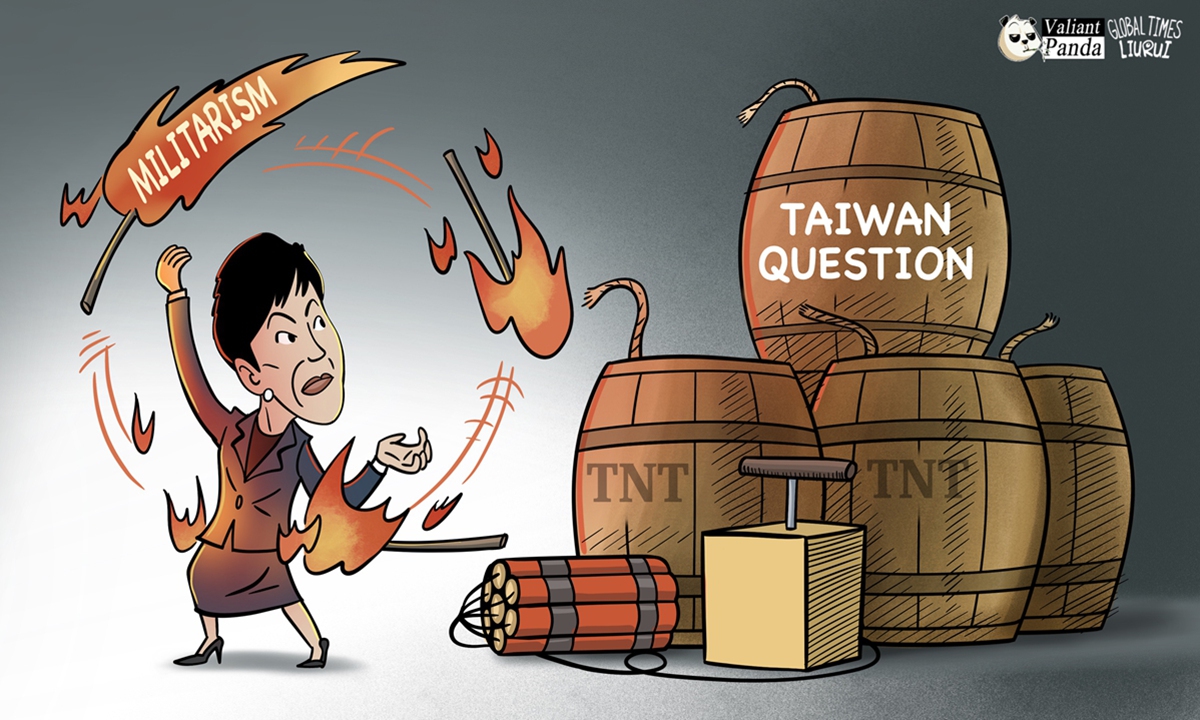
Illustration: Liu Rui/GT
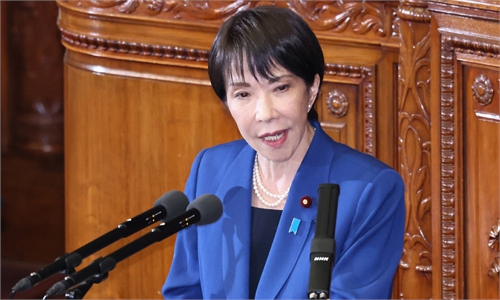
The controversy surrounding Japanese Prime Minister Sanae Takaichi's remarks on Taiwan continues to escalate. Her latest statements on the matter have exposed Tokyo's sinister intent to play word games and muddle through.
During a plenary session of the House of Councillors on Wednesday, when responding to an inquiry from a Komeito party member regarding China-Japan relations and the Taiwan question, Takaichi said that the Japanese government's basic position regarding Taiwan remains as stated in the 1972 Sino-Japanese Joint Statement, and there has been no change to this position.
This shows that Takaichi remains unrepentant. Not only has she failed to retract her earlier erroneous statements, but she is unwilling to honestly, accurately, and completely clarify Japan's stance on the Taiwan question. If the Japanese side insists on this evasive and perfunctory attitude, it will not help de-escalate the situation but only make it severer. China will not tolerate or condone this.
In the face of Beijing's unprecedentedly severe diplomatic reaction and countermeasures, the gravity of the problem is gradually being realized within Japan, leading to a split in opinion across the political spectrum. Among them, right-wing conservatives, who form Takaichi's political base, hold that she said nothing wrong. The support of figures like Liberal Democratic Party Vice President Taro Aso has become the main backing that enables Takaichi to refuse to admit her mistakes and act with impunity.
Japanese politics, especially the ruling establishment, still lacks a comprehensive and deep reflection on the severe error of Takaichi's remarks on Taiwan. The right-wing conservative forces remain obstinately committed to the policy of "using Taiwan to contain China." The Japanese authorities consistently refuse to confront the severe error of Takaichi's statement from the high perspective of international law and the political foundation of China-Japan relations. Instead, they are adopting a strategy of minimizing the issue and muddling through to let the matter fade away.
In the past, Japan long pursued an "ambiguous strategy" on the Taiwan question, seeking to both use the question to contain China's development and avoid the serious consequences of damaging China-Japan relations. It attempted to obscure its position with vague statements, testing the boundaries without crossing the line on sensitive issues. However, times have changed. Given the malicious nature and serious consequences of Takaichi's remarks, Japan's fantasy of reverting to its previous "ambiguous strategy" is no longer feasible.
The Taiwan question is a fundamental issue bearing on the political foundation of China-Japan relations. It is not a political bargaining chip that can be manipulated at will. It concerns explicit norms of international law and unequivocal historical conclusions. Only by strictly adhering to the principles and spirit of the four political documents between China and Japan, as well as relevant international legal instruments, and by stating its position honestly, accurately, and comprehensively, can Japan prevent China-Japan relations from sliding into a deeper crisis.
First, Japan must abandon its evasive, perfunctory approach. Rather than attempting to muddle through with ambiguous remarks such as claiming that "there is no change" to this position, Japan needs to face squarely its obligations on the Taiwan question.
Second, Japan should accurately reaffirm the core content of the 1972 Sino-Japanese Joint Statement that "the Government of Japan recognizes the Government of the People's Republic of China as the sole legal Government of China. The Government of the People's Republic of China reiterates that Taiwan is an inalienable part of the territory of the People's Republic of China. The Government of Japan fully understands and respects this stand of the Government of the People's Republic of China, and it firmly maintains its stand under Article 8 of the Potsdam Proclamation." These three elements are indispensable and must not be omitted.
Third, Japan must give a full and explicit explanation of the concrete substance of its so-called "unchanged" position on the Taiwan question. It cannot merely cite concepts while avoiding the essence. Its explanation should fully cover all key aspects, including Japan's obligations under international law and its political commitments in documents between China and Japan.
Japan must soberly recognize that on this red line concerning the Taiwan question, there is no "grey area" and no room for ambiguity. Wordplay will not work. China's bottom line cannot be tested, and China's patience is not unlimited. Takaichi's retraction of her erroneous remarks is only the minimum requirement. Articulating their positions on the Taiwan question honestly, accurately, and completely is a compulsory question Japan must answer.
The author is a distinguished research fellow at the Department for Asia-Pacific Studies of the China Institute of International Studies. opinion@globaltimes.com.cn
RELATED ARTICLES