Shares of China’s chipmaker Moore Threads soar over 400% on Shanghai STAR board debut
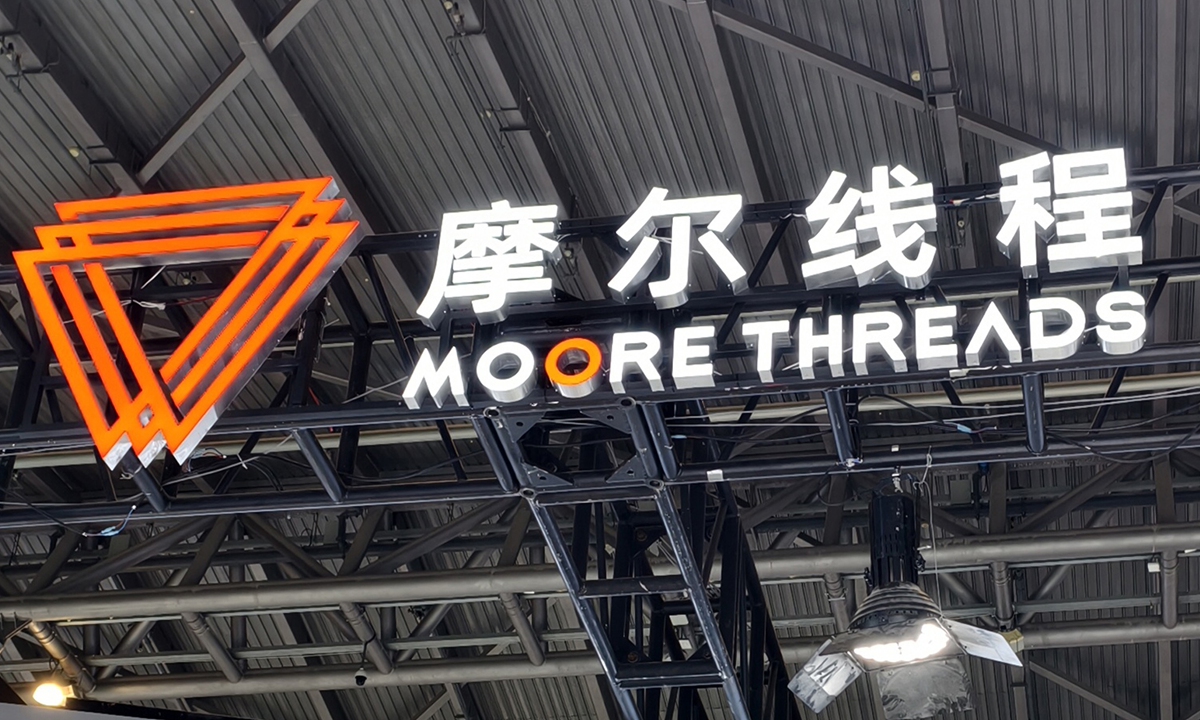
A logo of Moore Threads at the 2025 World Artificial Intelligence Conference in Shanghai on July 28, 2025 Photo: VCG
Chinese artificial intelligence (AI) chipmaker Moore Threads Technology Co surged 425 percent to 600.5 yuan ($84.85) per share on its first trading day on the STAR board of the Shanghai Stock Exchange on Friday. Industry analysts said the surge in the company's shares highlights the huge market potential for domestic replacements for Western-made graphics processing units (GPUs) amid the booming growth in the AI industry.
As the first Chinese full-function GPU enterprise to be listed, the Beijing-based company raised about 8 billion yuan in its IPO. The proceeds will be used for next-generation projects in areas like graphics chips, and to supplement working capital, according to an IPO prospectus submitted to the exchange.
The company's IPO generated huge interest, with its shares being oversubscribed more than 4,000 times by retail investors - a testament to the red-hot demand.
"The investor frenzy over Moore Threads reflects broad expectations for the prospects of China's AI chip industry, and the market potential is huge thanks to supportive national policies," Ma Jihua, a veteran telecom industry analyst, told the Global Times on Friday.
China has been gradually closing the gap in GPU production compared with the world's most advanced semiconductor technology providers, and Moore Threads is one of the leading companies making contributions to the GPU field in the country, Ma said.
The IPO is a key milestone in the company's development, as it's a recognition of the company's long-term commitment to independent innovation of core technologies and acceleration of product iterations, Moore Threads said on its official WeChat account. It's also a key symbolic step in China's pursuit of independently developed high-end GPUs, the company added.
Moore Threads was established in 2020 with a focus on universal GPUs and related products, supporting a range of workloads such as AI computing acceleration, 3D graphics rendering, UHD video encoding and decoding, physical simulation, and scientific computing, according to the company's website.
Over the past five years, the company has successfully mass-produced five chips, and developed four generations of GPU architecture and intelligent security operations center products. It has built a diversified layout ranging from chips and computing cards to intelligent computing clusters, and comprehensively supports all scenarios of the "cloud-edge-end," according to a Securities Times report on Friday.
"Growing capital inflows into companies like Moore Threads will help them gain momentum in multiple aspects including research and development capabilities and market influence, and eventually, this will be transformed into industrial capacity and innovative products," Xiang Ligang, director-general of the Beijing-based Information Consumption Alliance, told the Global Times on Friday.
Xiang said the Moore Threads' IPO is expected to accelerate the listing plans of other domestic GPU developers, such as MetaX and Biren Technology.
Looking ahead, Moore Threads said that it will continue to focus on independent innovation. It also said it will deepen efforts in the frontier fields of high-performance GPUs and intelligent computing clusters, drive the computing industry to continuously evolve toward a more universal and intelligent direction, and contribute to the development of the national digital economy and scientific and technological self-reliance.
RELATED ARTICLES