Number of direct ‘Cherry Express’ sailings doubles this year, as first shipment arrives in S.China metropolis
By Published: Dec 07, 2025 11:01 PM

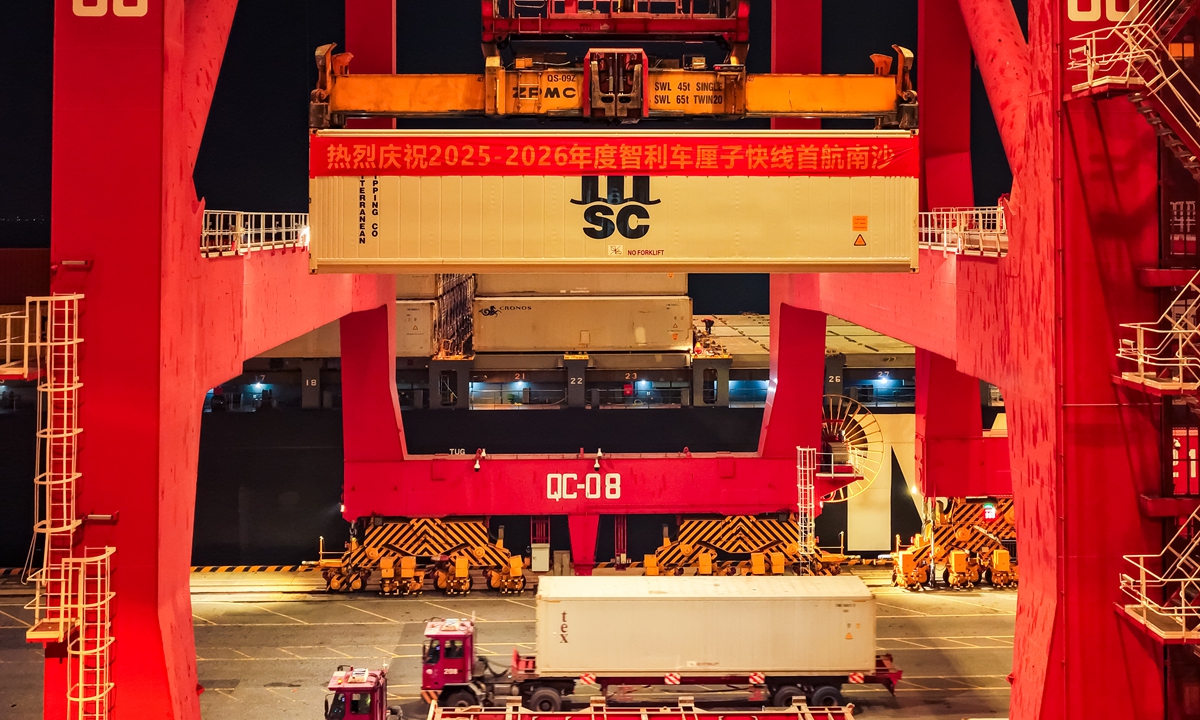
Cranes handle a cargo of cherries at Guangzhou's Nansha Port on December 6, 2025. The shipment is China's first batch of Chilean cherries transported by sea for the 2025-2026 season. Photo: Courtesy of Port of Guangzhou
The number of direct "Cherry Express" sailings has doubled for this year's cherry season, a Chilean industry expert said on Sunday, as the first seaborne shipment of Chilean cherries arrived in the Port of Guangzhou in South China's Guangdong Province over the weekend.
Chinese experts said on Sunday that the improved trade infrastructure across the Pacific Ocean has accelerated the pace of China-Latin America trade and economic cooperation, as more companies from Latin American countries tap into China's vast market.
With the recent addition of new air links, the cherry shipment expansion is one of the latest examples of practical cooperation between China and countries in Latin America within the framework of Global South collaboration, Chinese experts said.
In the early hours of Saturday, China's first batch of Chilean cherries transported by sea for the 2025-2026 season arrived at Guangzhou's Nansha Port, carrying some 370 containers of fresh cherries. With Chile entering peak harvest, more "Cherry Express" sailings will reach major Chinese ports in the coming weeks, supplying China's winter market with fresh, safe, and high-quality cherries, according to Chilean fruits association Frutas de Chile.
"This season, direct 'Cherry Express' shipments to China have increased to 32 - twice as many as last year. Supported by efficient logistics, Chilean cherries travel 20,000 kilometers in 23 days, arriving in China with excellent freshness to meet winter demand for premium fruit," Ivan Marambio, president of Frutas de Chile, told the Global Times in a statement on Sunday.
Thanks to strong China-Chile trade ties and an advanced cold chain system, Chilean cherries enjoy an efficient and reliable route to China, the executive added.
Port of Guangzhou said in a statement sent to the Global Times on Sunday that it expects that its Nansha Port area will receive 19 ships or 200,000 tons, for the season.
The port has been actively engaging with new opportunities arising from China-Latin America trade since 2019, the port said.
The cherry shipment came as a Chinese airline operated the world's longest one-way air route, with a flight linking Shanghai and Buenos Aires, the capital of Argentina, via Auckland, New Zealand, connecting cities geographically located on opposite sides of the Earth.
On the return leg, the hold of the aircraft, operated by China Eastern Airlines, carried 2.1 tons of Argentine cherries and 10.5 tons of chilled Chilean salmon back to the Chinese market, according to the Xinhua News Agency.
At the Chancay Port in Peru, a flagship project of Belt and Road cooperation between China and Peru, the value of import and export cargo shipped via the "Chancay-Shanghai" shipping route has exceeded 5 billion yuan ($706.7 million) by handling 197,000 tons of goods worth 5.35 billion yuan since its two-way launch nearly a year ago, the Xinhua News Agency reported on Saturday, citing data from Shanghai Customs on Friday.
From "Cherry Express" vessels to the sea lanes linking Shanghai to Peru's Chancay Port to this new skyway to Buenos Aires, China and Global South countries are turning connectivity into a genuine global public good, while China's policies such as the "Healthy China" initiative continue to generate demand for high-quality foods and create opportunities for growth for agricultural produce from Latin American countries, experts said.
Song Wei, a professor at the School of International Relations and Diplomacy at Beijing Foreign Studies University, told the Global Times on Sunday that cross-Pacific trade between China and Latin American countries, which has seen rapid growth in volume and continuous improvement in trade facilitation such as trade agreements and infrastructure, is based on economic complementarity and contributes to the recovery and growth of the world economy.
Wan Zhe, an economist and professor at the Belt and Road School of Beijing Normal University, told the Global Times on Sunday that trade growth and newly generated market demand will have an interplay with a number of major infrastructure projects in Latin America, including forming a self-reinforcing positive trend with the Chancay Port and the Brazil-Peru transcontinental railway in the future.
China-Latin America economic and trade cooperation has yielded impressive results. In 2024, bilateral trade reached a record high of $518.47 billion, a year-on-year rise of 6.0 percent, Xinhua said.
In the first 10 months of 2025, imports with Latin American countries grew by 1 percent year-on-year, customs data showed.
RELATED ARTICLES